


Astroloba foliolosa
Introduction
If you're looking to add year-round greenery, interesting texture and vertical height to your garden, the Camdeboo astroloba is an excellent choice. This hardy, low-maintenance plant brings structure and visual interest to rock gardens, succulent displays and water-wise landscapes.
Description
Description
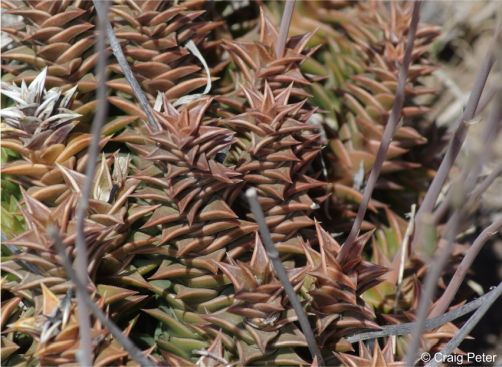
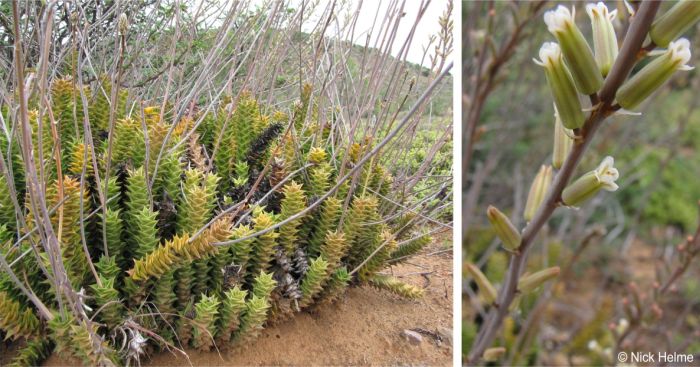
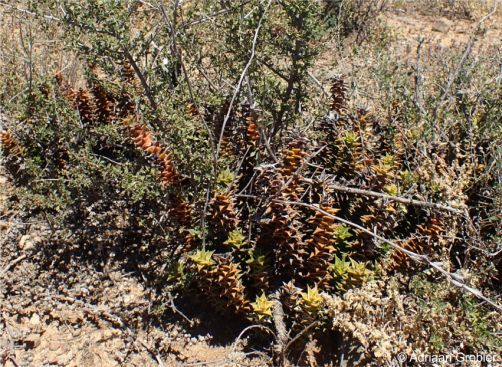
Astroloba foliolosa is a small succulent plant characterized by compacted leaves arranged in five spiral rows. The leaves emerge from slender, upright and sometimes sprawling stems. The plant has a base from which the stems grow, reaching about 200 mm in height. The leaves are light to mid-green, smooth and shiny, turning purple when exposed to high light intensity. They are rigid, have a flat, triangular shape that tapers to a sharp point, are held at almost right angles to the stem, and measure about 15 mm in length and width. The margins are keel-like, slightly thick, with a cartilaginous texture. The stems of this astroloba can be described as prickly columns due to their many tightly packed leaves with sharply pointed tips that project horizontally from the stems, making them painful to touch. The plants form dense clusters, with initially straight columnar stems that, as they grow taller, tend to tilt and ultimately sprawl along the ground.
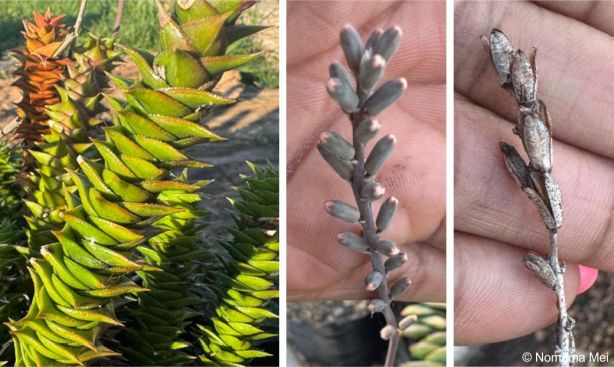
During summer, from late winter to early autumn (August to March), Astroloba foliolosa produces small, greenish-white or pale cream-coloured flowers with green midribs. The flowers appear on slender, usually unbranched stalks that can grow over 300 mm long.
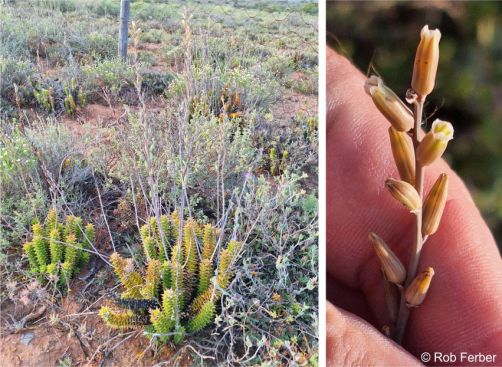
Astroloba foliolosa is commonly confused with its sister species A. congesta, but it may be differentiated by its smaller and thinner leaves, which are more rounded at the base and are bent outwards or lie horizontally, at nearly right angles to the stem whereas those of A. congesta are straight or curving inwards. It is also similar to A. robusta, which is easily distinguished from A. foliolosa by its short, robust inflorescence that appears in winter (May to October).
Conservation Status
Status
According to the Red List of South African Plants Astroloba foliolosa is assessed as Least Concern (LC). The last assessment was done in 2006, and the population trend was stable.
Distribution and habitat
Distribution description
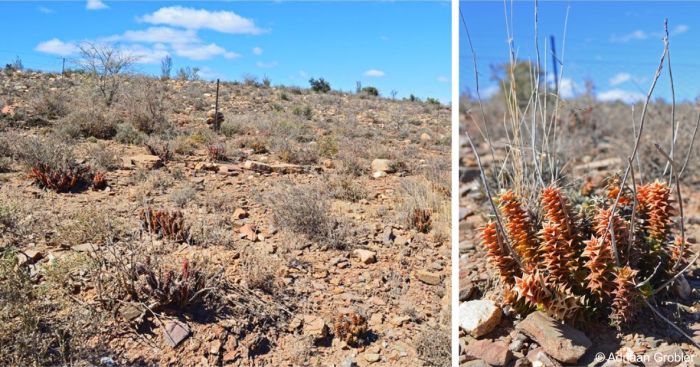
This species is found on the Karroid flats of the southern Great Karoo in the Eastern Cape Province, South Africa. Its range falls in the area between Steytlerville, Addo, Robert Sobukwe (Graaff-Reinet), and eastward to Nxuba (Cradock). It shares the eastern edge of its range with Astroloba congesta, and A. robusta is predominantly located to the west of Steytlerville. This arid region experiences relatively heavy rainfall, ranging from 250 to 400 mm, primarily during the summer months.
Derivation of name and historical aspects
History
The genus Astroloba was described by Dutch botanist A.J. Uitewaal in 1947, the name merges the two Greek words, astron and lobos, meaning ‘a star’ and ‘lobe’, thus ‘star lobe’, which refers to how the lobes of the tubular flowers open at their tips in a distinct, star-shaped arrangement. The species name foliolosa comes from a Latin word, foliolum, which means ‘little leaf’ combined with the suffix osus meaning ‘full of’ thus ‘with many little leaves’.
The genus Astroloba is part of the Asphodelaceae and is closely related to Aloe, Haworthia, Gasteria, Tulista and Haworthiopsis. There are currently 12 accepted species, all endemic to South Africa, and they are easily distinguished by their short, leathery, firm, succulent leaves ending in a hard point, and star-lobed flowers.
Ecology
Ecology
Species of Astroloba are pollinated by insects and/or sunbirds, the tubular shape of the flowers requires a pollinator with a long tongue, or beak, to be able to reach the nectar at the base of the flower. Astroloba foliolosa is probably pollinated by insects.
The spiky leaves of both A. congesta and A. foliolosa serve as a defense mechanism by making it difficult for herbivores to feed on them, and may also deter trampling.
Astrolobas are often seen growing inside or close beside other plants, known as nurse bushes, which shade and shelter them.
Uses
Use
No cultural or medicinal information has been found on Astroloba foliolosa, but they are becoming popular container plants and garden plants.
Growing Astroloba foliolosa
Grow
In Kwelera National Botanical Garden this species was propagated from cuttings using a rooting hormone for semi-hardwood cuttings. A medium of one part cocoa peat and one part vermiculite was used to root this plant in spring (September). The cuttings were placed in a propagation house with an average temperature of 25°C with no humidity. The cuttings were watered at least three times a week, or as and when it was required, to minimise rotting. Monitoring of rooting was done every week. After four weeks the cuttings were rooted and were moved to the hardening off area where they were given less water and light. After two weeks, the cuttings were potted up in a potting medium of one part sand, one part compost and one part loam soil and remained in the shade house for another two weeks before they were taken outside into direct sun light.
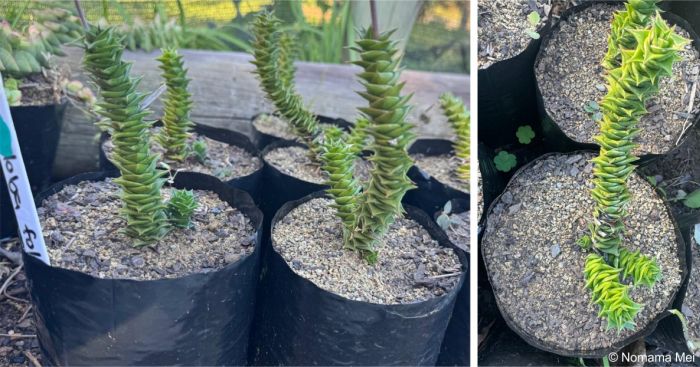
The mother stock from which this species was propagated was at the seedling stage and was discovered through a search and rescue mission in Wolwefontein, between Kariega and Uitenhage, during the construction of a wind farm. They were immediately rehabilitated by potting them up in a well-drained medium consisting of equal parts of sand, composted bark and loam soil. They were placed under a shade net with a density of 80/20 percent and were watered well. After four weeks they were taken outside into direct sunlight and watered once a week in winter and twice a week in summer. Most of them have flowered but we are yet to collect seeds for further propagation. They were given a very low dose of organic fertilizer that is balanced with both micro- and macronutrients to replenish all the nutrients lost during flowering.
Plants that are rehabilitated are subjected to a lot of shock which causes a lot of stress and some plants die because they do not recover from the shock. Astroloba foliolosa is very resilient as we were able to rehabilitate all of the rescued plants and bring them back to life.
This plant thrives in full sun and dislikes too much water. Because of the texture of its leaves and columnar stems this plant would create a lot of interest when it is planted with companion plants like crassulas, gasterias and haworthiopsis, in rockeries and succulent gardens.
No pest and diseases have been found yet.
References
- Bredenkamp, C. L. 2019. A Flora of the Eastern Cape Province. Volume 3. Strelitzia 41. South African National Biodiversity Institute, Pretoria.
- Ferber, R. 2024-Feb. Observations of Astroloba foliolosa. iNaturalist. Online. https://www.inaturalist.org/observations/199221779 & https://www.inaturalist.org/observations/199224903.
- Grobler, A. 2013-Sep. Observation of Astroloba foliolosa, near Steytlerville, EC. iNaturalist. Online. https://www.inaturalist.org/observations/10875543.
- Grobler, A. 2023-Nov. Observation of Astroloba foliolosa, Bleugumvale Farm, EC. iNaturalist. Online. https://www.inaturalist.org/observations/193821154.
- Helme, N. 2013-Dec. Observation of Astroloba foliolosa, Haaspoort, EC. iNaturalist. Online. https://www.inaturalist.org/observations/10915508.
- Jilemicky, J. & Molteno, S. n.d. Astroloba foliolosa. https://haworthia-gasteria.blogspot.com/2016/03/astroloba-foliolosa-springbokvlakte.html. Accessed 7 July 2026
- Jilemicky, J. & Molteno, S. n.d. Astroloba robusta. https://haworthia-gasteria.blogspot.com/2016/03/astroloba-robusta.html. Accessed 7 July 2026.
- Klopper, R., Smith, G.F. & Molteno, S.M. 2023. Astroloba Uitewaal (Asphodelaceae). PlantZAfrica. Online. http://pza.sanbi.org/astroloba-genus.
- Manning, J. & Goldblatt, P. 2012. Plants of the Greater Cape Floristic Region 1: the Core Cape Flora. Strelitzia 29. South African National Biodiversity Institute, Pretoria.
- Peter, C. 2016-Sep. Observation of Astroloba foliolosa, Graaff-Reinet, EC. iNaturalist. Online. https://www.inaturalist.org/observations/287937196.
- Plants of the World Online. Astroloba Uitewaal. https://powo.science.kew.org/taxon/urn:lsid:ipni.org:names:24022-1. Accessed 7 July 2026.
- Raimondo, D., Von Staden, L., Foden, W., Victor, J.E., Helme, N.A., Turner, R.C., Kamundi, D.A. & Manyama, P.A. (eds) 2009. Red list of South African plants. Strelitzia 25. South African National Biodiversity Institute, Pretoria.
- Van Jaarsveld, E. 2016-03. Astroloba cremnophila Van Jaarsv. (Asphodelaceae). PlantZAfrica. Online. https://pza.sanbi.org/astroloba-cremnophila.
- Wikipedia, Astroloba foliolosa. https://en.wikipedia.org/wiki/Astroloba_foliolosa. Accessed 30 Jun 2026.
- Zikishe, V. 2025-04. Astroloba congesta (Salm-Dyck) Uitewaal (Asphodelaceae). PlantZAfrica. Online. https://pza.sanbi.org/astroloba-congesta.
Credits
Nomama Mei
Kwelera National Botanical Garden
July 2026
Acknowledgements: the author thanks Eric Sikhumbuzo Phete, Horticultural Conservation Worker at Kwelera NBG, who propagated the plants for the garden, and Adriaan Grobler, Craig Peter, Nick Helme and Rob Ferber for making their images of Astroloba foliolosa in habitat available via iNaturalist.
Plant Attributes:
Plant Type: Succulent
SA Distribution: Eastern Cape
Soil type: Sandy, Loam
Flowering season: Spring, Early Summer, Late Summer, Winter
PH: Acid, Neutral
Flower colour: Green, Cream
Aspect: Full Sun, Morning Sun (Semi Shade), Afternoon Sun (Semi Shade)
Gardening skill: Average
Special Features:
 Drought resistant
 Good potplant
Horticultural zones





Rate this article
Article well written and informative
Rate this plant
Is this an interesting plant?
Login to add your Comment
Back to topNot registered yet? Click here to register.