


Conophytum regale
Introduction
Conophytum regale is a dwarf cluster-forming to cliff-hugging, summer-dormant succulent with greyish-green succulent leaves fused into a 2-lobed body and solitary pink or white, scented flowers with yellow stamens. Plants grow wild on quartz cliffs near Springbok in the Northern Cape. This is a Rare species that is Red Listed as Critically Endangered due to plant poaching. It is well-established in cultivation and easily grown as a potted plant. Be sure to purchase only nursery-grown plants from registered, reputable growers.
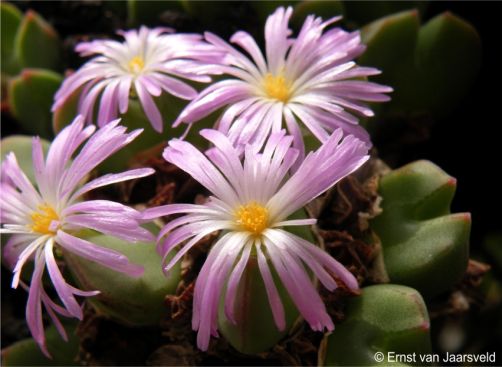
Fig. 1. Conophytum regale in flower at the Kirstenbosch Succulent Collection Nursery. Note the pink flowers and yellow stamens. This collection was made by Harry Hall (1906–1986), first horticulturist in charge of the succulent collection at Kirstenbosch.
Description
Description
The plants form small, loose, winter-active (summer-resting) clusters up to 100 mm in diameter. Roots fibrous. The leaves are fused into a 2-lobed body, the lobes keeled with reddish margins. On each side of the fissure are two distinctive, large, urn-shaped windows. The bodies are 50 × 20 mm, pale greyish-green green, with a papillate surface. The older withered leaf sheath is pale brownish and heavily spotted. The flowers are diurnal, large, up to 40 mm in diameter, rose pink and slightly scented. The petals in 3–5 series, up to 18 × 2 mm, spoon-shaped, and the staminodes are filamentous, white to golden. The fruiting capsule hygrochastical, 5- or 6-locular, 4 × 5 mm, turbinate. The seed 0.65 × 0.45 × 0.30 mm, pustulate. Flowering time is in early autumn. Flowers are scented, and open during midday, suggesting a day-flying insect.
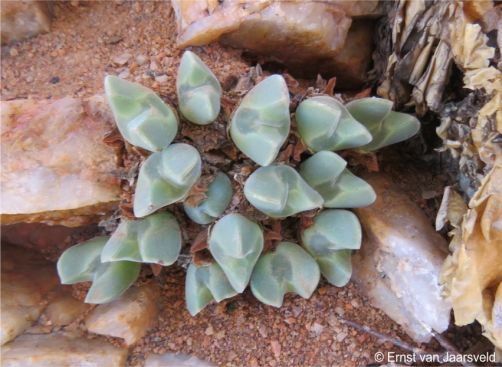
Fig. 2. Conophytum regale in its natural south facing quartz cliff habitat, growing in gravel and sand. Note the large urn-shaped windows on each side of the fissure allowing light to penetrate the leaf during its shady winter season.
Conservation Status
Status
Classified as Rare in 1996, Critically Rare in 2009 and assessed as Critically Endangered since 2017 by the Red List of South African Plants, the primary threat to this species is the illegal collection of plants from their habitat for the international trade in succulent plants. Conophytun regale has a small wild population, a small natural range and a specific habitat preference, which make it very susceptible to localised disturbances and rapid declines. It faces an extremely high risk of extinction in the wild in the next 10 years should this threat not diminish. Although wild plants are now being heavily collected, this species has long been well established in cultivation (ex situ conservation), and seed is available from reputable sources.
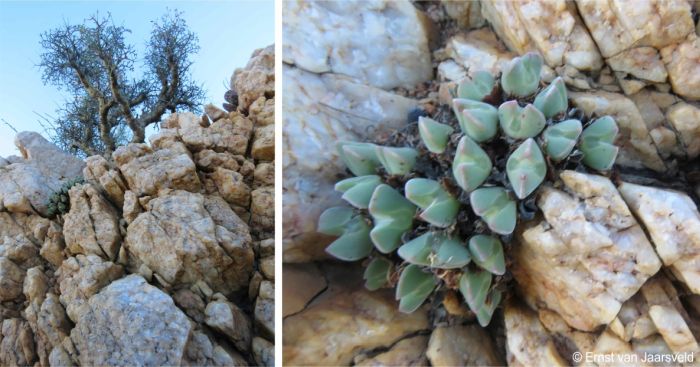
Fig. 3. Conophytum regale growing in habitat on a south-facing, vertical quartz cliff (upper left hand in left hand photo) in winter, with a Pelargonium crithmifolium plant on top of the cliff.
Distribution and habitat
Distribution description
Conophytun regale grows in crevices and fissures on south-facing quartz cliffs and steep slopes and occasionally also on other accessible quartz pockets. The species is highly localised and is known from a solitary quartz ridge near Springbok at 995–1 150 m. altitude. The plant often shares its habitat with other small succulents. Summers are hot and dry and the plants are subject to occasional fog from the Atlantic Ocean. The average daily maximum temperature about 25°C and average daily minimum is about 12°C, with frost absent. Rainfall is mainly in winter (cyclonic cold fronts), late summer and autumn (thunder showers), 150–250 mm per annum. The plant grows in the Succulent Karoo biome and occurs in the Namaquland Klipkoppe Shrubland which is part of the Namaqualand Hardeveld Bioregion. The plant shares its south-facing quartz cliff habitat with other succulents such as Tylecodon tuberosus, Tylecodon paniculatus, Conophytum bilobum, Crassula montana subsp. borealis, Crassula tomentosa, Haworthia arachnoidea var. namaquensis and Othonna euphorbioides.
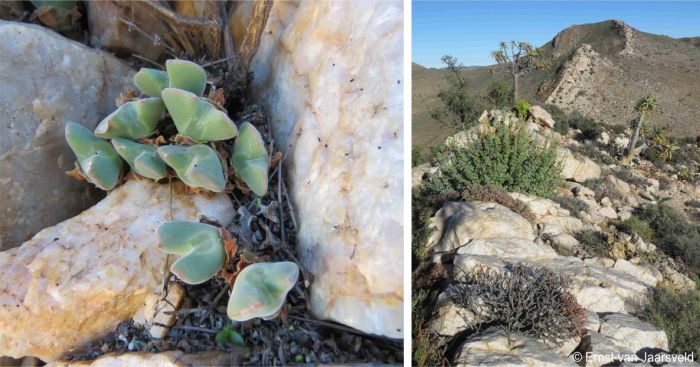
Fig. 4. LEFT A nine-bodied plant of Conophytum regale on a south-facing aspect in winter, note the flower remnants as well as the large urn-shaped windows. RIGHT The habitat of Conophytum regale, a quartz ridge near Springbok, Northern Cape, where grows here sharing its habitat with Crassula macowaniana, an old specimen in the foreground and younger ones nearby, Aloidendron dichotomum (quiver trees) as well as Othonna cerarioides.
Derivation of name and historical aspects
History
Conophytum regale was named in 1934 by Mary Lavis (later O’Connor-Fenton) (1903-1992), from plants collected by Piet van Heerde (1893-1979), Headmaster of Springbok School, and a lover and collector of succulent plants and an explorer from Springbok. The species name regale, meaning ‘royal’ or ‘regal’, something magnificent, pertains to its beauty, both in flowers and appearance, and rare status.
Conophtyum regale belongs to subgenus Derenbergia section Herreanthus which includes C. blandum, C. herreanthus, C. jarmilae, C. marginatum, C. regale and C. semivestitum. From these it is immediately distinguished by its sharply keeled lobes and large windows adjacent on each side of the fissure, as well as its flowers which are scented.
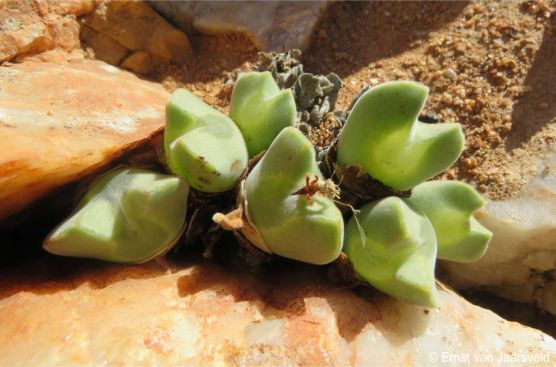
Fig. 5. A seven-bodied plant of Conophytum regale on a south-facing aspect in winter, note the sharply keeled leaves and large urn-shaped windows.
The genus Conophytum, the name meaning ‘cone plant’ from conus, Latin for ‘cone’ and phyton, Greek for ‘plant’, was created by N.E. Brown in 1922 to accommodate the many species with fused leaves forming a cone-shaped body. For additional information on cone plants, see the two books by Conophytum specialist, Steven Hammer: ‘The Genus Conophytum, a Conograph’ and ‘Dumpling and His Wife: New Views of the Genus Conophytum.’
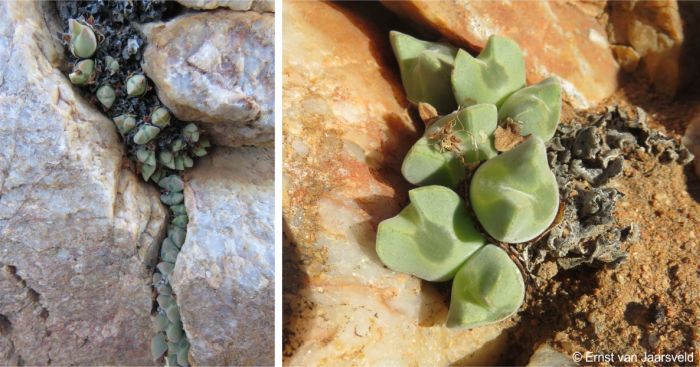
Fig. 6. LEFT Conophytum regale occupying a vertical crevice in its natural south-facing, vertical, quartz cliff habitat. Note the previous seasons fruiting capsules. RIGHT A seven-bodied plant of Conophytum regale on a south facing aspect in winter, note the flower remnants as well as the large urn-shaped windows.
Ecology
Ecology
Conophytum regale is a long-lived winter growing, summer resting succulent. The plants form loose clusters, and this habit is retained in cultivation. The plants grow in quartz crevices and rocky pockets on south-facing aspects and its highly succulent leaves enables the plant to survive the long dry summers when the plant goes into its resting phase. The darker urn-shaped leaf windows adjacent to the leaf fissures allow light to penetrate the swollen succulent tissue, a characteristic also found on a few other cliff-dwelling succulents. Like most other species of Conophytum, at the end of spring, the moisture from the old fused leaf pair is recycled into a new leaf pair (below), and the older withering remnants of the leaf pair becomes a covering that protects the younger leaf pair from the sun, during the long dry summer months. In autumn, with cooler conditions, the new leaf pair and flower emerges, breaking through the protective covering. The simple, white to pink flowers are large, conspicuous, and scented, reaching maturity during the summer months. The dry fruiting capsules retain the seeds like most other species of Conophytum, only to release the seeds during periods of rain. The capsule is hygrochastical, opening with moisture and closing again with dry conditions. During a rain event, the seeds are dispersed. The seeds are small with a tuberculate surface, ideal for establishment in crevices.
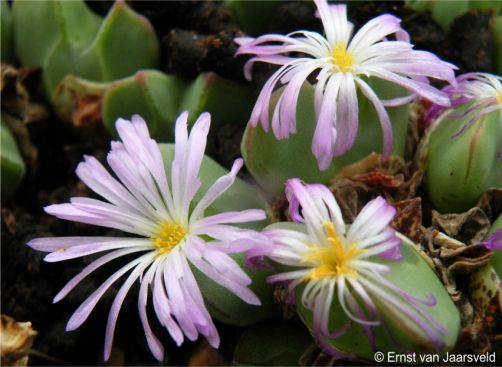
Fig. 7. Conophytum regale in flower in the Kirstenbosch Succulent Collection Nursery. This collection was made by Harry Hall (1906–1986), first horticulturist in charge of the succulent collection at Kirstenbosch. Note the pink flowers and yellow stamens.
Uses
Use
There are no known medicinal or cultural uses for Conophytum regale.It is a popular and well-known container plant, mainly for succulent specialists.
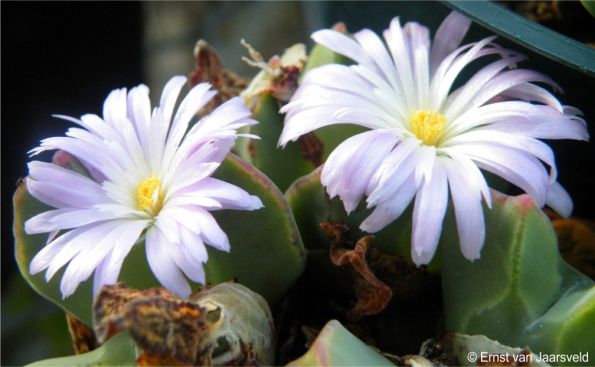
Fig. 8. Conophytum regale in flower at the Kirstenbosch Succulent Collection Nursery. The petals are almost white, slightly flushed with pink. This collection was made by Harry Hall (1906–1986), first horticulturist in charge of the succulent collection at Kirstenbosch.
Growing Conophytum regale
Grow
Among growers of Conophytum this is a popular plant due to its ornamental clusters and appealing scented flowers. Best for small containers grown in a protected environment where moisture and light can be controlled. The soil should be sandy, mineral-poor, slightly acidic and with a low organic component.
Plants are easily cultivated and prefer dappled shade. Commence watering in autumn when the new leaf pair and flower emerge. Keep moist until spring, then reduce watering drastically and abstain from watering through the summer months. Plants can be fed with a diluted organic fertiliser.
Propagate from cuttings or seed.
Cuttings are best made in autumn. The best medium is sand. Plant with the leaf tips emerging from the substrate and keep moist. Rooting is usually within a week or two. Once rooted they can be planted into individual containers.
The seed is fine and can be sown in a sandy mixture in autumn and covered with a very thin layer of gravel. Keep moist. Remove seedlings as soon they are large enough to handle.
References
- Clarke, H. & Charters, M. 2016. The illustrated dictionary of southern African plant names. Flora & Fauna Publications Trust, Jacana, Johannesburg.
- Hammer, S. 1993. The genus Conophytum. Succulent Plant Publications, Pretoria.
- Hammer, S. et al. C. 2002. Dumpling and his wife; new views of the genus Conophytum. EAE Creative Colour Limited.
- Hartmann, H.E.K. 1991. Mesembryanthema. In Systematics, Biology and Evolution of Some South African taxa. Contributions from the Bolus Herbarium 13. 75-157.
- Hartmann, H. 2001. Aizoaceae A-E. In Eggli, U. & Hartmann, H.E.K. (eds.) Handbook of succulent plants. Springer, Heidelberg, New York
- Herre, H. 1971. The genera of the Mesembryanthemaceae. Tafelberg, Cape Town.
- Lavis, M. 1934. In H.M.L. Bolus, Notes on Mesembryanthemum and allied genera 2: 469. Bolus Herbarium, Cape Town.
- Van Jaarsveld, E.J. 2011. Cremnophilous succulents of southern Africa: diversity, structure and adaptations. Ph.D.Thesis, University of Pretoria.
- Young, A.J., Desmet, P.G., Ebrahim, I., Guo, D., Harrower, A., Jabar, L., Knoetze, L., Rodgerson, C., Van Wyk, P.C.V. & Mhlongo, N.N. 2021. Conophytum regale Lavis. National Assessment: Red List of South African Plants version 2024.1.
Credits
Ernst van Jaarsveld
Kirstenbosch National Botanical Garden (Retired)
Babylonstoren Farm (Current)
Extraordinary senior lecturer and researcher,
Department of Biodiversity and Conservation, University of the Western Cape
August 2026
Plant Attributes:
Plant Type: Succulent
SA Distribution: Northern Cape
Soil type: Sandy
Flowering season: Autumn
PH: Acid
Flower colour: White, Pink
Aspect: Shade, Morning Sun (Semi Shade), Afternoon Sun (Semi Shade)
Gardening skill: Average
Special Features:
 Drought resistant
 Fragrant
 Good potplant
 Feeds honeybees
Horticultural zones



Rate this article
Article well written and informative
Rate this plant
Is this an interesting plant?
Login to add your Comment
Back to topNot registered yet? Click here to register.