


Kniphofia triangularis subsp. triangularis
Introduction
Kniphofia triangularis subsp. triangularis a dainty red-hot poker with grass-like leaves and vibrant and radiant orange-red flowers in late summer, that makes a lovely subject for the grassland garden.
Description
Description
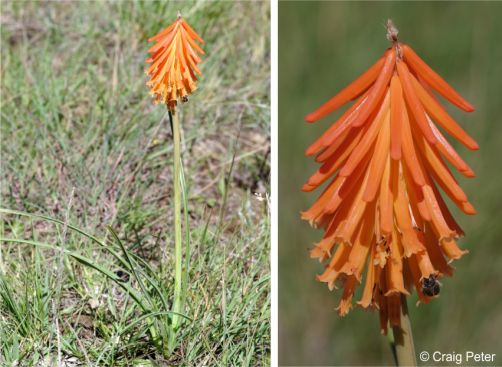
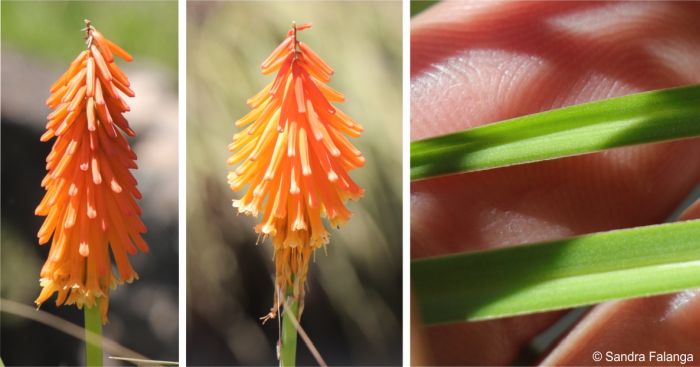
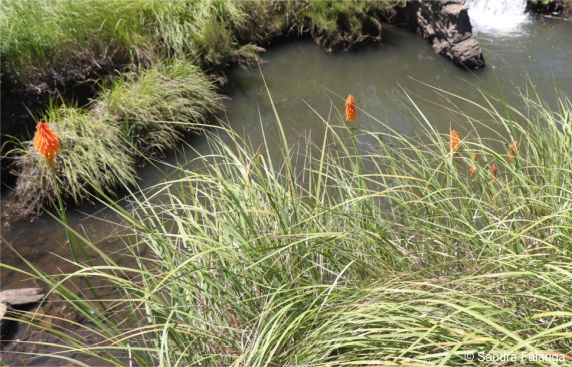
An evergreen clump-forming perennial up to 600 mm high, solitary or in small groups, with a rhizomatous rootstock which aids the spread of plants. The leaves are soft, curved, narrow and grass-like, approximately 280-600 mm long and 1-6 mm wide, keeled beneath, with finely toothed or smooth margins. Flowers are in a dense raceme forming a cylindrical head 50-80 mm long and 40-50 mm wide, made up of nodding, tubular, coral-red to orange-yellow flowers 24-35 mm long. Open flowers are usually the same colour as the buds but may be paler than the buds. Buds are hanging. Flowering is in late summer (January to April). Fruit is a globose capsule containing flattened, three-angled, winged, black seeds.
Conservation Status
Status
Kniphofia triangularis subsp. triangularis is assessed as Least Concern (LC). No threats are recorded by the Red List of South African Plants.
Distribution and habitat
Distribution description
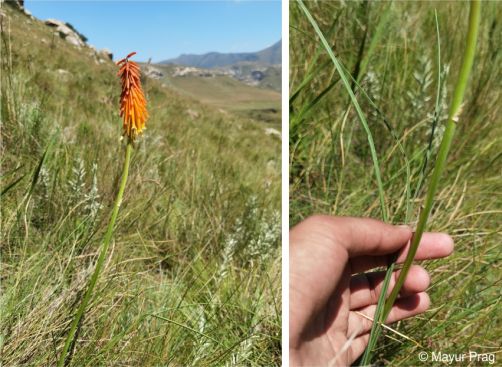
It occurs mostly in mountain grassland, on damp grassy slopes, on streambanks and in moist areas, along the Drakensberg in the rocky sandstone areas, found growing up to 2 500 m altitude, in the Eastern Cape, Free State and KwaZulu-Natal in South Africa and in Lesotho.
Derivation of name and historical aspects
History
The genus is named after J.H. Kniphof (1704-1763), Professor of Medicine at Erfurt University. The species name means ‘three sided’ or ‘with three angles’, from the Latin tri meaning ‘three’ and angularis meaning ‘having angles’ in reference to the cross-sectional shape of its leaf.
Ecology
Ecology
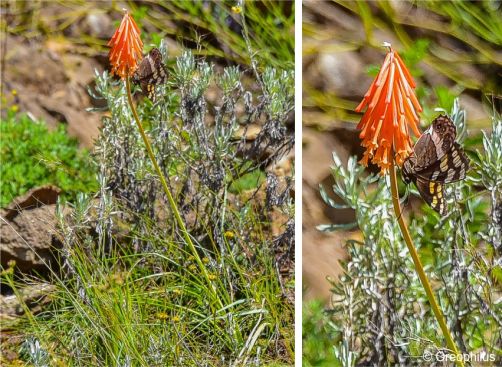
The flowers of Kniphofia triangularis subsp. triangularis provide nectar and pollen for nectar-loving birds, butterflies, bees and other pollinators, thus playing a vital role in the maintenance of ecological diversity in the wetland areas of its habitat.
Uses
Use
Pieces of the rhizome of Kniphofia triangularis subsp. triangularis are threaded onto necklaces worn by pregnant women as protection against lighting. Cut flowers of the species are attractive in flower arrangements in vases.
Growing Kniphofia triangularis subsp. triangularis
Grow
Kniphofia triangularis subsp. triangularis can be easily propagated from offsets and seed. Divide large clumps in spring. Sow seed in late autumn to early spring, in a moist, well-drained seedling mix and cover with a fine layer of sand, germination takes place in 2 weeks.
Grow in fertile, compost-rich soil, in a full sun position, apply a layer of mulch during the first year of cultivation especially in the colder regions, such as the Free State where frost occurs. Cut back the plants after flowering to maintain a neat appearance. The species doesn’t grow very high, and it is suited to smaller gardens and requires little to no maintenance and it makes an excellent subject for rock gardens and compact beds.
There are no known pests or diseases that attack this species.
References
- Coulsen, D. 2016. Kniphofia traingularis subsp. triangularis. Clarens News. Online. https://clarensnews.co.za/kniphofia-triangularis-subsp-triangularis/.
- Davis Landscape Architects. Landscape Architects’ Pages. Kniphofia triangularis. https://davisla.wordpress.com/2012/11/22/plant-of-the-week-kniphofia-triangularis/. Accessed 24 Jul 2026.
- Falanga, S. 2024. Observation of Kniphofia triangularis, Golden Gate Highlands National Park, Free State. iNaturalist. Online.https://www.inaturalist.org/observations/199350349.
- Manning, J. 2001. Eastern Cape. South African Wild Flower Guide 11. Botanical Society of South Africa, Cape Town.
- Manning, J., Goldblatt, P. & Snijman, D. 2002. The color encyclopedia of Cape bulbs. Timber Press, Cambridge.
- Oreophilus. 2026. Observation of Kniphofia triangularis, Saalboomnek, Eastern Cape. iNaturalist. Online. https://www.inaturalist.org/observations/340394346.
- Pacific Bulb Society. Kniphofia triangularis. https://www.pacificbulbsociety.org/pbswiki/index.php/Kniphofia_triangularis. Accessed 24 Jul 2026.
- Peter, C. 2021. Observation of Kniphofia triangularis, Katberg Pass, Eastern Cape. iNaturalist. Online. https://www.inaturalist.org/observations/69706611.
- Pooley, E. 1998. A field guide to wild flowers of Kwazulu-Natal and the eastern region. Natal Flora Publications Trust, Durban.
- Pooley, E. 2003. Mountain flowers, a field guide to the flora of the Drakensberg and Lesotho. Natal Flora Publications Trust, Durban.
- Prag, M. 2026. Observation of Kniphofia triangularis, Golden Gate Highlands National Park, Free State. iNaturalist. Online. https://www.inaturalist.org/observations/350738727.
- Raimondo, D., Von Staden, L., Foden, W., Victor, J.E., Helme, N.A., Turner, R.C., Kamundi, D.A. & Manyama, P.A. (eds) 2009. Red list of South African plants. Strelitzia 25. South African National Biodiversity Institute, Pretoria.
- Whitehouse, C. 2016. Kniphofia the complete guide. Royal Horticultural Society: RHS Media. Peterborough.
Credits
Ofentse Naanyane
Free State National Botanical Garden
July 2026
Acknowledgements: the author thanks iNaturalist photographers Craig Peter, Mayur Prag, Oreophilus and Sandra Falanga for granting permission to use their photographs to illustrate this article.
Plant Attributes:
Plant Type: Bulb
SA Distribution: Eastern Cape, Free State, KwaZulu-Natal
Soil type: Sandy, Loam
Flowering season: Late Summer, Autumn
PH: Acid, Neutral
Flower colour: Red, Orange
Aspect: Full Sun
Gardening skill: Average
Special Features:
 Attracts birds
 Attracts butterflies
 Good potplant
 Wet sites
Horticultural zones




Rate this article
Article well written and informative
Rate this plant
Is this an interesting plant?
Login to add your Comment
Back to topNot registered yet? Click here to register.