


Pillansia templemannii
Introduction
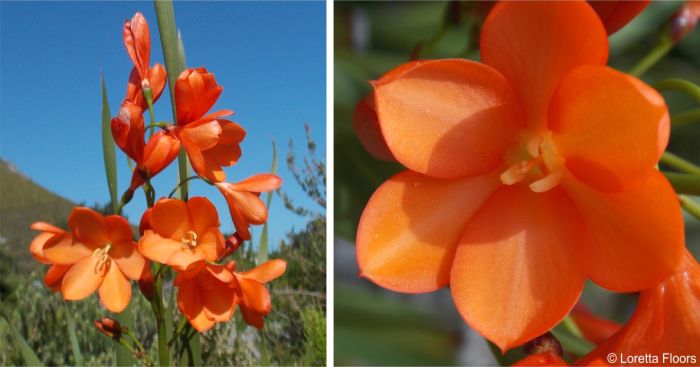
Pillansia templemannii is a fynbos geophyte, with upright, strap-shaped leaves and bright orange, bowl-shaped flowers in late spring. This plant is fire-dependent and mass flowering occurs after a fire.
Description
Description
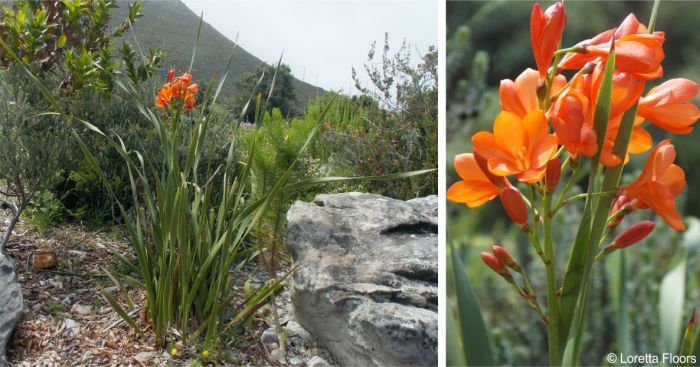
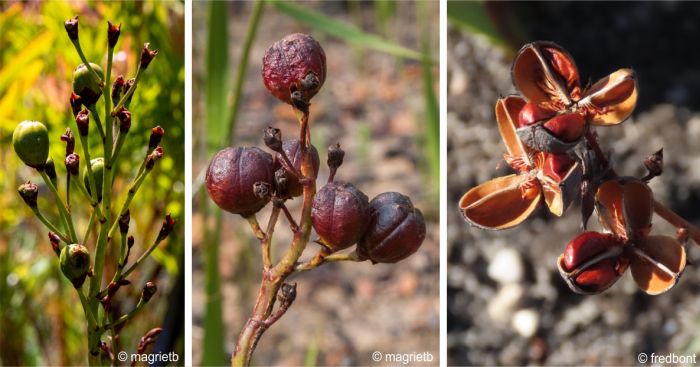
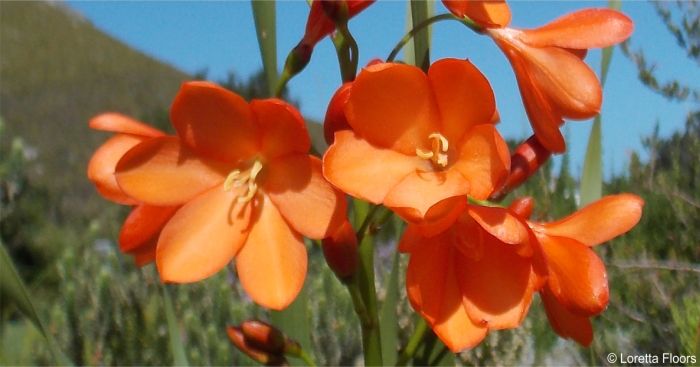
A cormous, evergreen geophyte, 900 mm in height with a small corm, 15-25 mm in diameter, covered with coarsely fibrous tunics. Leaves (4-5) are linear, strap-like, loosely twisted, without a mid-rib. Stem erect, branched. Inflorescence much-branched, panicle-like, with thick-textured, leathery floral bracts that are green with reddish brown margins and clasp the ovary and produce a sticky mucilage on the inner surface. Flowers are bright orange, bell-shaped, with a short funnel-shaped perianth tube and spreading, obovate, almost equal sized tepals. The flowers are odourless, do not close at night, and produce nectar from septal nectaries. Fruit is a woody almost globose capsule, containing reddish brown seeds about 8 mm long. Flowering occurs in spring to early summer, from October to November.
Conservation Status
Status
Pillansia templemannii is not threatened, its population is stable. It is assessed as Least Concern (LC) by the Red List of South African Plants.
Distribution and habitat
Distribution description
Pillansia templemanii, is a local endemic that occurs in the southwestern coastal mountains of the Western Cape, from Kogelberg to Klein River Mountains, on cooler south-facing sandstone slopes, with an elevation of 300-700 m but also occurring at lower altitudes near the coast.
Derivation of name and historical aspects
History
The genus Pillansia was named after Neville Stuart Pillans (1884–1964), a South African botanist, author, collector and assistant Curator of the Bolus Herbarium. Pillansia is a genus of flowering plants in the Iridaceae, a family of plants with corms or sometimes with rhizomes, that are woody or herbaceous. It was described as a genus in 1914. Pillansia is monotypic, containing only one species, Pillansia templemanii, it is placed in the Watsonieae tribe and is most closely related to Watsonia.
Pillansia templemannii was first collected in 1827 by C.F. Ecklon who named it Wredowia but did not write a formal description for it, making this name invalid. It was first described by J.G. Baker in 1892, who placed it in the genus Tritonia due to its radially symmetric, bright orange flowers. Baker named it after Robert Templeman, a seedsman, florist and nurseryman from Cape Town, who collected the type specimen in 1887. Louisa Bolus removed it from Tritonia in 1914 and placed it in the genus Pillansia, because its multi-branched stem, leathery floral bracts and divided style branches are not characteristics that are typical in the genus Tritonia. Recent molecular studies have validated Bolus’s thesis that this genus is a close relative to the genus Watsonia.
Ecology
Ecology
Pillansii templemannii flowers have no scent, their bright orange flowers attract bees and monkey beetles.
The main predators of fynbos bulbous plants are aphids, lily borers, mealybugs, molerats, slugs, snout beetles, red spider mites and porcupines.
Uses
Use
Pillansii templemanii has no medicinal uses.
Growing Pillansia templemannii
Grow
Most bulbous species are very easy to propagate, but they can also be challenging in gardens, especially with Pillansia templemanii. Plants do not flower when they are removed in clumps from their natural habitat. Also, even in nature they flower best after fire, which is a requirement that is difficult to mimic in cultivation.
This bulb can be grown from seeds and mature clumps can be lifted and the corms divided and replanted. Seeds can be sown in autumn. Use a well-drained soil mix of medium river sand, fine-milled bark and compost, placed in deep seedling trays. Seeds must be spread far apart when sown to allow the new seedlings space to develop, and covered with a thin layer of sand (3-4 mm), kept moist and shaded. Seed germination will take 3-4 weeks. Leave the seedlings in the trays to allow them to stabilize before planting in the Garden or in plant pots.
Plant Pillansia templemannii in full sun, in well-drained, sandy, acidic soil suitable for fynbos plants. They require water in autumn, winter and spring, and prefer not to dry out completely during summer. Do not overwater, as it can lead to rotting.
References
- Baker, J.G. 1892. Tritonia templemannii. Handbook of the Irideae: 193. Accessible online at https://archive.org/details/handbookofiridea00bake/page/192/mode/2up.
- Bean, A. & Johns, A. 2005. Stellenbosch to Hermanus. South African Wild Flower Guide 5. Botanical Society of South Africa, Cape Town.
- Brown, N.A.C. & Duncan, G.D. 2006. Grow fynbos plants. Kirstenbosch Gardening Series. South African National Biodiversity Institute, Cape Town.
- Fredbont. 2023-Apr. Observation of Pillansia templemannii, Kogelberg Biosphere Reserve, WC. iNaturalist. Online. https://www.inaturalist.org/observations/160294039.
- Manning, J. & Goldblatt, P. 2012. Plants of the Greater Cape Floristic Region 1: the Core Cape Flora. Strelitzia 29. South African National Biodiversity Institute, Pretoria.
- Goldblatt, P. & Manning, J.C. 2020. Iridaceae of southern Africa. Strelitzia 42. South African National Biodiversity Institute, Pretoria.
- magrietb.2018-Mar. Observation of Pillansia templemannii, Kleinmond, WC. iNaturalist. Online. https://www.inaturalist.org/observations/10111780.
- magrietb.2023-Nov. Observation of Pillansia templemannii, Kleinmond, WC. iNaturalist. Online. https://www.inaturalist.org/observations/192948091.
- Nichols, G. 2005. Growing rare plants: a practical handbook on propagating the threatened plants of southern Africa. Southern African Botanical Diversity Network Report No. 36.
- Plug, C. 2021. Templeman, Mr Robert Birmingham (horticulture). S2A3 Biographical Database of Southern African Science. Online. https://www.s2a3.org.za/bio/Biograph_final.php?serial=2804.
- Raimondo, D., Von Staden, L., Foden, W., Victor, J.E., Helme, N.A., Turner, R.C., Kamundi, D.A. & Manyama, P.A. (eds) 2009. Red list of South African plants. Strelitzia 25. South African National Biodiversity Institute, Pretoria.
- Trinder-Smith, T.H. 2003. The Levyns Guide to the plant genera of the south western Cape. Bolus Herbarium, UCT, Red Roof Design CC, Cape Town
Credits
Loretta Floors
Harold Porter National Botanical Garden
December 2025
Acknowledgements: images of Pillansia templemannii in fruit by magrietb and fredbont, from their observations on iNaturalist.
Plant Attributes:
Plant Type: Bulb
SA Distribution: Western Cape
Soil type: Sandy
Flowering season: Spring, Early Summer
PH: Acid
Flower colour: Orange
Aspect: Full Sun
Gardening skill: Challenging
Special Features:
 Feeds honeybees
Horticultural zones


Rate this article
Article well written and informative
Rate this plant
Is this an interesting plant?
Login to add your Comment
Back to topNot registered yet? Click here to register.