


Quercus robur
Introduction
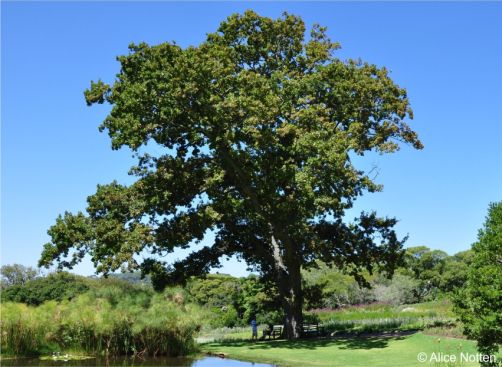
The European oak is a majestic, long-lived deciduous tree known for its large, rugged broad leaves, knotted trunk and broad, rounded, and irregular crown with spreading branches. It is not indigenous in South Africa, but many are present in our landscapes as legacy and ornamental trees.
Description
Description
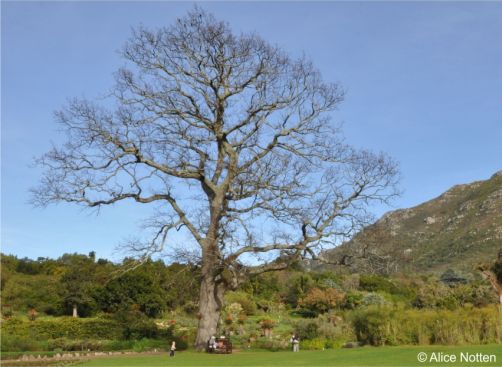
A deciduous tree with a relatively thick, strong main stem (trunk) with a diameter of about 2 m, with thick, vertically fissured bark. Its branches spread out broadly, forming a wide canopy that may grow to a height and breadth of 25 m. The main trunk of Q. robur while stout at the base, tends to disappear in the crown, developing irregular boughs with twisting branches.
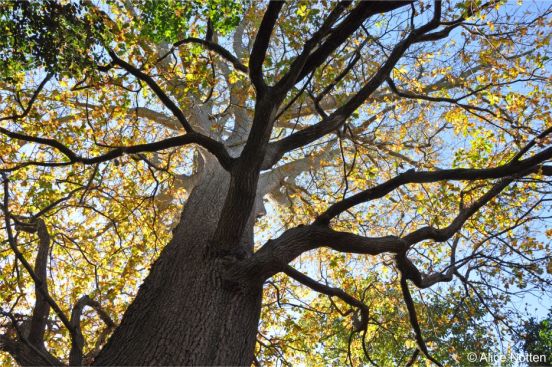
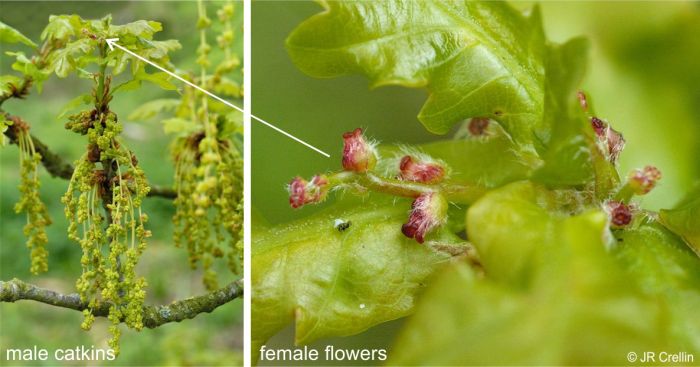
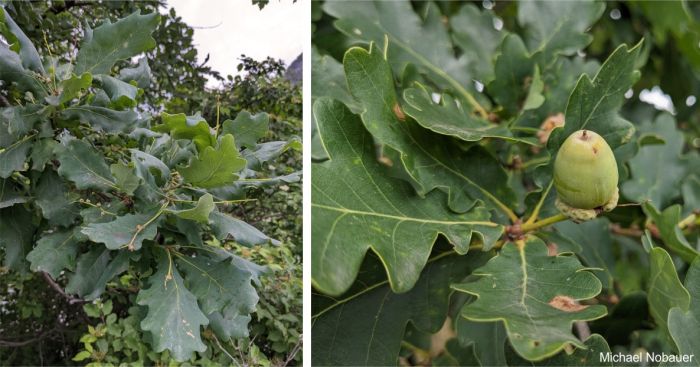
The leaves are attached to the branches by very short petioles, about 2-3 mm long. The leaves are simple, about 130 mm long and 80 mm wide, with 3–7 pairs of rounded lobes. The upper surface is dark green, paler green undereath, and they become golden brown in autumn before dropping in winter but do not change colour quickly, when compared to some other deciduous trees. The flowers are minute, male and female are in separate inflorescences that are borne on the same tree, appearing with the new leaves in spring and are pollinated by wind. The male inflorescence is a pendulous catkin, 20-40 mm long, in small bunches. The female inflorescence is an erect spike, about 2 mm wide, at the tips of new shoots, on peduncles 20-50 up to 100 mm long. It has an acorn fruit, a type of true nut, which is brown when ripe, ovoid, 18-30 mm long, in clusters of 1-4 on long, slender stalks 50-100 mm long.
Conservation Status
Status
Quercus robur is assessed as Least Concern (LC) by the IUCN Red List. It has a wide native distribution and although affected by habitat loss, timber trade, pests and diseases it is still common and abundant over its range and is protected under EU legislation. It is an introduced species in South Africa and therefore is not evaluated for the Red List of South African Plants. Although it is not listed as invasive in South Africa in the Regulations of NEMBA or the Conservation of Agricultural Resources Act 43 of 1983, there have long been reports of naturalisations and invasions of Quercus species in several regions.
Distribution and habitat
Distribution description
Quercus robur naturally occurs widely across most of Europe, reaching northwards to southern Norway and Sweden, and southwards to the northern part of the Iberian Peninsula, southern Italy, the Balkan Peninsula and Turkey, and extends its distribution, reaching more northerly ranges on the Norwegian coast and in northern Scotland and it is also present in Mediterranean areas such as Portugal, Greece and southern Turkey, and eastwards into continental central Russia, up to the Ural Mountains. Q. robur grows on heavier soils in more continental climates, in wet lowlands and damp areas beside streams and rivers, tolerating periodic flooding.
Derivation of name and historical aspects
History
The genus name Quercus is the Latin word for oak. The species name robur comes from Latin, meaning ‘strength’, which highlights the toughness and durability of its wood. The common name, pedunculate oak, refers to the stalk that attaches the acorn to the tree, which distinguishes it from the sessile oak (Quercus petraea) which doesn’t have a stalk.
Quercus is a large genus, consisting of over 400 species of trees and shrubs with native ranges mostly confined to the northern hemisphere, in temperate seasonally dry forests, and tend to be distributed in well-drained upland areas and often in montane areas. There are no species native to sub-Saharan Africa. Quercus robur belongs to the white oak group, distinguished by its lobed leaves that lack bristle tips, unlike those of the red oak group.
European oaks were among the first plant species introduced to South Africa. Quercus robur was introduced in Cape Town by Van Riebeeck and the Dutch settlers in 1656. This species was widely cultivated across South Africa in many rural and urban areas and is it one of the most widespread and recognizable cultivated trees in South Africa.
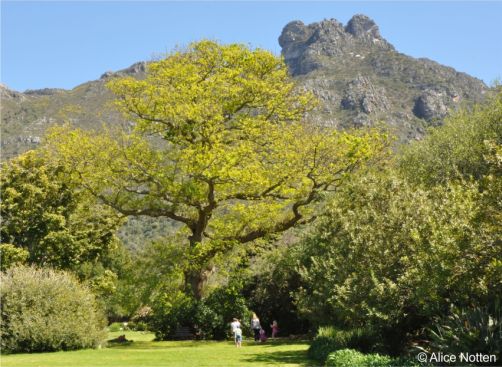
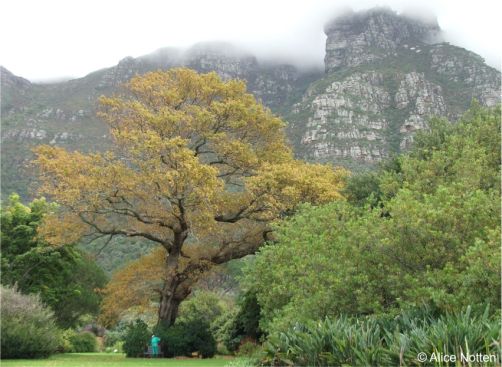
The oak trees in Kirstenbosch were probably planted during the 1800s when it was a farm, prior to 1913 when it became a botanical garden. Many were felled to make way for other species in the garden, and many have died of natural causes or been blown down during winter storms over the years. Those that have persisted are easy to distinguish in autumn and early winter when their canopies turn gold, and in spring when they are bright green.
Ecology
Ecology
In their natural habitat, oaks are a foundation species of many ecosystems, and they are associated with a rich biodiversity and provide a variety of ecosystem services. The trees are known to be long lived, reaching over 1 000 years in some cases, their ability to live for centuries underscores their resilience and adaptability, making them a legacy species in landscapes or forests.
Quercus robur flowers are wind-pollinated. The acorns are eaten by small mammals and birds.
In South Africa, Quercus robur trees are not as long-lived as they are in Europe, and they are highly susceptible to fungal diseases, including powdery mildew, root rot and heart rot. Oak trees are also attacked by the Polyphagous Shot Hole Borer, an invasive beetle from Asia that was first recorded in South Africa in 2012.
Uses
Use
The significance of Quercus robur in South African literature, art, and architecture is well established, with oak symbols such as acorns and leaves appearing in the logos of many local schools and organizations. The wood of the oak tree is used in making wine barrels due to it being strong, dense, long-lasting and resistant to decay. The bark was used for tanning. The acorns were fed to pigs, and soaked in hot water to make a medicine to treat dysentery and diarrhoea, and also roasted, ground and used to make a coffee-like drink. Oak trees are also associated with edible mushrooms. The trees were originally introduced for their timber which was needed for the construction of ships and buildings, but in the warmer climate of South Africa, the oak trees grow faster than they do in Europe and are susceptible to fungal pathogens including heart rot, resulting in the timber being less dense and weaker, and unfortunately, it has proved useless for construction.
Growing Quercus robur
Grow
Quercus robur can be propagared from acorns. Fill small pots with well-drained, peat-free potting soil. Collect acorns as or soon after they fall and sow them immediately. Select the plump, undamaged ones. Remove the acorn from its cup, it should come out easily. Place the acorn on its side and cover with 2-3 cm of soil. Water the pot and place it in a sheltered, well-lit place and make sure it is protected from birds and rodents that may steal the acorn. Keep moist until it germinates. Repot into a larger container when the seedling outgrows its pot. It can be planted out into the garden after its first year. Choose a site with deep fertile well-drained soil in full sun or dappled shade. Remember this is a large and long-lived tree and it will take up a lot of space, in time. Water it well in summer, especially during dry periods.
Quercus robur is susceptible to many fungal infections, in particular downy mildew. In Cape Town oak trees are colonised and killed by the Polyphagous Shot Hole Borer and gardeners are discouraged from growing them.
References
- Barstow, M. & Khela, S. 2017. Quercus robur. The IUCN Red List of Threatened Species 2017: e.T63532A3126467. Online. https://www.iucnredlist.org/species/63532/3126467.
- Blanc-Jolivet, C. & Liesebach, M. 2015. Tracing the origin and species identity of Quercus robur and Quercus petraea in Europe: a review. Silvae Genetica 64(1-6): 182–193.
- Britannica. English oak. https://www.britannica.com/plant/English-oak. Accessed 20 April 2026.
- Crellin J.R. 2026. Images of Quercus robur. Floralimages. Online. https://www.floralimages.co.uk/page.php?taxon=quercus_robur,1.
- Donald, D.G.M. 1978. The oak at the Cape, its care and maintenance. Veld & Flora 64: 98-102.
- Gildenhuys, C.P., Potgieter, L.J. & Richardson, D.M. 2024. The genus Quercus (Fagaceae) in South Africa: Introduction history, current status, and invasion ecology. South African Journal of Botany 167: 150–165.
- Mitchell, D.T. 1978. Pathology of the Cape oak. Veld & Flora 64: 107-110.
- Smith, C.A. 1966. Common names of South African plants. Memoirs of the Botanical Survey of South Africa No. 35. Government Printer, Pretoria.
- Wikipedia. Quercus robur. https://en.wikipedia.org/wiki/Quercus_robur. Accessed 18 June 2026.
- Wilson, N. 2023. Complete guide to oak trees. GardenersWorld.com. Online. https://www.gardenersworld.com/how-to/grow-plants/complete-guide-to-oak-trees.
Credits
Clare Sitoe and Alice Notten
Kirstenbosch National Botanical Garden
July 2026
Acknowledgements: images by Alice Notten, Michael Nobauer and J.R. Crellin.
Plant Attributes:
Plant Type: Tree
SA Distribution:
Soil type: Loam
Flowering season: Spring
PH:
Flower colour: Green
Aspect: Full Sun, Morning Sun (Semi Shade), Afternoon Sun (Semi Shade)
Gardening skill: Easy
Special Features:
 Feature plant
 Edible plant
 Medical plant
 Useful plant
Horticultural zones




Rate this article
Article well written and informative
Rate this plant
Is this an interesting plant?
Login to add your Comment
Back to topNot registered yet? Click here to register.