


Rhombophyllum rhomboideum
Introduction
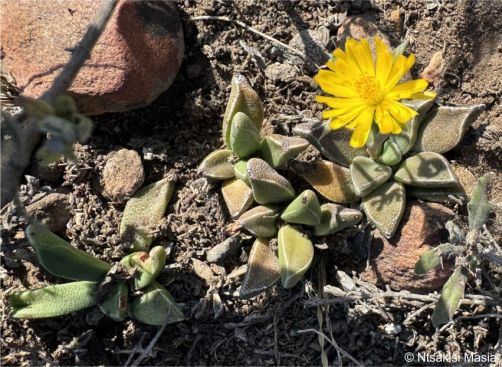
The diamond-leaved rhombophyllum is one of five species in the genus, distinguished by its distinctive diamond-shaped leaves. These leaves are borne on short stalks and support the development of a bright yellow flower.
Description
Description
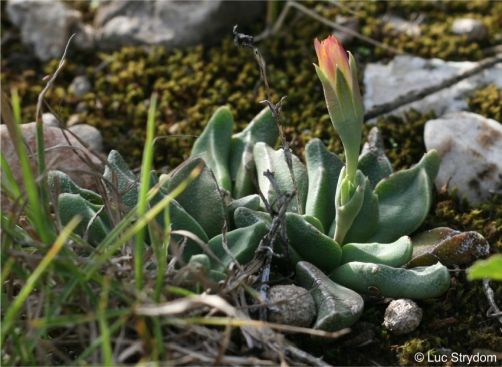
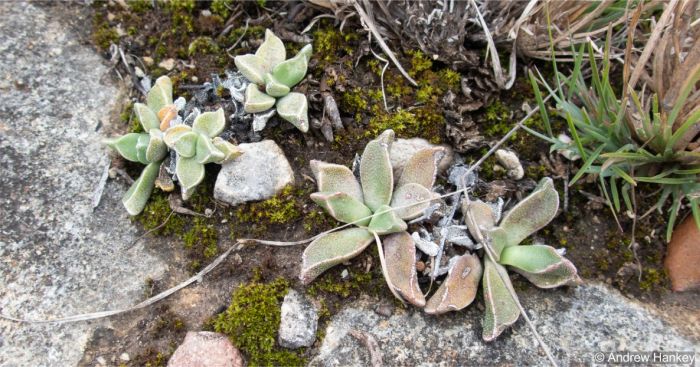
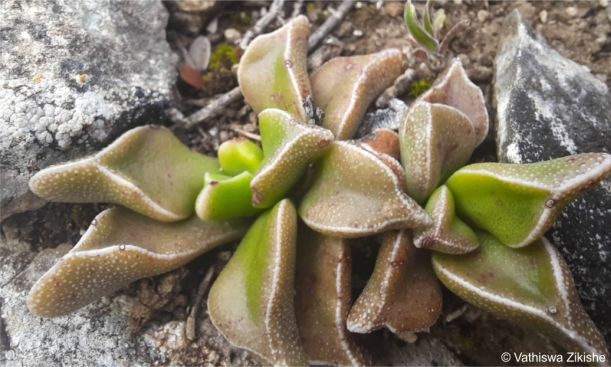
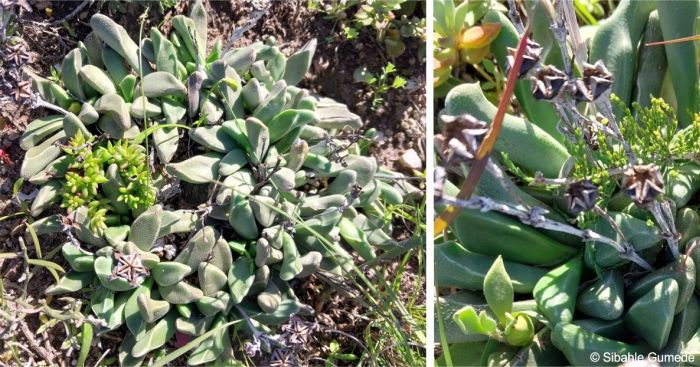
Rhombophyllum rhomboideum is a dwarf, cluster-forming, stemless succulent, often appearing with 8 to 10 long and thick leaves that end with a notch at the top giving the leaf a boat-like shape. It has a tuberous root system, allowing it to naturally reproduce asexually. Fleshy leaves grow from the base and branch into new clusters that can grow up to 50 mm wide on average. The leaf surface is thick and grey-green, marked with whitish to greyish spots, and a distinct white line along the leaf margins.
The inflorescence consists of solitary, stalked flowers arising from the leaf rosettes. The flowers are daisy-like, with numerous narrow petals, typically bright yellow and about 30 mm in diameter. The flowers are borne on relatively long peduncles, elevating them above the foliage. They typically open up late in the afternoon when receiving sunlight. Flowering time ranges from late winter (August) to mid-autumn (April), depending on environmental conditions. Like other Aizoaceae species, the fruit is a capsule, with five distinctive locules that remain brown after the seeds have dispersed. Seeds are small, smooth and dark brown, and are naturally dispersed after rains.
Conservation Status
Status
Rhombophyllum rhomboideum is currently assessed as Endangered (EN) in the Red List of South African Plants. It has a small natural range and its population continues to decline due to habitat destruction, illegal harvesting and urbanization; therefore, a reassessment of its conservation status may be necessary within the next decade.
Distribution and habitat
Distribution description
The diamond-leaved rhombophyllum is native to South Africa, where it occurs in the Eastern Cape Province, endemic to a small region in the south-eastern parts, between Kariega (formerly Uitenhage), Coega, Swartkops River, Sundays River and Gqeberha. Its distribution is relatively restricted, reflecting its adaptation to specific environmental conditions within this region. The species forms part of the rich succulent flora in parts of the semi-arid zones adjacent to the Cape Floristic Region.
The population of Rhombophyllum rhomboideum is mostly in dense thicket vegetation receiving summer rainfall, often on calcrete soils. This species inhabits dry, rocky environments, typically occurring on stony slopes, rocky outcrops, and in sandy or gravelly soils with excellent drainage. The species is commonly associated with open, sun-exposed habitats and is often found growing in sparse vegetation where competition is limited.
Derivation of name and historical aspects
History
The genus name Rhombophyllum is derived from Greek roots: rhombos meaning ‘rhombus’ or ‘diamond-shaped’, and phyllon meaning ‘leaf’. Together, the name translates to ‘diamond-shaped leaf’, referring to the distinctive rhomboid form of the leaves that characterizes species within this genus. The specific epithet rhomboideum is derived from the Latin rhomboideus, meaning ‘rhombus-like’ or ‘diamond-shaped’. This further emphasizes the characteristic shape of the leaves, effectively reinforcing the meaning already conveyed by the genus name.
This genus belongs to the family Aizoaceae, a group well known for its succulent species adapted to arid and semi-arid regions of southern Africa; a family with 135 genera and about 1 800 species. The genus Rhombophyllum was established in the early 20th century during a period of active taxonomic work on South African succulents, when botanists began separating closely related taxa based on detailed morphological differences, particularly leaf shape and floral structure. Species in this genus were previously grouped with other mesembs (members of Aizoaceae), but were later distinguished as a separate genus due to their unique combination of rhomboid leaves and floral characteristics. Currently, the genus is composed of five species: Rhombophyllum albanense, R. dolabriforme, R. dyeri, R. nelii and R. rhomboideum, with three of the species having lobed vertical plane leaves in close range to the ground surface.
Rhombophyllum rhomboideum was originally named Mesembryanthemum rhomboideum in the year 1840, then renamed when moved to the current genus in 1927. This reflects an earlier stage in the taxonomy of the family Aizoaceae, when many succulent species were broadly grouped under the large and diverse genus Mesembryanthemum.
Ecology
Ecology
Rhombophyllum rhomboideum relies on thick, fleshy leaves that retain water to enhance its chances of survival on dry soil. Other than its survival mechanism, the diamond-leaved rhombophyllum has traits shared by many Aizoaceae species, producing hygrochastic capsules that open when wet, allowing rainfall to wash the tiny seeds out of the capsules and disperse them into crevices.
Uses
Use
The diamond-leaved rhombophyllum has not been reported to have any medicinal or cultural uses and also, the plant has no edible material. However, aesthetically, it can be used as an ornamental plant. The plant looks extremely well as a pot plant, with its dense growth form and bright yellow flowers. Additionally, it can be added as a fill-up plant in a rocky succulent garden.
Growing Rhombophyllum rhomboideum
Grow
Rhombophyllum rhomboideum can be propagated by seeds or cuttings (splitting) in a well-drained media. Even though it may survive excessive watering, the plant requires moderate watering while positioned in a sunny spot.
Seed sowing is ideally done in spring, while plants are actively growing. Use seedling trays and growth medium containing 1 part river sand, 1 part sifted red soil and 1 part sifted compost. With the drainage of germination trays supported by coarse particles such as bark, crushed stones etc. at the base, fill trays with growth medium and moisten it. Scatter seeds evenly on the growth medium surface and then add a thin layer of the germination mix to anchor the seeds and prevent them from moving over. The layer should be minimal to allow sunlight to reach the seeds, since it is needed for germinating the diamond-leaved rhombophyllum. Place the trays inside the greenhouse receiving indirect sunlight, with a temperature ranging between 21–26°C. Then water seed trays on a daily basis using a misting sprayer, until they germinate. Where germination is practiced at home, trays can be gently watered and then sealed with plastic to retain moisture until seeds germinate, with regular misting when needed. Germination can be achieved in the first 2–4 weeks after sowing, provided that the conditions are constantly kept favourable. When seedlings are established, gradually expose them to more light and airflow before transplanting, until they can withstand direct sunlight. Hardened off seedlings can be transplanted into suitable pots using potting mix suitable for succulent plants.
For vegetative propagation, R. rhomboideum is best propagated by splitting. Propagation by splitting involves separating naturally formed offshoots from the parent plant (division of offsets). Splitting is best done early in the morning, while the plant hormones are active and the temperature is cool. When the plant has formed a dense clump, carefully remove the plant from its pot or loosen the surrounding soil. Identify individual offshoots that have their own roots or are sufficiently developed, with at least have two sets of leaves. Gently pull the offshoot away from the parent plant; if necessary, use a clean, sharp knife or secateurs to separate offshoots from the mother plant. Allow the separated pieces to dry for few hours so that any wounds can callus, reducing the risk of rot. Offshoots with roots will gain a survival advantage, but the ones without roots also stand a chance to survive. Use a well-draining succulent mix with a high content of river sand to pot up offshoots in small, shallow pots or trays if there are many. After planting, do not water immediately, spare few more hours to allow any damaged parts to heal. Place the containers in a bright, well-lit area with indirect sunlight initially; avoid harsh direct sun until the plants are established. Once rooted, the plants can tolerate full sun to partial sun, similar to their natural habitat. Maintain warm, dry conditions, as the species is adapted to semi-arid environments.
The diamond-leaved rhombophyllum looks great when cultivated as a pot plant, placed in a sunny spot receiving indirect sunlight. Grow it in a well-draining succulent potting mix, such as 1 part river sand, 1 part red soil and 1 part compost or any organic medium. Ensure that the soil pH is neutral to slightly acidic (6.0–7.0). This plant does well with minimal watering, though it may survive regular watering. This species is suitable for dry, rocky gardens designed for low maintenance. Grow the diamond-leaved rhombophyllum in dry climates, in full sun to partial shade. The soil should be well-draining and with moderate to low water-holding capacity. Water the plant well during spring and summer, and sparingly in autumn and winter (dormant season) – ideally once every two weeks to a month.
Rhombophyllum rhomboideum may suffer from root rot caused by overwatering and poor drainage – which should be avoided at all times. Additionally, given the smooth thick leaves of this species, the plants may be attacked by white scale, which is a common sap-sucking pest on succulents. Spray the plants with insecticidal soap or neem oil solution, covering all surfaces. Repeat the application every 7 – 10 days and wash the scale off with high pressure water. To prevent the plant from hosting pests, often remove dead or damaged parts from the plant.
References
- Barkhuizen, B.P. 1978. Succulents of southern Africa. Purnell and Sons Publishers, Cape Town.
- Bredenkamp, C. 2019. A flora of the Eastern Cape Province. Strelitzia 41. South African National Biodiversity Institute, Pretoria.
- Court, D. 1981. Succulent flora of southern Africa. Balkema, Cape Town.
- El-Raouf, H.S.A. 2021. Taxonomic significance of leaves in family Aizoaceae. Saudi Journal of Biological Sciences 28: 512–522.
- GBIF Secretariat. Rhombophyllum rhomboideum (Salm-Dyck) Schwantes. https://www.gbif.org/species/3705088. Accessed on 2026/04/27.
- Hartmann, H.E. ed. 2002. Illustrated handbook of succulent plants: Aizoaceae F–Z (Vol. 2). Springer Science & Business Media, Berlin, Heidelberg, New York.
- Klak, C., Reeves, G. & Hedderson, T. 2004. Unmatched tempo of evolution in southern African semi-desert ice plants. Nature 427: 63–65.
- Makola, T. 2025. Corpuscularia lehmannii (Eckl. & Zeyh.) Schwantes (Aizoaceae). PlantZAfrica. Online. https://pza.sanbi.org/corpuscularia-lehmannii.
- Manning, J. & Goldblatt, P. 2012. Plants of the Greater Cape Floristic Region 1: the Core Cape Flora. Strelitzia 29. South African National Biodiversity Institute, Pretoria.
- Plants of the World Online. Rhombophyllum rhomboideum (Salm-Dyck) Schwantes. https://powo.science.kew.org/taxon/urn:lsid:ipni.org:names:364165-1. Accessed 2026/04/27.
- Raimondo, D. & Dold, A.P. 2008. Rhombophyllum rhomboideum (Salm-Dyck) Schwantes. National Assessment: Red List of South African Plants version 2024.1. Accessed on 2026/04/27.
- Smith, G., Chesselet, P., Van Jaarsveld, E.J., Hartmann, H., Hammer, S., Van Wyk, B., Burgoyne, P., Klak, C. & Kurzweil, H. 1998. Mesembs of the world. Briza Publications, Pretoria.
- Smith, G.F., Crouch, N.R. & Figueiredo, E. 2017. Field guide to succulents in southern Africa. Struik Nature, Cape Town.
- Storms, E. 1976. Growing the mesembs. Tarrant Printing, Fort Worth.
- WFO The World Flora Online. Rhombophyllum rhomboideum (Salm-Dyck) Schwantes. https://www.worldfloraonline.org/taxon/wfo-0001293856. Accessed on 2026/04/27.
Credits
Thabang Makola & Nondumiso Mokwena
Karoo Desert National Botanical Garden
April 2026
Acknowledgements: images by Ntsakisi Masia, Luc Strydom, Vathiswa Zikishe, Andrew Hankey and Sibahle Gumede from their observations uploaded on iNaturalist.
Plant Attributes:
Plant Type: Succulent
SA Distribution: Eastern Cape
Soil type: Sandy, Loam
Flowering season: Spring, Early Summer, Late Summer
PH: Acid, Neutral
Flower colour: Yellow
Aspect: Full Sun
Gardening skill: Average
Special Features:
 Drought resistant
 Good potplant
Horticultural zones




Rate this article
Article well written and informative
Rate this plant
Is this an interesting plant?
Login to add your Comment
Back to topNot registered yet? Click here to register.