


Schinziophyton rautanenii
Introduction
Schinziophyton rautanenii is a protected tree with socio-economic value due to the number of ecosystem services linked to it.
Description
Description
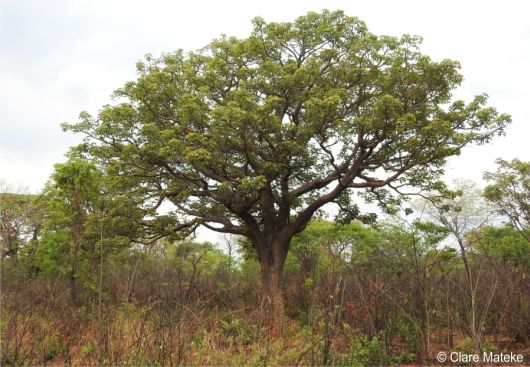
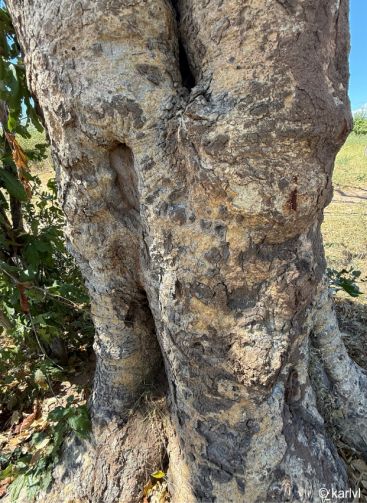
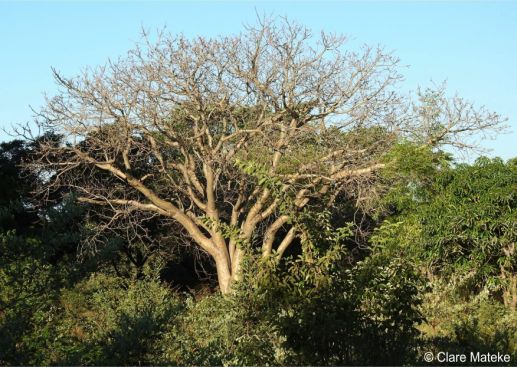
Schinziophyton rautanenii is a deciduous, spreading tree of 8-20 m in height. The trunk is stout, thickset and can reach a diameter of 1 m, it often grows in clusters with 3-4 trunks growing adjacent to each other. The grey to light golden-brown bark is smooth and flaky, young branches are covered in soft, rust-coloured hairs that fall off as the branches mature.
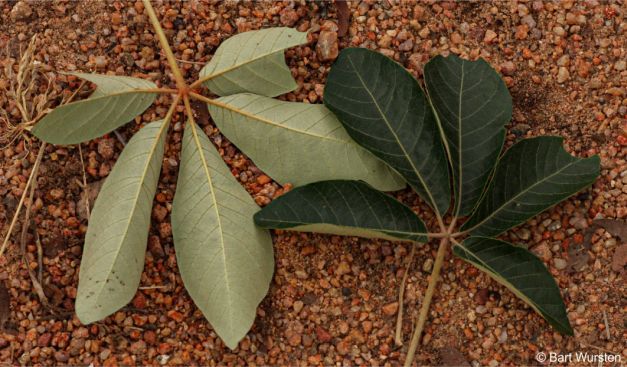
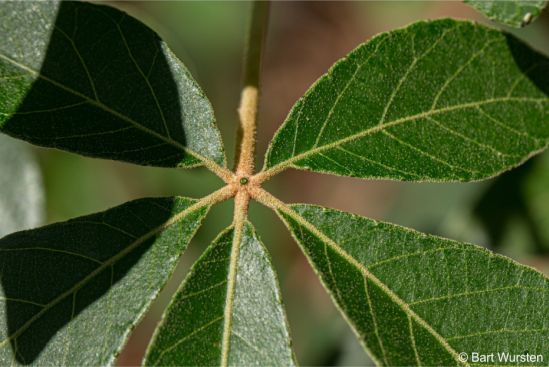
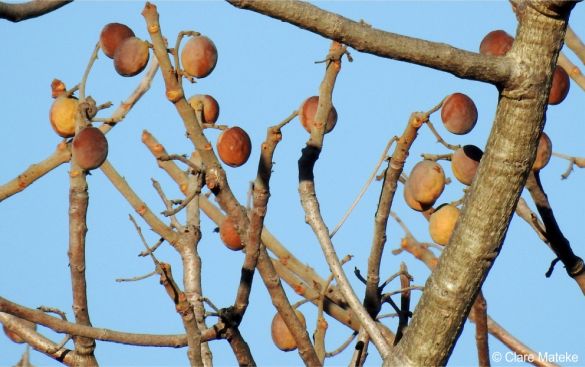
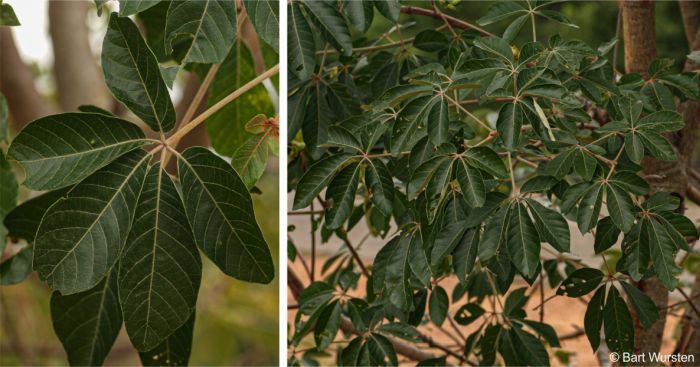
The leaves are alternate, digitally compound, with 3-7 leaflets leaflets that are dark green above, with a greyish underside, turning bright yellow in winter before falling off. The midrib and veins are covered in rusty brown, furry hairs; margin is serrated or lobed and edged with gland dots. Flowers are yellow or white and appear in early summer (Oct-Nov), in slender loose sprays or paniculate cymes up to 120 mm long. Schinziophyton rautanenii is dioecious (male and female flowers on separate trees), male cymes are longer than the females , and female trees also produce fewer flowers. Fruit is ovoid, 35 mm long and 25mm in diameter, waxy, light grey-green and covered with velvety hairs. The fruit ripens on the ground after falling in autumn (April-May). The seed is shaped and sized like a small hazelnut and is creamy white in colour.
Conservation Status
Status
Schinziophyton rautanenii is listed as a species of Least Concern (LC) on the Red List of South African plants. However, it is declared as a protected tree in terms of section 12 of the National forests Act No. 84 of 1998.
Distribution and habitat
Distribution description
Schinziophyton rautanenii occurs in a narrow belt across the subtropical latitudes of southern Africa. This tree occurs in Angola, Botswana, the Democratic Republic of Congo, Mozambique, Namibia, South Africa, Zambia and Zimbabwe. In South Africa, the tree occurs in the Limpopo province. The Manketti tree grows in deep sand, among sand dunes and on wooded hills, at altitudes of 800–1 000 m. The tree is found deep in sand with high sand content and little to no clay content present. This tree occurs in a summer rainfall region with an annual rainfall of 200–1 000 mm but can tolerate periods of drought. Mature trees tolerate light frost but young growth and young plants are damaged below 7°C.
Derivation of name and historical aspects
History
The genus name Schinziophyton honours Hans Schinz, a Swiss botanist and botanical collector who studies natural history at Zurich polytechnic and obtained a PhD by 1983. The species epithet rautanenii honours a Finnish missionary and amateur botanist Martin Rautanen.
Schinziophyton is a monotypic genus, Schinziophyton rautanenii is the only species in this genus. It was until 1990 known as Ricinodendron rautanenii Schinz.
Ecology
Ecology
The fruit is eaten by elephant, porcupine, ostrich and kudu, which aid in the dispersal of the seed. Human activity relating to harvesting and transportation of plant material also assists in seed dispersal.
Uses
Use
Schinziophyton rautanenii has various uses in rural communities and commercial industry. The fruit is edible and is enjoyed fresh, dried or cooked. The pulp is used to prepare soups, sweet porridge and processed to make a potent beer. The kernel is removed from the fruit by boiling the fruit in fresh water, it can be eaten raw, roasted or used to make oil. The oil extracted from the kernel is used for cooking by rural communities and in commercial industry to produce soaps, cosmetics and varnishes. The roots of the tree are used to remedy stomach aches, and it is believed that tying the nuts around the ankles can relieve leg pains.
Growing Schinziophyton rautanenii
Grow
Schinziophyton rautanenii can be propagated through seeds and cuttings. The seeds are difficult to germinate, and germination is often erratic and takes a long time. The woody shell surrounding the seed needs to be removed prior to sowing the seeds. Soak the seeds in water for 5 days, and sow in a growth medium of sandy soil and keep in semi shade until germination occurs. Once the seedlings are established, they need little attention. Truncheon cuttings are used by local communities and root easily.
The timber is affected by a sap stain fungus and the fallen fruit as attacked by moth larvae that eat all the fleshy parts.
References
- ABS Biotrade. Mankettii (Schinziophyton rautanenii). https://www.abs-biotrade.info/value-chains/manketti-schinziophyton-rautanenii/. Accessed 17 June 2026.
- Bio Innovation Zimbabwe. Mongongo or Mankettii Tree (Schinziophyton rautanenii). https://www.bio-innovation.org/mongongo-or-manketti-tree-schinziophyton-rautanenii/. Accessed 10 June 2026.
- Chidumayo, E. N. 2016. Distribution and abundance of a keystone tree, Schinziophyton rautanenii, and factors affecting its structure in Zambia, southern Africa. Biodiversity and Conservation 25(4):711-724.
- Clarke, H. & Charters, M. 2016. The illustrated dictionary of southern African plant names. Flora & Fauna Publications Trust, Jacana, Johannesburg.
- Coates Palgrave, K. 2002. Trees of southern Africa. Struik, Cape Town.
- Cosmacon. Manketti Oil. https://www.cosmacon.de/en/manketti-oil/. Accessed 10 June 2026.
- Graz, F. P. 2002. Description and ecology of Schinziophyton rautanenii (Schinz) Radcl. -Sm in Namibia. Dinteria 27:19-35.
- karlvl. 2026-Apr. Observation of Schinziophyton rautanenii, Mashonaland, Zimbabwe. iNaturalist. Online. https://www.inaturalist.org/observations/357104379.
- Mateke, C. 2023-Nov. Observation of Schinziophyton rautanenii, Livingstone Zambia. iNaturalist. Online. https://www.inaturalist.org/observations/192376773.
- Mateke, C. 2024-Apr. Observation of Schinziophyton rautanenii, Mulobezi, Zambia. iNaturalist. Online. https://www.inaturalist.org/observations/208583921.
- Orwa, C., Mutua, A., Kindt, R., Jamnadass, R. & Simons, A. 2009. Agroforestree Database: a tree reference and selection guide version 4.0. Online. http://www.worldagroforestry.org/af/treedb/.
- Plants For a Future. Schinziophyton rautanenii - (Schinz) Radcl. -Sm.. https://pfaf.org/user/Plant.aspx?LatinName=Schinziophyton+rautanenii. Accessed 17 June 2026.
- Raimondo, D., Von Staden, L., Foden, W., Victor, J.E., Helme, N.A., Turner, R.C., Kamundi, D.A. & Manyama, P.A. (eds) 2009. Red list of South African plants. Strelitzia 25. South African National Biodiversity Institute, Pretoria.
- Usher, G. 1966. A Dictionary of Botany. Constable, London.
- Wursten, B. 2010-Jan. Observation of Schinziophyton rautanenii, Hwange, Zimbabwe. iNaturalist. Online. https://www.inaturalist.org/observations/172030914
- Wursten, B. 2016-Jan Observation of Schinziophyton rautanenii, Gokwe South, Zimbabwe. iNaturalist. Online. https://www.inaturalist.org/observations/350552778.
Credits
Siphesihle Precious Sibiya
Kirstenbosch National Botanical Garden
July 2026
Acknowledgements: the author thanks Clare Mateke, karlvl and Bart Wursten for granting permission to use their images of Schinziophyton to illustrate this article.
Plant Attributes:
Plant Type: Tree
SA Distribution: Limpopo
Soil type: Sandy, Loam
Flowering season: Early Summer
PH: Acid, Neutral
Flower colour: Yellow
Aspect: Full Sun, Morning Sun (Semi Shade), Afternoon Sun (Semi Shade)
Gardening skill: Average
Special Features:
 Drought resistant
 Edible plant
 Medical plant
 Useful plant
Horticultural zones


Rate this article
Article well written and informative
Rate this plant
Is this an interesting plant?
Login to add your Comment
Back to topNot registered yet? Click here to register.