


Secamone alpini
Introduction
Robust climber or sometimes a scrambling shrub, with milky latex, glossy dark green leaves and rope-like stems, found along forest margins in thicket, coastal bush and dune forest.
Description
Description
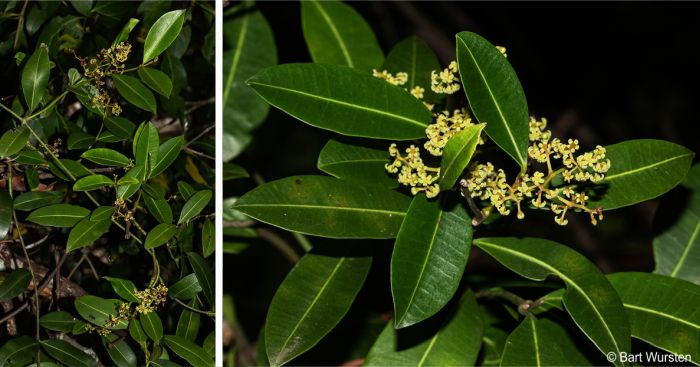
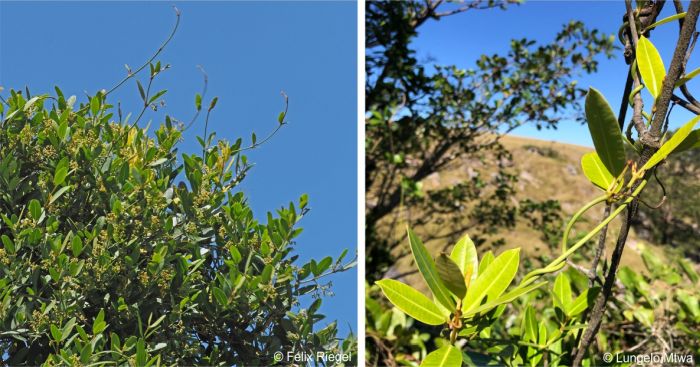
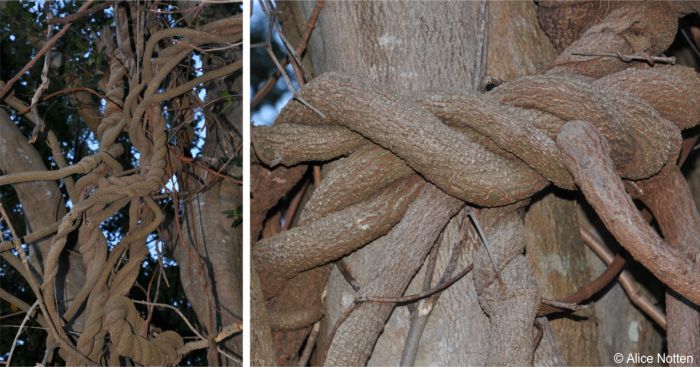
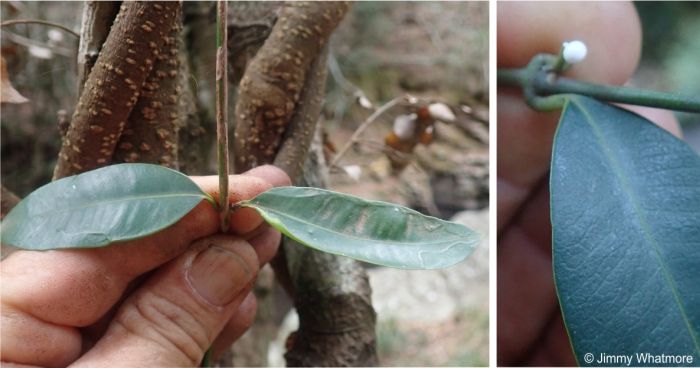
Secamone alpini is a slender climber or scrambling or scandent shrub that can grow up to 10 m by climbing up into tall trees. The sap is milky white and oozes from wounds on the stems and leaves. Stems climb by forming tendril-like coils and twining around the stems of other plants, and are covered in minute rusty hairs. Leaves are opposite, lanceolate to ovate, 25-90 mm long and 6-25 mm wide, shiny dark green with rusty hairs underneath when young.
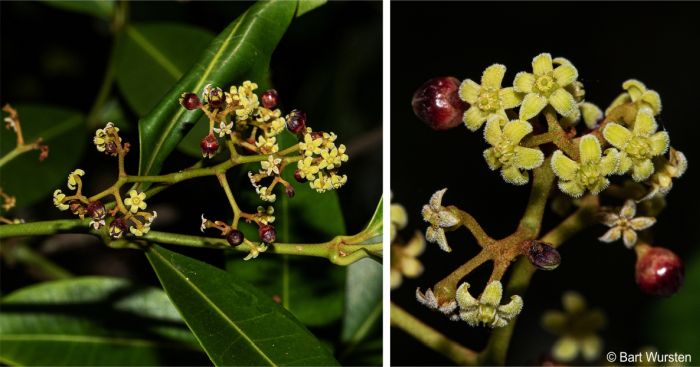
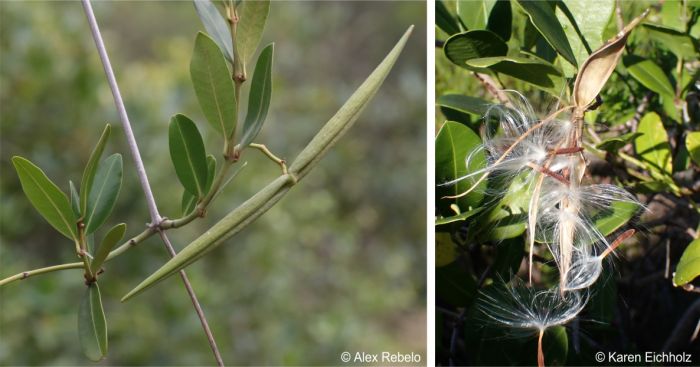
Flowers are cream-coloured, very small, in branched heads. The corolla is greenish-yellow to white with lobes that are finely hairy above, corona lobes erect and curved inwards over the anthers. Pollen is 4-locular and gathered into 4 pollinia. The fruit (seed pod) is a pair of widely diverging, slender follicles, 45-100 mm long, splitting open along a built-in line of weakness, to release the seeds, each with a tuft of long silky hairs on one end. Flowering occurs in summer, from October to April.
Conservation Status
Status
According to the Red List of South African Plants, Secamone alpini is a widespread species with no severe threats, and is therefore not in danger of extinction, and is thus assessed as Least Concern (LC).
Distribution and habitat
Distribution description
Secamone alpini is widespread across eastern South Africa, from the Limpopo River Valley in Limpopo Province southwards through North West, Gauteng, Mpumalanga and KwaZulu-Natal to the eastern and southern coastal areas of the Eastern Cape as far south as the Cape Peninsula and west to the Bokkeveld Escarpment in the Western Cape. It also occurs in Eswatini, Kenya, Mozambique, Malawi, Tanzania, Uganda, Zambia and Zimbabwe. Plants grow in forest, at the margins of forest, in thicket, coastal bush and dune forest and occur in a wide range of vegetation types, including Scarp, Afrotemperate, Mistbelt and Coastal Forest, Dune, Shale, Sandstone and Granite Fynbos, Coastal Belt, Highveld, Basalt and Dolomite Grassland and Flats, Dune, Granite and Shale Strandveld.
Derivation of name and historical aspects
History
This species is named after Prospero Alpino (1553-1617), an Italian botanist. The genus name is derived from squamona, the Arabic name for Secamone aegyptiaca now Oxystelma esculentum. Secamone is a genus of 150 species of lianas or scrambling shrubs that occur in tropical and subtropical regions of Africa, Madagascar, Asia and Australia, with 5 species in South Africa.
Ecology
Ecology
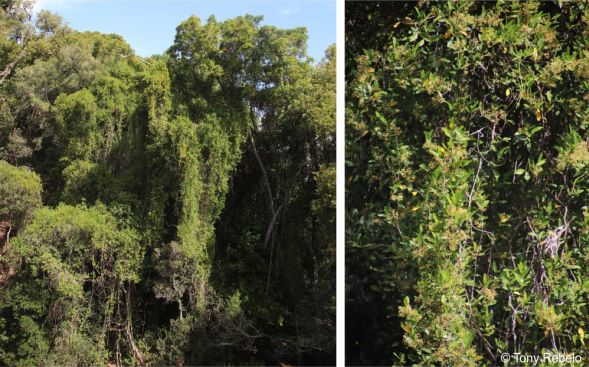
Secamone alpini seeds are dispersed by wind, the tuft of silky white hairs allowing them to be lifted and carried on the air. The long stems that twine around the branches and stems of other plants and drape themselves through and over other shrubs and trees, allow the plant to climb to the tops of tall forest trees, sometimes also smothering and killing them. As they age the stems become thick and strong, often retaining their coiled and twining shapes, and are used like ropes by monkeys and baboons, to swing themselves through the trees.
Uses
Use
Secamone alpini is used as a medicinal plant to relieve back pain, to treat stomach gas, to ease child birth, to treat heartburn, diabetes, dizziness and stiff joints. It is also used in ritual to protect livestock against sickness and witchcraft. A leafy stem is tied above and across the entrance of a kraal so that the cattle will pass underneath it every day because it is believed to keep evil spirits away and ensure a healthy herd.
The wood is white, hard and tough but pieces do not get very thick and thus their use is limited. The pliable stems can be used for making baskets and ropes.
Secamone alpini also can be used as ornamental plant in the garden, given a trellis or pergola to climb on or it can be trained along a fence, but be aware that plants can grow large and spread far. Best suited to frost-free climates.
Growing Secamone alpini
Grow
Secamone alpini can be propagated by seed, sown in spring in summer-rainfall regions and in autumn in winter-rainfall regions. Collect the fruits just as they start to split open, before the seeds blow away. Remove the tuft of silky hairs before sowing to prevent the seeds from blowing away. Use a sandy, well-drained soil mix, lightly cover the seeds, place the tray in a warm, well-ventilated, well-lit place and keep moist. Transplant the seedlings after their first pair of true leaves have developed.
Secamone alpini is best grown in full sun and well-drained, composted soil. Moderate water can be given all year. This species is adapted to survive in a wide range of habitats, mostly frost-free with rainfall in summer or winter or all year. It should require minimal additional water once established and it will tolerate periods of drought, but will perform best with regular watering. In a container, Secamone alpini grows best in well-draining soil, which also helps prevent root rot – a common problem caused by overwatering.
References
- Dold, A.P. & Cocks, M.L. 1999. Preliminary list of Xhosa plant names from the Eastern Cape, South Africa. Bothalia 29,2: 267-292.
- Eichholz, K. 2025-May. Observation of Secamone alpini, Eden, WC. iNaturalist. Online. https://www.inaturalist.org/observations/281506106.
- Fernkloof Nature Reserve. Secamone alpinii. https://www.fernkloof.org.za/index.php/all-plants/plant-families/item/secamone-alpini. Accessed on 2025/05/17.
- Hyde, M.A., Wursten, B.T., Ballings, P. & Coates Palgrave, M. 2025-May. Secamone alpini. Flora of Zimbabwe. Online.https://www.zimbabweflora.co.zw/speciesdata/species.php?species_id=146070
- Jackson, W.P.U. 1990. Origins and meanings of names of South African plant genera. University of Cape Town Printing Department, Cape Town.
- Mtwa, L. 2025-Apr. Observation of Secamone alpini, Pondoland. iNaturalist. Online. https://www.inaturalist.org/observations/275080251.
- Nichols, G. 2005. Growing rare plants: a practical handbook on propagating the threatened plants of southern Africa. Southern African Botanical Diversity Network Report No. 36.
- Plants of the World Online. Secamone R.Br. https://powo.science.kew.org/taxon/urn:lsid:ipni.org:names:30167675-2. Accessed 10/12/25.
- Pooley, E. 1998. A field guide to wild flowers of Kwazulu-Natal and the eastern region. Natal Flora Publications Trust, Durban.
- Rebelo, A. 2025-Mar. Observation of Secamone alpini, Magaliesberg. iNaturalist. Online. https://www.inaturalist.org/observations/265531535.
- Rebelo, T. 2019-Dec. Observation of Secamone alpini, Grootbos Nature Reserve. iNaturalist. Online. https://www.inaturalist.org/observations/37109460.
- Riegel, F. 2023-Oct. Observation of Secamone alpini, Dutoitskloof Pass. iNaturalist. Online. https://www.inaturalist.org/observations/202992711.
- Useful Tropical Plants. Secamone alpini Schult. Apocynaceae. https://tropical.theferns.info/viewtropical.php?id=Secamone%20alpini. Accessed 2025-05-17.
- Von Staden, L. 2020. Secamone alpini Schult. National Assessment: Red List of South African Plants version. https://redlist.sanbi.org/species.php?species=2641-2.
- Whatmore, J. 2019-Nov. Observation of Secamone alpini, Lydenburg, MP. iNaturalist. Online. https://www.inaturalist.org/observations/36312385.
- Wursten, B. 2019-Dec. Observation of Secamone alpini, Chimanimani National Park Zimbabwe. iNaturalist. Online. https://www.inaturalist.org/observations/150765045.
- Zukulu, S., Dold, T., Abbott, T. & Raimondo, D. 2012. Medicinal and charm plants of Pondoland. South African National Biodiversity Institute, Pretoria.
Credits
Nonhlanhla Masinga, KwaZulu-Natal National Botanical Garden
and Alice Notten, Kirstenbosch National Botanical Garden
December 2025
Acknowledgements: images by Bart Wursten, Alex Rebelo, Karen Eichholz, Tony Rebelo, Jimmy Whatmore, Lungelo Mtwa and Felix Riegel from their observations on iNaturalist.
Plant Attributes:
Plant Type: Climber, Scrambler
SA Distribution: Eastern Cape, Gauteng, KwaZulu-Natal, Limpopo, Mpumalanga, North West, Western Cape
Soil type: Sandy, Loam
Flowering season: Early Summer, Late Summer
PH: Acid, Neutral
Flower colour: Green, White, Cream
Aspect: Full Sun
Gardening skill: Easy
Special Features:
 Medical plant
 Useful plant
Horticultural zones


Rate this article
Article well written and informative
Rate this plant
Is this an interesting plant?
Login to add your Comment
Back to topNot registered yet? Click here to register.