


Stachys thunbergii
Introduction
A sprawling aromatic perennial herb with prickly stems and whorls of reddish to purple tubular flowers in summer.
Description
Description
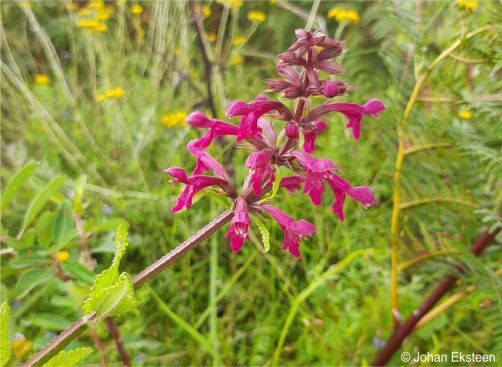
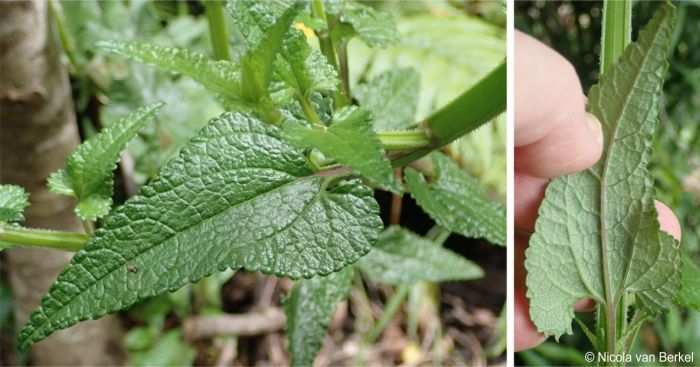
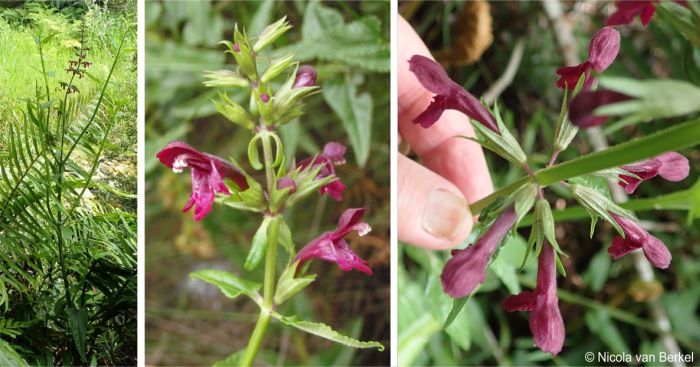
Stachys thunbergii is a perennial herb that has strong, 4-sided stems that grow upright or slightly spreading, reaching up to about 2 m long. The stems are softly woody, with a few branches, and have noticeable backward-facing prickles along the edges and at the nodes, but are otherwise smooth. The leaves grow on short stalks and are fairly thick and slightly wrinkled, turning dark brown as they dry. They are broadly to narrowly triangular, measuring about 30–60 mm long and 15–30 mm wide, with a pointed tip, a heart-shaped base, and finely toothed margins. The leaf surface is generally smooth or thinly covered with fine hairs.
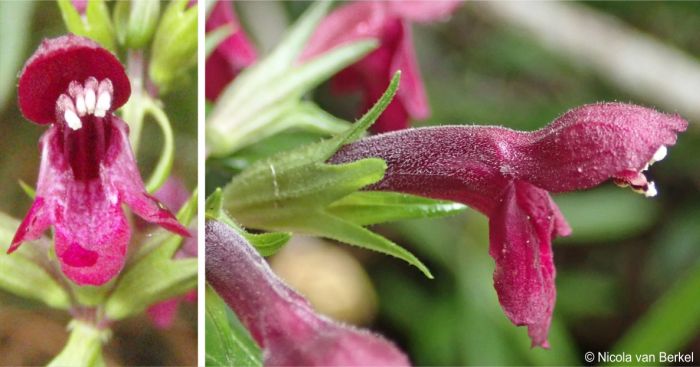
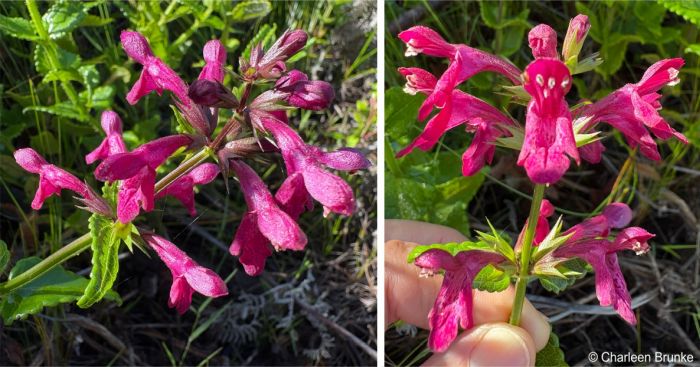
The flower spikes are sparse to moderately dense, 60–150 mm long, and made up of whorls of 4–6 tubular flowers. The calyx is lightly to moderately hairy and about 12–14 mm long, with narrow, pointed lobes usually ending in small spines. The corolla is a curved tube about 16–20 mm long, a striking red, magenta or purple, and covered with minute hairs. The upper lip is slightly shorter (about 4–5 mm long) than the lower one (6–7 mm long), giving the flowers a graceful, arching appearance. Flowering time is in spring and summer, from September to March.
Conservation Status
Status
According to the Red List of South African plants, this species is assessed as Least Concern (LC), indicating that it is widespread and abundant in its natural habitat and is not currently at risk of extinction.
Distribution and habitat
Distribution description
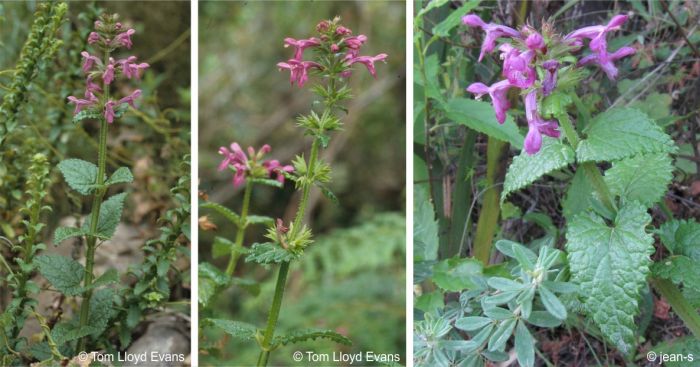
Stachys thunbergii is a South African endemic species that occurs naturally within the Eastern Cape and Western Cape provinces, where it is commonly found on the south-eastern slopes of Devil’s Peak and neighbouring mountains on the Cape Peninsula, as well as along forest margins in the George–Knysna–Humansdorp region, with a few scattered populations in between. It typically grows in the Fynbos and Afromontane Forest biomes.
Derivation of name and historical aspects
History
The genus name Stachys is derived from the Greek word stachys, meaning ‘an ear of grain or corn,’ a reference to its densely packed, spike-like flower clusters that resemble grains on a stalk. The species name thunbergii honours Carl Peter Thunberg, an 18th-century Swedish botanist known as the father of South African botany for his extensive explorations and documentation of plants across Africa and Asia. Naming this species after him recognizes his significant contributions to botanical science.
Stachys thunbergii belongs to a large and diverse genus of about 450 species, appreciated for their charming flowers and often fragrant foliage, making them both ecologically valuable and garden favourites. The genus includes shrubs as well as annual or perennial herbs. They have simple, opposite, triangular leaves, often with serrated edges and soft hairs. The flowers, grow in clusters in the upper leaf axils, with a 5-lobed calyx and 2-lipped corolla with a hood-shaped upper lip, appearing in shades of white, pink, purple, red, or pale yellow.
Ecology
Ecology
Stachys thunbergii stands out from other species in the genus due to its long-tubed red, magenta or purple flowers and ecological adaptation. It is the only member of the genus with long-tubed flowers that grows in the winter-rainfall region of the Western and Eastern Cape. Its flowers may be pollinated by local long-proboscid flies, such as Philoliche rostrata (Tabanidae) or Prosoeca nitidula (Nemestrinidae). It is also possible that they attract sunbirds, which pollinate similarly coloured and shaped flowers of many plant species in the Western Cape.
Uses
Use
Stachys thunbergii was used in traditional medicine to treat chest ailments and this plant was commonly called kattekruie, the Dutch name for catnip (Nepeta cataria) which was transferred to this species and Ballota africana by Dutch settlers. It was also mixed with Valeriana capensis and Ballota africana to treat asthma, bronchitis, hysteria and insomnia. Many Stachys species are known for their aromatic leaves and have been used in traditional medicine for their mild antiseptic, digestive, or calming properties. Stachys thunbergii also has potential for ornamental and herb gardens, well-suited to mixed beds and borders and semi-shaded areas. Additionally, it plays a key ecological role by providing nectar for specialized insect pollinators. In the Western and Eastern Cape winter-rainfall areas, it supports native long-proboscid flies, contributing to the conservation of these species and local ecosystem balance.
Growing Stachys thunbergii
Grow
Stachys thunbergii can be propagated by seeds, stem cuttings, or division.
Seeds should be collected once the flower spikes have dried, usually in late summer or autumn, then cleaned and sown on the surface of a well-drained, seedling mix. They should be kept moist and placed in a warm, bright position, where they typically germinate within three to six weeks. When seedlings are strong enough, they can be pricked out and planted into small pots before being established in garden beds.
Stem cuttings are best taken in spring or early summer, from healthy, non-flowering shoots, avoiding any terminal flowering buds. The lower leaves are removed, and the cuttings are propagated in a medium composed of 70% vermiculite and 30% milled bark. Cuttings should be kept in a warm, humid, shaded environment until roots are formed, usually within three to four weeks, after which they can be potted up and gradually hardened off.
Mature plants can also be propagated by division in early spring or autumn. Clumps should be carefully lifted and separated into smaller sections, each with healthy roots and shoots. Divisions should be replanted immediately into well-drained soil and watered thoroughly to help them establish.
Like many other members of the mint family, Stachys thunbergii prefers full sun to light shade, well-drained, composted soil, and regular watering but take care not to over water once established to avoid root rot. Prune after flowering to keep it tidy and encourage fresh growth.
Because of its softly hairy and aromatic leaves, Stachys thunbergii is generally free from pests, as these traits help deter most herbivorous insects.
References
- Brunke, C. 2025-Apr. Observation of Stachys thunbergii, Agulhas Plain, Western Cape. https://www.inaturalist.org/observations/270018361.
- Codd, L.E. 1985. Lamiaceae. Flora of southern Africa, Vol. 28, 4. Botanical Research Institute, Department of Agriculture and Water Supply, Pretoria.
- Eksteen, J. 2021-Mar. Observation of Stachys thunbergii, George, Western Cape. iNaturalist. Online. https://www.inaturalist.org/observations/71817636.
- Hartmann, H.T., Kester, D.E., Davies, F.T. & Geneve, R.L. 2011. Plant propagation: Principles and practices. 8th. Prentice Hall, New Jersey.
- jean_s. 2016-Nov. Observation of Stachys thunbergii, Table Mountain, Western Cape. iNaturalist. Online. https://www.inaturalist.org/observations/11253850.
- Lloyd Evans, T. 2025. Observations of Stachys thunbergii, Table Mountain, Western Cape. iNaturalist. Online. https://www.inaturalist.org/observations?taxon_id=594741&user_id=tomlloydevans.
- Manning, J. & Goldblatt, P. 2012. Plants of the Greater Cape Floristic Region 1: the Core Cape Flora. Strelitzia 29. South African National Biodiversity Institute, Pretoria.
- Nichols, G. 2005. Growing rare plants: a practical handbook on propagating the threatened plants of southern Africa. Southern African Botanical Diversity Network Report No. 36.
- PlantZAfrica, Search results for Stachys. https://pza.sanbi.org/plants/search/advanced?pow_page=genus&name=Stachys&title_sort=ASC. Accessed 13/11/2025.
- Pooley, E. 1998. A field guide to wild flowers of KwaZulu-Natal and the eastern region. Natal Flora Publications Trust, Durban.
- Potgieter, C.J. & Edwards, T. 2001. The occurrence of long, narrow corolla tubes in southern African Lamiaceae. Systematics and Geography of Plants 71: 493–502.
- Raimondo, D., Von Staden, L., Foden, W., Victor, J.E., Helme, N.A., Turner, R.C., Kamundi, D.A. & Manyama, P.A. (eds) 2009. Red list of South African plants. Strelitzia 25. South African National Biodiversity Institute, Pretoria.
- Rattray, R.D. et al. 2025. The medicinal uses, chemistry and phylogenetic relationships of ethnobotanically relevant South African Stachys species. Journal of Ethnopharmacology 353 Article 120467.
- Smith, C.A. 1966. Common names of South African plants. Memoirs of the Botanical Survey of South Africa No. 35. Government Printer, Pretoria.
- The Herbarium Catalogue, Royal Botanic Gardens Kew. Online. http://www.kew.org/herbcat. Consulted 13/11/2025.
- Tundis, R., Peruzzi, L. & Menichini, F. 2014. Phytochemical and biological studies of Stachys species in relation to chemotaxonomy: A review. Phytochemistry 102: 7–39.
- Van Berkel, N. 2025. Observations of Stachys thunbergii, George-Knysna area. iNaturalist. Online. https://www.inaturalist.org/observations?taxon_id=594741&user_id=nicky.
- Van Wyk, B.-E. & Gericke, N. 2000. People's plants, a guide to useful plants of southern Africa. Briza Publications, Pretoria.
Credits
Bontle Matetoane
Kirstenbosch National Botanical Garden
January 2026
Acknowledgments: images by Johan Eksteen, Charleen Brunke, Nicola van Berkel, Tom Lloyd Evans and jean-s.
Plant Attributes:
Plant Type: Perennial
SA Distribution: Eastern Cape, Western Cape
Soil type: Sandy, Loam
Flowering season: Spring, Early Summer, Late Summer
PH: Acid, Neutral
Flower colour: Purple, Red
Aspect: Full Sun, Morning Sun (Semi Shade), Afternoon Sun (Semi Shade)
Gardening skill: Easy
Special Features:
 Attracts birds
 Fragrant
 Medical plant
 Feeds honeybees
Horticultural zones


Rate this article
Article well written and informative
Rate this plant
Is this an interesting plant?
Login to add your Comment
Back to topNot registered yet? Click here to register.