


Streptocarpus silvaticus
Introduction
In the cool, shaded forests of eastern South Africa grows a delicate flowering plant that many people walk past without noticing. Growing on moss-covered rocks and on tree trunks, Streptocarpus silvaticus quietly produces attractive soft violet flowers that stand out in the dim forest understory. Although less showy than some of South Africa’s more famous flowering plants, this species possesses a subtle beauty that makes it particularly rewarding to discover in the wild or cultivate in a shaded garden.
Description
Description
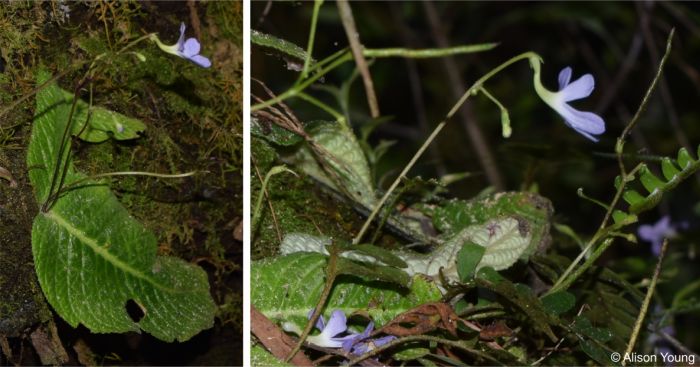
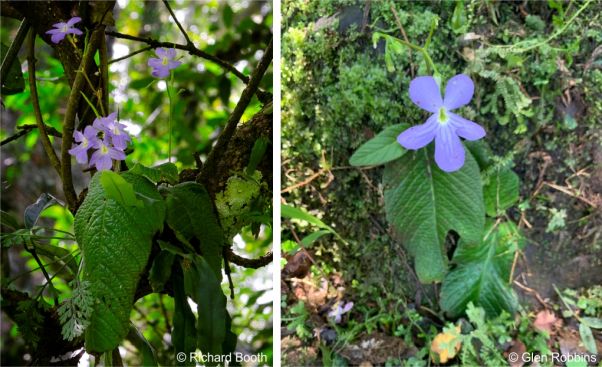
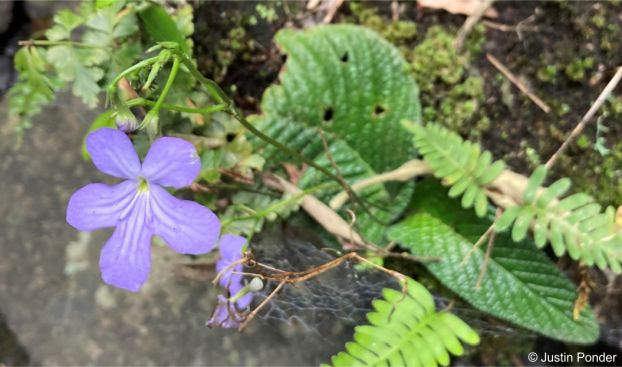
Streptocarpus silvaticus is a small, delicate perennial plant that grows on other plants such as trees (epiphyte) and on rocks (lithophyte), beneath taller vegetation in shaded forest habitats. The plant typically has 2-5 soft, medium to dark-green leaves arranged in an irregular rosette. The leaves are slightly hairy, oval to elliptic, and have gently scalloped (crenate) margins. They usually measure about 120 × 70 mm and display noticeable veins. Like many forest plants, the leaves are adapted to capture the limited sunlight filtering through the forest canopy.
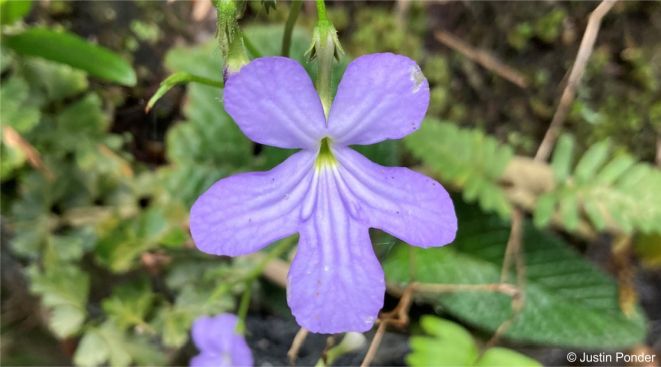
The flowers are borne on slender stalks from the base of the midrib, rising above the leaves and can appear in groups of up to 10 flowers per plant. Each flower has a distinctive S-shaped flower tube and the mouth of the tube is compressed from the sides, which gives it a keyhole-shape. The corolla is about 32 mm long, coloured pale to medium violet, often with a yellow-green throat, and two noticeable ridges (keels) inside the flower tube. The flowers are bilaterally symmetrical, meaning they can be divided into two equal halves along one plane, a characteristic feature of the genus. Flowering occurs in early summer (October to January). When flowering, groups of plants can create striking displays of violet colour in otherwise dark and shaded forest environments. After flowering, the plant produces long, slender seed capsules that twist as they dry.
A distinguishing feature of Streptocarpus silvaticus is the structure of its female reproductive organ (pistil). Unlike the closely related S. prolixus, the stigma of S. silvaticus is positioned at the tip of the pistil, where pollen lands to enable fertilisation.
Conservation Status
Status
Streptocarpus silvaticus is assessed as Least Concern (LC) by the Red List of South African Plants.
Distribution and habitat
Distribution description
Streptocarpus silvaticus occurs naturally in the eastern parts of South Africa and is found in small, scattered populations, making it vulnerable to habitat disturbance. Understanding where the species occurs is important for both conservation and identification. The species is endemic to parts of the Eastern Cape and KwaZulu-Natal, particularly Ngeli Forest in the northern areas of the Eastern Cape and the Greytown region of the KwaZulu-Natal Midlands. It is usually found at altitudes above 900 m above sea level, where cooler and wetter conditions prevail.
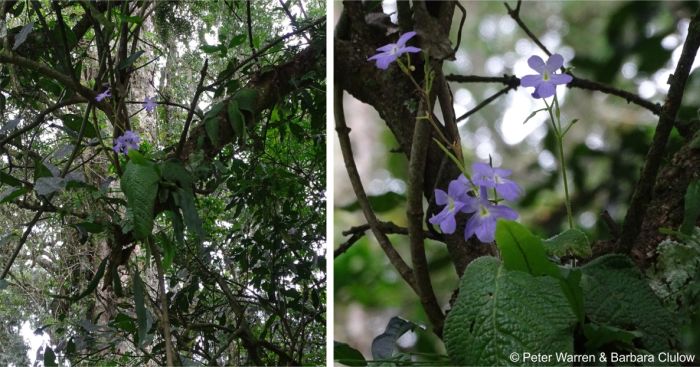
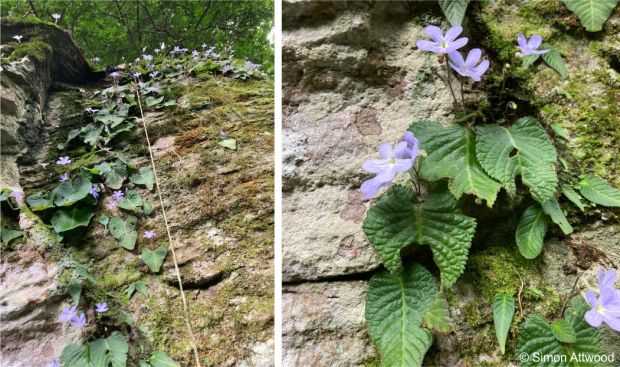
Streptocarpus silvaticus thrives in cool, humid, and shaded environments, especially within subtropical forest regions. It is commonly found growing on shaded rocky slopes, mossy embankments, cliff faces, tree trunks and tree branches in indigenous forest margins and moist forest understories. The plant prefers humus-rich, well-drained soils, where filtered sunlight and high humidity create favourable growing conditions.
Although Streptocarpus silvaticus closely resembles Streptocarpus prolixus, the two species occur in different geographical areas, and their natural distributions do not overlap. This difference in range can help with species identification in the field.
Derivation of name and historical aspects
History
Konrad Gesner, a 16th century Swiss botanist, gave his name to the Gesneriaceae, the family that includes ornamental plants such as African violets and Gloxinia. In South Africa, Streptocarpus is the only naturally occurring genus in this family, with about 51 species known. The genus entered cultivation in 1818 when James Bowie discovered a blue-flowered species near Knysna. Seeds were sent to the Royal Botanic Gardens, Kew, where it flowered in 1827. Initially named Didymocarpus rexii, the species was later reclassified as Streptocarpus rexii, becoming the first formally described species in the genus.
The genus is named for its fruit capsule that twists as it matures, streptos meaning ‘twisted’ and carpos meaning ’fruit’. The species name silvaticus means ‘of the forest’ in Latin, referring to the woodland habitat of Streptocarpus silvaticus, which thrives in cool, shaded forests and is valued for its trumpet-shaped flowers and softly hairy leaves.
Ecology
Ecology
Streptocarpus silvaticus is well adapted to cool, moist forest environments and grows both as an epiphyte (on trees) and a lithophyte (on rocks). It is commonly found on steep, shaded rocky slopes in forests and bushy areas, where moisture levels remain high throughout the year. The species thrives in filtered light beneath the forest canopy, often growing on moss-covered rocks, tree trunks and branches, damp embankments, or among organic matter that accumulates in sheltered crevices. It tends to favour cool, shady areas, particularly on south or southwest-facing slopes, where exposure to harsh sunlight is reduced and humidity is maintained.
The delicate flowers are likely pollinated by small insects attracted to their colour and nectar. Like many species in the genus, Streptocarpus silvaticus can also self-pollinate, although cross-pollination with other Streptocarpus species may occur when plants grow close together. After flowering, the plant produces slender seed capsules filled with numerous tiny seeds. As the capsules dry, they split open and release the seeds, which are dispersed by wind into suitable moist crevices and sheltered spaces where new plants can establish. Its natural habitat provides stable humidity and cooler temperatures, conditions that help protect the soft, delicate leaves from drying out. In the wild, the species often benefits from the shelter of rocks, trees, and leaf litter, which help create the cool and moist microclimate it requires to survive.
Uses
Use
Streptocarpus silvaticus is an attractive indigenous forest plant valued for its pale violet flowers and soft green foliage, making it well suited to shaded gardens, patios, containers, and indoor spaces with filtered light. Its long-lasting flowers can also be used in floral arrangements. In Zulu traditional medicine, Streptocarpus species have been used to ease birthing pains. Although S. silvaticus has limited medicinal or economic importance, it holds significant ornamental and conservation value, particularly in botanical gardens and ex situ conservation of indigenous forest flora.
Growing Streptocarpus silvaticus
Grow
Streptocarpus can be propagated in several ways, including seed, leaf cuttings, division, and stem cuttings. However, most cultivated hybrids and ex-situ conservation collections are propagated vegetatively to ensure that new plants remain identical to the parent and do not lose their genetic integrity. The most common and reliable method of propagation is through leaf cuttings. Healthy, mature leaves are removed and inserted into a moist, well-drained rooting medium, usually a peat or fibre-based mix combined with vermiculite. Leaves may be planted whole or cut lengthwise along the midrib to produce several new plantlets. The lower part of the leaf often roots more vigorously and produces plantlets more quickly. Successful rooting is encouraged by high humidity, bright filtered light, and temperatures of around 20°C. New plantlets usually appear after several weeks and should be gradually hardened off before being transplanted into individual pots.
Mature plants may also be propagated through division, particularly when overcrowded. Each division should include healthy roots and can be replanted into fresh growing medium during the active growing season. The seeds are extremely fine and should be lightly scattered over the surface of a fine sowing medium without being covered. Germination is best under warm, humid conditions with bright, indirect light, and seedlings generally emerge within a few weeks. Under suitable growing conditions, plants may begin flowering within six months.
Streptocarpus silvaticus grows best in conditions that mimic its natural forest habitat. It prefers bright, filtered light, cool temperatures, and high humidity. Direct sunlight, especially during summer, can scorch the delicate leaves and flowers, while insufficient light may reduce flowering and encourage excessive leaf growth. The species performs well in shaded greenhouses, conservatories, patios, or bright indoor spaces, particularly near east- or west-facing windows. The plant grows best at moderate temperatures of around 20°C during active growth. While it can tolerate cool winter conditions indoors, frost should be avoided, as it can damage or kill the plant.
A well-drained potting mix is essential for healthy growth. Because Streptocarpus has a relatively shallow root system, shallow containers are generally better than deep pots. Plants often perform best when slightly root-bound, meaning frequent repotting is unnecessary. Careful watering is important, as overwatering is one of the most common causes of plant loss. The growing medium should remain lightly moist but never waterlogged. During warmer months, watering may need to be more frequent, while less water is required in winter. Allowing the soil to dry slightly between watering is usually safer than keeping it constantly wet.
Regular feeding with a balanced fertiliser high in potassium helps promote flowering without encouraging excessive leafy growth. Feeding can be reduced during winter or slower growth periods. Routine maintenance includes removing spent flowers and old flower stalks to encourage continued blooming and reduce disease problems such as mould. Dead or ageing leaves should also be removed. In mild climates, Streptocarpus silvaticus can be grown outdoors in shaded gardens or protected patios, provided it is sheltered from direct sun, strong wind, and frost.
References
- Attwood, S. 2022-Jan. Observation of Streptocarpus silvaticus. iNaturalist. Online. https://www.inaturalist.org/observations/115441589.
- Booth, R. 2019-Feb. Observation of Streptocarpus silvaticus. iNaturalist. Online. https://www.inaturalist.org/observations/323430302.
- Dibley, R. 2008. Streptocarpus. Dibleys Nurseries, Colwyn Bay.
- Hilliard, O.M. & Burtt, B.L. 1971. Streptocarpus, an African plant study. University of Natal Press, Pietermaritzburg.
- Jackson, W.P.U. 1990. Origins and meanings of names of South African plant genera. University of Cape Town Printing Department, Cape Town.
- Ponder, J. 2021-Nov. Observation of Streptocarpus silvaticus. iNaturalist. Online. https://www.inaturalist.org/observations/102875426.
- Pooley, E. 1998. A field guide to wild flowers of Kwazulu-Natal and the eastern region. Natal Flora Publications Trust, Durban.
- Raimondo, D., Von Staden, L., Foden, W., Victor, J.E., Helme, N.A., Turner, R.C., Kamundi, D.A. & Manyama, P.A. (eds) 2009. Red list of South African plants. Strelitzia 25. South African National Biodiversity Institute, Pretoria.
- Robbins, G. 2024-Nov. Observation of Streptocarpus silvaticus. iNaturalist. Online. https://www.inaturalist.org/observations/252900247.
- Viljoen. C. 2008. Streptocarpus primulifolius Gand. (Gesneriaceae). PlantZAfrica. Online. https://pza.sanbi.org/streptocarpus-primulifolius.
- Warren, P. & Clulow, B. 2019-Feb. Observation of Streptocarpus silvaticus. iNaturalist. Online. https://www.inaturalist.org/observations/20256956.
- Young, A. 2025-Jan. Observation of Streptocarpus silvaticus. iNaturalist. Online. https://www.inaturalist.org/observations/260155944.
Credits
Thamsanqa Msweli and Shane Koorbanally
KwaZulu-Natal National Botanical Garden
June 2026
Acknowledgements: images by Alison Young, Justin Ponder, Peter Warren, Barbara Clulow, Richard Booth, Glen Robbins and Simon Attwood, from their observations on iNaturalist.
Plant Attributes:
Plant Type: Perennial
SA Distribution: Eastern Cape, KwaZulu-Natal
Soil type: Loam
Flowering season: Early Summer
PH: Acid, Neutral
Flower colour: Blue, Mauve/Lilac
Aspect: Shade
Gardening skill: Average
Special Features:
 Good potplant
Horticultural zones


Rate this article
Article well written and informative
Rate this plant
Is this an interesting plant?
Login to add your Comment
Back to topNot registered yet? Click here to register.