


Trianoptiles
Species
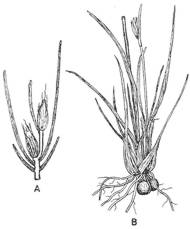
Trianoptiles capensis Harv.
This grass-like annual reaches 250 mm high and many of the aerial inflorescences project beyond the leaves. The greenish aerial spikelets form lax clusters on branches that arise in the axils of leaves. Most of the bisexual spikelets have five bracts and the perianth scale terminates in three bristles. The ovary is not stalked but terminates into a beak at the tip. The smoothly ribbed fruit is divided into three fused parts, the cell outlines clearly visible. The basal fruit is often found away from the central axis of the plant, as it tends to drift by intercalary growth.
T. capensis has a range extending from Ceres to the Cape Peninsula to Knysna.
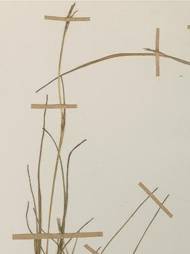
Trianoptiles solitaria (C.B. Clarke) Levyns ( Subterranean Cape sedge)
A tufted annual herbaceous plant growing to 30 cm in height. The leaves arise in dense bunches and are hairless. The ligule (or membranous outgrowth at the junction of the leaf sheath and blade) is absent. The aerial flowering stems are angular to flattened and usually do not project beyond the leaves, often being found to be hidden among the leaves. They arise either singly or in pairs. The greenish spikelet is long and narrow with three bracts. The axis above the first flower is united to the second bract along the majority of its length and the second flower appears superimposed on the first. The perianth scales are linear, hairy and barely longer than the ovary. The two lateral bristles are either absent or reduced.
See more below.

Trianoptiles solitaria (C.B. Clarke) Levyns ( Subterranean Cape sedge)
The ovary is 3-angular with an almost hairless beak-like tip. The fruit is about 2 mm long with a densely pitted surface.
The basal spikelet has an extensive sheathing bract around the style. The fruits ripen in the axils of the leaves close to the stems, unlike T. capensis where some intercalary growth occurs and the fruits ripen away from the main axis of the plant. This gives a superficial resemblance to the genus of fern Isoetes.
See more below.
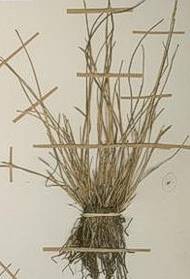
Trianoptiles solitaria (C.B. Clarke) Levyns ( Subterranean Cape sedge)
Interestingly enough, Subterranean Cape sedge is red listed as Critically Endangered in its local habitat, of which only fragments of natural vegetation remain on the Cape Flats, yet it is a declared weed in Australia, where it is on the Federal Government's Alert List for Environmental Weeds that was established in 2001. This is a list of weeds that currently pose more of a threat than a real problem but should be eradicated as they have the potential to cause significant damage.
(http://www.weeds.crc.org.au/documents/wmg_subterranean_cape_sedge.pdf)
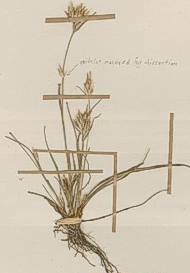
Trianoptiles stipitata Levyns
Reaching 20 cm in height, this species resembles T. capensis in its growth form, although the reproductive stuctures differ slightly. It also differs from T. capensis in that its perianth scales are larger, hairier on the outer surface, and also with a tuft of hairs on the inner surface below the bristles. It has a stalked ovary, and no cell outlines are visible at the intersections of the faces.
The species has scattered collections from the Calvinia District, Vanrhynsdorp, the Cape Peninsula and Bain's Kloof, although these seem to be localised population.
Plant Attributes:
Plant Type:
SA Distribution:
Soil type:
Flowering season:
PH:
Flower colour:
Aspect:
Gardening skill:
Special Features:
Horticultural zones

Rate this article
Article well written and informative
Rate this plant
Is this an interesting plant?
Login to add your Comment
Back to topNot registered yet? Click here to register.