


Polypodiaceae
Plant Attributes:
Plant Type:
SA Distribution:
Soil type:
Flowering season:
PH:
Flower colour:
Aspect:
Gardening skill:
Special Features:
Horticultural zones

Species
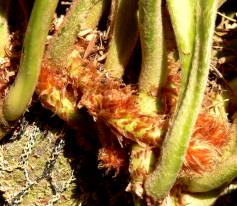
Pyrrosia africana is restricted to the eastern coastal regions of South Africa, extending northwards to southern Mozambique. The specific epithet is therefore somewhat misleading as it suggests the species occurs widely in Africa. Although the species mostly occurs as a low to medium high epiphyte in seasonally moist evergreen coastal forests, it often extends to the KwaZulu-Natal midlands, occurring at an elevation of approximately 700 m. The species also grows on rocks in forests. Pyrrosia africana has a rhizome up to 4 mm in diameter with fronds arranged dorsally on it. The short phyllopodia to which the fronds are attached, are up to 25 mm apart. The rhizome grows on the surface of the growing medium and is initially closely set with reddish brown scales, but soon becomes bare.

The small round sori, up to 2 mm in diameter, occur closely on the upper half of the fronds.
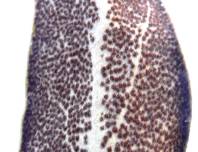
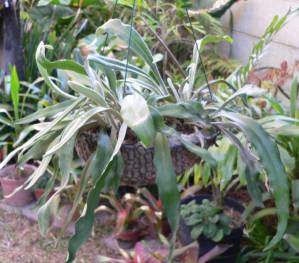
Pyrrosia schimperiana var. schimperiana is widely distributed in the tropical parts of Africa, occurring from West Africa to Ethiopia and southwards to Angola and Zimbabwe. The species has a restricted distribution in South Africa and is confined to the Blyde River Canyon and Mariepskop in Mpumalanga. Although the species also occurs as a low-level epiphyte, it often occurs in rock crevices on exposed and shaded cliffs, but never in deep shade. This species is named after the Strasbourg Professor of Botany, W.P. Schimper (1804-1878), who collected plants in various parts of Africa, particularly Ethiopia.
The rhizome of P. schimperiana grows up to 2 mm in diameter and is also not as widely creeping as that of the former species. The fronds are borne up to 10 mm apart and are firmly herbaceous, but not as leathery as that of the former species.
Both frond surfaces of this species remain densely covered by stellate hairs, giving the plant a greyish colour. The fronds grow up to 180 x 25 mm. The fronds of both species are poikilohydrous (frond turgidity varies in accordance with the available habitat moisture: fronds will roll up when dry and unfold when moisture levels increase).
Plant Attributes:
Plant Type:
SA Distribution:
Soil type:
Flowering season:
PH:
Flower colour:
Aspect:
Gardening skill:
Special Features:
Horticultural zones
Species
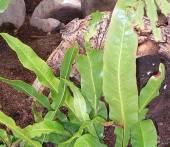
Microsorum pappei (Mett. ex Kuhn) Ching - Pappe's wart fern
The species is named after K.W.L. Pappe, the first colonial botanist at the Cape. The species is rare throughout its distribution, occurring from Madagascar to Tanzania, Mozambique, Zimbabwe and South Africa. In South Africa it is known from only a very restricted area in the KwaZulu-Natal midlands occurring in upland, moist, evergreen forests at about 750 mm above sea level. See more info below.
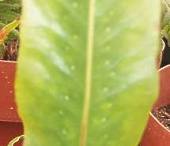
Microsorum pappei (Mett. ex Kuhn) Ching - Pappe's wart fern
Microsorum pappei has a widely creeping rhizome up to 3 mm in diameter with fronds spaced about 30 mm apart. The leaf stalk grows up to 120 mm long, and the glabrous, simple, narrowly elliptic lamina is up to 370 x 80 mm. The circular sori are 1.5 to 2.5 mm in diameter, and occur half-way between the midrib and the margin in one or two rows on either side of the costa.
The species is not available in the trade, but should it become available, it must be grown in light to deep shade in an environment with a high humidity. The species should be grown in a loose, well-drained medium that should always be kept moist.
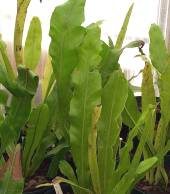
Microsorum punctatum (L.) Copel.-pitted wart fern
The specific epithet punctatum refers to the minutely pitted or dotted nature of the lamina.
Microsorum punctatum is widespread in the Old World, occurring from the Pacific islands, Malesia, tropical Asia and southern China to India , Madagascar and Africa. In Africa it occurs from West Africa through central to tropical East Africa to the east coast of South Africa as far south as Port St Johns. It is a predominantly low-altitude species occurring from near sea level to 1 500 m. The species rarely occurs on the ground, but more frequently in leaf litter and mosses on rocks in the forks of trees, often high above the ground. See more info below.
Microsorum punctatum (L.) Copel.-pitted wart fern
Microsorum punctatum has a short, creeping rhizome up to 4 mm in diameter and is covered with a thick felt of roots. The fronds are short-stalked and up to 10 mm apart. The narrowly elliptic lamina is simple, and up to 1500 x 110 mm. It has a thin leathery texture and is minutely pitted. The sori are about 1 mm in diameter and are irregularly scattered on the undersurface of the lamina.
The species is ideal for cultivation indoors and outdoors provided that it is planted in deep shade, never exposed to direct sunlight and kept moist at all times. An increased humidity will be beneficial. The species is best cultivated in a well-drained humus-rich medium kept moist at all times.
Uses: A tea of the plant is drunk for coughing fits. The leaf sap has also been reported to be used as an enema.
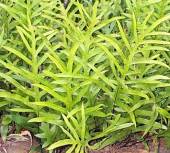
Microsorum scolopendria (Burm.f.) Copel.-embossed fern
The specific epithet scolopendria refers to the scalloped nature of the lamina.
Microsorum scolopendria , formerly known as Phymatodes scolopendria, is widespread in the Old World, occurring from Australia , throughout Polynesia and Asia and extending to Madagascar and Africa. In Africa it occurs from West Africa, throughout tropical Africa to the east coast of South Africa as far south as Port St Johns. In South Africa it mostly occurs in dune forests and dune scrub, near sea level. See more info below.
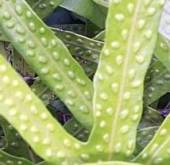
Microsorum scolopendria (Burm.f.) Copel.-embossed fern
Microsorum scolopendria has a widely creeping rhizome up to 10 mm in diameter that mostly occurs on the soil surface. The deeply pinnatifid, leathery fronds, up to 0.9 m long, are widely spaced along the rhizome. The stipe (leaf stalk) is up to 400 mm long. The leaf blade is divided into narrowly oblong lobes, up to 220 x 30 mm. The somewhat sunken sori are round to oval, 2 to 3 mm in diameter and occur in one or two rows on either side of the costa. Adaxially the sori are embossed.
This is a hardy species and easy to cultivate in a wide range of habitats. It is best cultivated outdoors in light shade, but it will also tolerate direct sunlight for part of the day. In older gardens it often establishes on brick or stone walls, or on trees, especially palms. Although it will tolerate short, dry spells it is best cultivated in conditions which remain constantly moist.
Uses: For abscesses, a paste of ground leaves mixed with earth from a wasp's nest is applied. For wounds, leaf pulp is used as a dressing, and for insanity, leaves are ground in water and the liquid drunk.
Plant Attributes:
Plant Type:
SA Distribution:
Soil type:
Flowering season:
PH:
Flower colour:
Aspect:
Gardening skill:
Special Features:
Horticultural zones
Rate this article
Article well written and informative
Rate this plant
Is this an interesting plant?
Login to add your Comment
Back to topNot registered yet? Click here to register.