


Grace, O.M., Klopper, R., Smith, G.F., Crouch, N.R., Figueiredo, E., RØnsted, N.E. & Van Wyk, A.E. 2013. A revised generic classification for Aloe (Xanthorrhoeaceae subfam. Asphodeloideae). Phytotaxa 76,1: 7–14.
Species
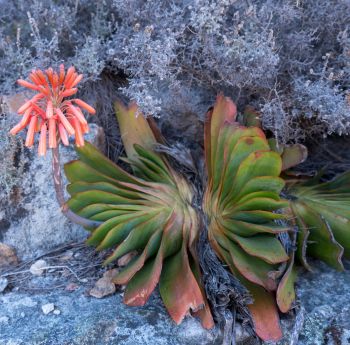
Plants form dense groups of stemless rosettes of up to 0.7 m high. Leaves are strap-shaped with a rounded tip, arranged in a fan, up to 200 mm long, and ± 80 mm wide, with reddish, mostly toothless margins. Orange to scarlet flowers (± 38 mm long) are borne in unbranched inflorescences consisting of head-shaped, rather dense racemes (flower heads) in spring, between September and December, but mainly in October. This species is restricted to high mountain peaks from Stellenbosch to near Ceres, Western Cape, South Africa. It grows on almost inaccessible Table Mountain Sandstone cliffs in the Cape Fold Belt Mountains, in very wet, grassy and rocky places on south- and southeast-facing slopes. The habitat is not warm in summer, but above the snowline in winter and experiences high winter rainfall and significant mist.
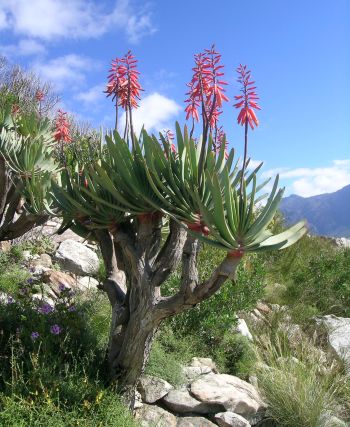
Plants form tall shrubs or small to medium-sized trees with a naked stem of 3–5 m high, which is dichotomously branched (forked) and rebranched. Leaves are strap-shaped with a rounded tip, arranged in a fan, ± 300 mm long, and ± 40 mm wide, with a narrow mostly toothless margin, which does not differ significantly in colour from the rest of the leaf. The leaf sap is clear, but becomes pale yellow and wax-like when dry. Scarlet flowers (up to 55 mm long) are borne in unbranched inflorescences consisting of cone-shaped, lax racemes (flower clusters) in late winter and spring (August to October). This species is restricted to mountainous parts from Franschhoek to Elandskloof, Western Cape, South Africa. It grows on Table Mountain Sandstone substrates in mountainous areas of very high winter rainfall, among Fynbos Heathland, on steep southwest-facing slopes in rocky areas.
Plant Attributes:
Plant Type:
SA Distribution:
Soil type:
Flowering season:
PH:
Flower colour:
Aspect:
Gardening skill:
Special Features:
Horticultural zones

Species

Haworthia arachnoidea (L.) Duval.
Plants form a stemless rosette, with dense, incurving, light to dark green leaves. Rosettes vary between 60–120 mm in diameter and are usually solitary or occasionally forming small clusters. The keel and leaf margins bear long translucent spines that may be soft or become very sharp when dried (as in the var. scabrispina). This species is fairly widespread throughout the western parts of the Northern Cape, the far northern parts and interior of the Western Cape, and as far as Steytlerville and Jansenville in the Eastern Cape, South Africa. It usually grows on southern slopes under the shade of shrubs and other plants in Fynbos vegetation in sandy, acidic, well-drained soil. It often grows in rock crevices or the shelter of boulders. This species has 7 described and currently accepted varieties: var. arachnoidea, var. aranea, var. calitzdorpensis, var. namaquensis, var. nigricans, var. scabrispina and var. setata.

Haworthia bolusii Baker
Plants form a stemless rosette, with dense, incurved, bluish green to bright green leaves. Rosettes vary between 40–150 mm in diameter and are solitary or in small groups. The keel and leaf margins bear long whitish spines. This species is fairly widespread in the Eastern Cape and extends into the Western Cape near Murraysburg, into the Northern Cape to near Victoria West and Hanover, and just into the southern Free State near Aliwal North, South Africa. It grows in rocky places in mountainous habitats, often in the protection of boulders or other plants. This species has 3 described and currently accepted varieties: var. blackbeardiana, var. bolusii and var. pringlei.

Haworthia cooperi Baker
Plants form a stemless rosette, with fairly dense, incurved, bright green, bluish green to pale greyish green, slightly translucent leaves. Rosettes vary between 20–80 mm in diameter and often form small groups. Leaves of some varieties are often very succulent and spineless, but in other varieties there are short soft spines on the keel and margins. This species is fairly widespread in the Eastern Cape as far northeast as King William’s Town and just enters the Western Cape at Nuwekloof, South Africa. It grows on flat areas or rocky slopes in dry open grassland, high-lying sourveld, dry Valley Bushveld and Karroid vegetation types. It often grows in the protection of boulders and other plants, or in exposed positions at the edge of rocky outcrops. This species has 13 described and currently accepted varieties: var. cooperi, var. dielsiana, var. doldii, var. gordoniana, var. gracilis, var. isabellae, var. leightonii, var. picturata, var. pilifera, var. tenera, var. truncata, var. venusta and var. viridis.

Haworthia cymbiformis (Haw.) Duval
A stemless or partially stemmed rosette, with spreading, opaque green leaves that turn yellowish to pinkish when exposed. Rosettes can be 40–80 mm in diameter and usually form small to large groups. Leaves are soft, thick and very succulent. This species is confined to the Eastern Cape, South Africa, between Port Elizabeth in the south and Umtata in the north. It is a very variable species in regard to size, coloration, shape and windows, with many geographical forms that are known. It is commonly known as the cathedral window haworthia for the windowed areas towards the leaf tips. This species has long been known in cultivation and is cultivated widely, and is thus often seen for sale in supermarkets across the world. It grows on cliffs and rock-faces in exposed or shaded positions or in the protection of other plants on dry hilly slopes, often along river courses. This species has 5 described and currently accepted varieties: var. cymbiformis, var. incurvula, var. obtusa, var. ramosa and var. setulifera.

Haworthia decipiens Poelln.
Plants form stemless rosettes, with spreading to incurved, bright green leaves. Rosettes range from 20–100 mm in diameter and are solitary or sometimes in small groups. Leaves are relatively thin, with sparse marginal spines. This species occurs in the Western and Eastern Cape, South Africa, from Merweville in the west to Bosberg and Port Elizabeth in the east. It usually grows in the protection of boulders and low Karoo scrub or in thicket and other plants. This species has 5 described and currently accepted varieties: var. cyanea, var. decipiens, var. minor, var. virella and var. xiphiophylla.

Haworthia marumiana Uitewaal
Plants form a stemless rosette, with spreading to incurved, purplish green leaves. This species is generally highly proliferous filling crevices or forming mounds, with the exception of var. archeri and var. dimorpha that normally remains solitary. Rosettes are up to 70 mm in diameter. Leaves are opaque with a reticulate patterning and with soft spines along the keel and margins. In some forms, like var. dimorpha, leaves may also have pellucid dots towards the leaf tips. This species occurs scattered throughout the Western and Eastern Cape, from Laingsburg in the west to King William’s Town in the east, and just enters the Northern Cape, South Africa, near Merweville. It often grows wedged in soft rock crevices or under other plants, usually on steep slopes in mountainous habitats. This species has 6 described and currently accepted varieties: var. archeri, var. batesiana, var. dimorpha, var. marumiana, var. reddii and var. viridis.

Haworthia mucronata Haw.
Plants form a stemless rosette, with incurved, brilliant green to grey-green or purplish brown leaves. Rosettes are between 60–80(–120) mm in diameter and often form small groups. Leaves are soft and slightly pellucid, often with spines along the translucent keel and margins. This species is restricted to the Western Cape, South Africa, between Montagu in the west and Oudtshoorn in the east. It grows in Karroid and Renosterbos vegetation, often on mountain slopes, in rock crevices or in the protection of other plants. This species has 5 described and currently accepted varieties: var. habdomadis, var. inconfluens, var. morrisiae, var. mucronata and var. rycroftiana.
Plant Attributes:
Plant Type:
SA Distribution:
Soil type:
Flowering season:
PH:
Flower colour:
Aspect:
Gardening skill:
Special Features:
Horticultural zones
Species

Tulista kingiana (Poelln.) Gideon F.Sm. & Molteno (= Haworthia kingiana Poelln.)
Plants form a stemless rosette, with erect to spreading, yellowish green leaves. Rosettes can be up to 180 mm tall, but are usually smaller than this, and occasionally form few-headed clusters. The leaf surface is scabrid (rarely glabrous) with white to concolorous, raised, non-confluent tubercles.
This species has a narrow distribution, restricted to a few scattered populations in the vicinity of Mossel Bay, Hartenbos, Great Brak, and near Herbertsdale in the Western Cape Province, South Africa. Plants are normally found in sandy soils, and either grow exposed in grassy terrain or sheltered beneath larger shrubs on sloped rocky areas.

Tulista marginata (Lam.) G.D.Rowley [= Haworthia marginata (Lam.) Stearn]
Plants form a stemless rosette, with erect to spreading, pale brownish green leaves. Rosettes are up to 200 mm tall, and occasionally form small clusters. The leaf surface is smooth and usually without any tubercles.
This variable species is restricted to the Western Cape, South Africa, from near Ashton and Bredasdorp in the west, to Riversdale in the east. These large plants usually grow exposed on flat to sloped grassy terrain with scattered shrubs.

Tulista minor (Aiton) Gideon F.Sm. & Molteno [= Haworthia minor (Aiton) Duval; H. minima (Aiton) Haw.]
Plants form a stemless rosette, with erect to spreading, light to darker green leaves (only occasionally bluish green). Rosettes are up to 150 mm tall, and occasionally form small clusters. The leaf surface is scabrid with white, raised, flattened, non-confluent tubercles. This species is morphologically variable, with many interesting and distinct geographical forms.
This is the most widespread species in the genus. It is mainly a coastal species, and is known from near Mossel Bay in the east, to Bredasdorp in the west, and to the north of the Langeberg Mountains, Western Cape Province, South Africa. The habitat varies considerably, but it is generally found in grassy vegetation.

Tulista pumila (L.) G.D.Rowley [= Haworthia pumila (L.) Duval; H. margaritifera (L.) Haw.; Haworthia maxima (Haw.) Duval]
Plants form a stemless rosette, with erect to spreading, brownish to olive-green leaves. Rosettes are up to 250 mm tall, and occasionally form small clusters. The leaf surfaces are variably scabrid with white, raised, generally rounded, non-confluent tubercles.
This species has a wide distribution range in the Western Cape, South Africa, and is the only species in the genus that may be locally abundant in some areas. Its main distribution area lies from near Worcester, eastwards to near Laingsburg in the north, and Swellendam in the south. The typical form is found in the Worcester-Robertson Karoo area, whereas some of the outlying populations are morphologically variable.
Plant Attributes:
Plant Type:
SA Distribution:
Soil type:
Flowering season:
PH:
Flower colour:
Aspect:
Gardening skill:
Special Features:
Horticultural zones
Species

Haworthiopsis attenuata (Haw.) G.D.Rowley [= Haworthia attenuata (Haw.) Haw.]
The zebra plant is an attractive rosette-forming plant, with erect to spreading leaves exhibiting an array of different leaf tubercle variation. Plants range from about 50 mm to 100 mm tall and form dense clusters. The white tubercles range from fine to conspicuous tubercles, scattered over the lower leaf surfaces, or forming confluent bands reminiscent of zebra bands, hence its common name.
This species is found widespread in the Eastern Cape, from near the Gamtoos River in the west to the Mbashe River in the east. This species has 2 described varieties, var. glabrata and var. radula.
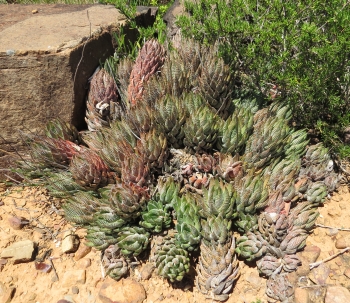
Haworthiopsis coarctata (Haw.) G.D.Rowley (= Haworthia coarctata Haw.)
This stemmed species of Haworthiopsis is easy to grow and makes excellent rock-garden subjects. Plants are stemmed, about 50–200 mm tall, growing longer as the stems become decumbent with age. Plants proliferate from the base and along the stem to form dense clumps. The lower leaf surfaces may be smooth or tuberculate and are clasping, covering most of the length of the stem.
This species is found in the Eastern Cape, from near Port Elizabeth in the west to the Fish River in the east. The generally smaller growing var. adelaidensis has a narrower distribution range.
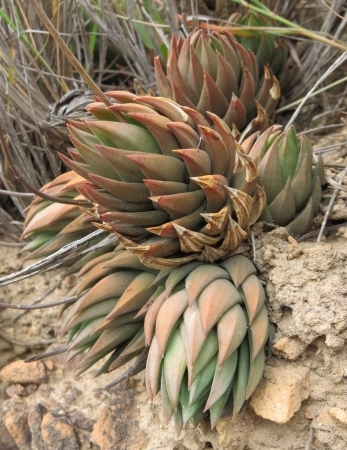
Haworthiopsis glauca (Baker) G.D.Rowley (= Haworthia glauca Baker)
This species is similar in appearance to H. coarctata and H. reinwardtii by sharing the same stemmed growth habit, but differ in having glaucous grey-coloured leaves. In most forms the plants are without distinct white tubercles, however, white tubercles are found on the leaf surfaces in plants of the var. herrei. In this species, plants also proliferate from the base and occasionally along the stem to form clumps, growing up to about 200 mm tall.
This species is found further inland than the above-mentioned and is known from relatively drier areas.
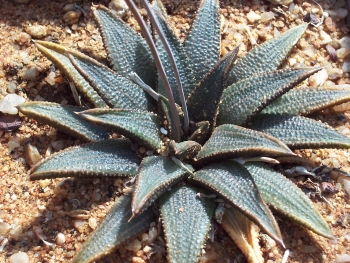
Haworthiopsis koelmaniorum (Oberm. & Hardy) Boatwr. & J.C.Manning (= Haworthia koelmaniorum Oberm. & Hardy)
This is the only species in the genus known to occur in the northern bushveld of Limpopo and extending its distribution into Mpumalanga, where the var. mcmurtyi occurs in grassland. This window-leaved species has star-like rosettes of spreading leaves that grows to about 100 mm in diameter. The var. mcmurtyi is very similar in appearance, but is generally much smaller in size than the typical variety.
Plants are slow-growing and best suited to cultivation in containers, planted in a well-drained medium. Plants rarely produce offsets and it is best propagated from seed or leaves.
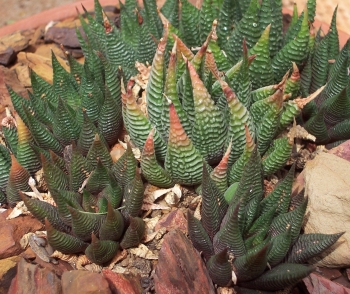
Haworthiopsis limifolia (Marloth) G.D.Rowley (= Haworthia limifolia Marloth)
This species is well suited to rockeries in summer rainfall areas. Plants form attractive rosettes of spiralling leaves, varying from being smooth to tuberculate, often with the tubercles forming confluent bands or ridges.
The only species in the genus known to occur in KwaZulu-Natal; it is also found in Mpumalanga and extending its distribution into Swaziland and possibly Mozambique. This species has become rare in its natural habitat because of over-collection for traditional purposes. Several varieties are recognised: var. arcana, var. gigantea, var. glaucophylla and var. ubomboensis.
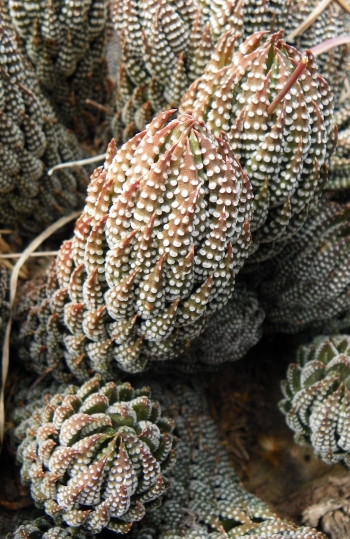
Haworthiopsis reinwardtii (Salm-Dyck) G.D.Rowley (= Haworthia reinwardtii (Salm-Dyck) Haw.)
Plants are stemmed, about 50–150 mm tall, growing longer as the stems become decumbent with age. Plants proliferate from the base and occasionally along the stem to form clumps. This species is similar in appearance to H. coarctata, but has narrower and denser arranged leaves and more conspicuous tuberculation. Lower leaf surfaces are generally densely tuberculate and are clasping, covering most of the length of the stem.
This species is found in the Eastern Cape, from west of the Fish River in the west to near East London in the east. The var. brevicula is generally smaller growing and has denser tooth-like tubercles.
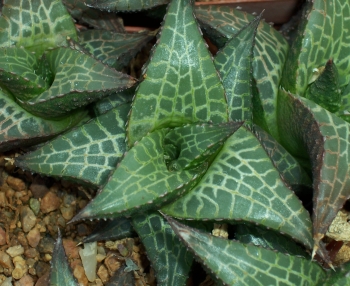
Haworthiopsis tessellata (Haw.) G.D.Rowley (= Haworthia tessellata Haw.)
The species is best suited to containers; it has a highly stoloniferous habit and produce many plantlets to eventually form a dense mat of compact rosettes. The starry rosettes (20–80 mm in diameter) have spreading to recurved leaves, with lines and reticulations, that are windowed on the upper surface.
This species is widespread and is known from the drier interior of South Africa where it is found in the Western Cape, Eastern Cape, Northern Cape, Free State and North-West Provinces. The distribution of this species also extends into Namibia. The var. crousii is similar in appearance to the typical variety, although much more robust and less proliferous.
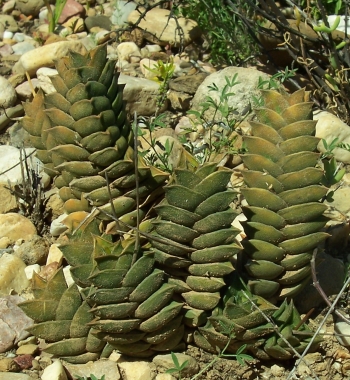
Haworthiopsis viscosa (L.) Gildenh. & Klopper (= Haworthia viscosa (L.) Haw.)
This species has a very interesting distinctly 3-ranked leaf arrangement along the length of the stem. It is a slow growing, hardy species that is best suited to cultivation in containers.
It is found mainly in the Western Cape, but also extends into the Eastern Cape. It can be found at lower altitudes on rocky areas closer to the coast, to further inland at higher altitudes. It is a variable species, both in terms of size, as well as leaf form and colouration.
Plant Attributes:
Plant Type:
SA Distribution:
Soil type:
Flowering season:
PH:
Flower colour:
Aspect:
Gardening skill:
Special Features:
Horticultural zones
Species
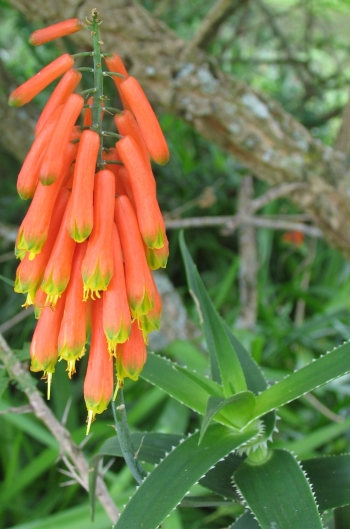
Aloiampelos ciliaris (Haw.) Klopper & Gideon F.Sm. var. ciliaris (= Aloe ciliaris var. ciliaris)
This tangled, climbing shrub has sheathing leaf bases that are collar-like, ciliate (with a fringe of hairs) and auriculate (ear-lobe-shaped). The green leaves are spreading to recurved. Racemes are short, broadly cylindrical and densely flowered. The bright red, cylindrical to slightly curved flowers are ± 30 mm long with pedicels (flower stalks) that can reach a length of 5–8 mm and are present throughout the year. This plant climbs through bushes, shrubs, and trees in bushland, wooded ravines and thickets of the coastal belt, and is always found near the sea in frost free areas. It only occurs in a narrow coastal strip from near Humansdorp to north of the Kei River Mouth, Eastern Cape, South Africa.
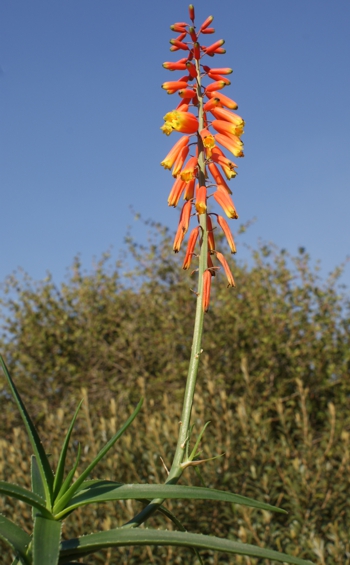
Aloiampelos ciliaris var. redacta (S.Carter) Klopper & Gideon F.Sm. (= Aloe ciliaris var. redacta)
The characters of A. ciliaris var. redacta are intermediate between those of the other 2 varieties of the species. However, it is not considered to be of hybrid origin. This climbing aloe flowers from November to April, and is considered to be Vulnerable (VU). It grows on sand dunes at the forest edge in a small area along the Kei River and around Qolora Mouth, Eastern Cape, South Africa.
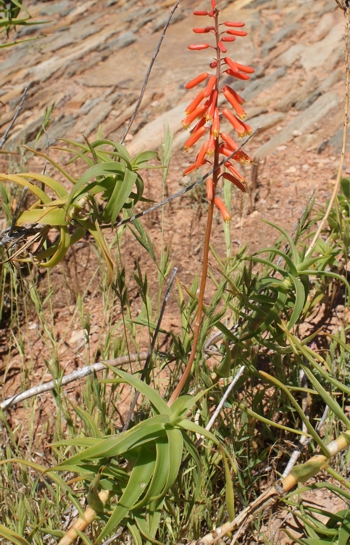
Aloiampelos ciliaris var. tidmarshii (Schonland) Klopper & Gideon F.Sm. (= Aloe ciliaris var. tidmarshii)
A tangled, climbing shrub, where the sheathing portion of the leaf base is only very slightly auriculate (ear-lobe-shaped) and the margin very minutely ciliate (with a fringe of hairs). This variety of A. ciliaris is in all aspects smaller than the typical variety of the species. Racemes are sublaxly flowered and more narrowly cylindrical than those of var. ciliata. The red flowers (16–23 mm long) and pedicels (flower stalks) (4–6 mm long), are also shorter, and present from November to April. This variety grows on stony, clayey soils in relatively dense savanna woodland, at higher altitudes and further from the sea than A. ciliaris var. ciliaris. It is restricted to an inland strip of the Eastern Cape along the Zuurberg range, South Africa, and is endemic to the Albany Centre of Endemism.
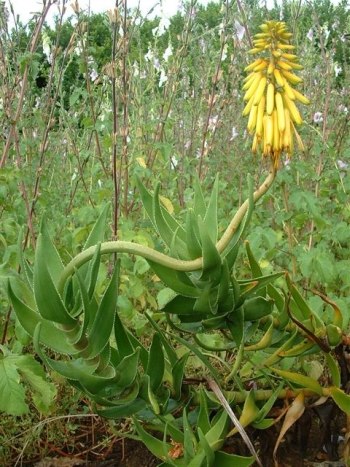
Aloiampelos commixta (A.Berger) Klopper & Gideon F.Sm. (= Aloe commixta)
The dull green leaves, with striatulate sheaths, of this branched, sprawling shrub are borne erectly (usually pointed towards the growing tip), not recurved. The peduncle (inflorescence stalk) is stout (15–17 mm in diameter) and bears a short, almost capitate (head-shaped), rather densely flowered, bicoloured raceme. Flowers are orangey-red in bud, but mature flowers are cylindrical, orange-yellow and 40 mm long, with pedicels (flower stalks) of 3–4 mm long. Plants flower from August to September. This creeping aloe is considered to be Vulnerable (VU) and is restricted to sandstone of the Table Mountain Group, where it grows between rocks and low shrubs in acidic soils, in an area of high winter rainfall, and close to the base of the summer mist belt. It is confined to the Cape Peninsula, Western Cape, South Africa.
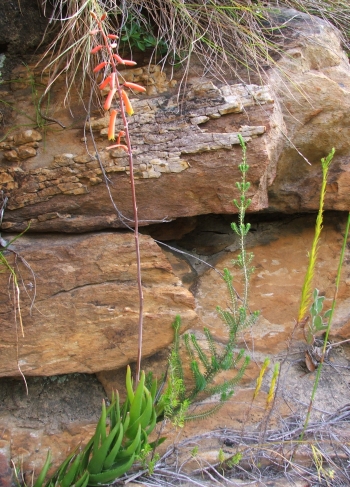
Aloiampelos decumbens (Reynolds) Klopper & Gideon F.Sm. (= Aloe decumbens)
This much-branched shrub has slender stems that are decumbent, but with the foliate portion held erect. The spreading leaves are bright green and faintly striate. The peduncle (inflorescence stalk) is slender (4–5 mm in diameter) bearing a sublaxly flowered cylindrical raceme. The red flowers are 28–33 mm long, cylindrical and slightly curved, with pedicels (flower stalks) of 4–5 mm long. Plants flower throughout the year, but flowering time is mostly between November and January. This species is considered to be Vulnerable (VU) and grows in South Langeberg Sandstone Fynbos on cliffs and steep north- and south-facing slopes, on sandstone of the Table Mountain Group. It is only known from the Langeberg (Riversdale region), Western Cape, South Africa.

Aloiampelos gracilis (Haw.) Klopper & Gideon F.Sm. (= Aloe gracilis)
The only faintly striated leaf sheaths of this much-branched shrub are not auriculate (ear-lobe-shaped) and lack ciliate margins. The dull green leaves are erectly spreading. Red flowers of 40–45 mm long, with pedicels ± 8 mm long, are borne in a laxly flowered, slightly conical (cone-shaped) raceme from May to August. This species grows in the ecotone between forest and fynbos at the eastern limit of the area that receives all season-rainfall. It typically occurs on stony places in thickets, along rocky hillsides and on steep rocky slopes of the coastal plain, or up to the top of the first range of mountains. It is only found in the Port Elizabeth and Joubertina areas, Eastern Cape, South Africa and is, therefore, more or less restricted to the Albany Centre of Endemism.
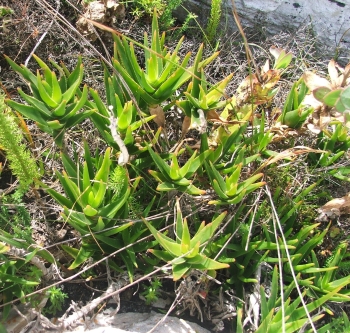
Aloiampelos juddii (Van Jaarsv.) Klopper & Gideon F.Sm. (= Aloe juddii)
This branched shrub has erect to somewhat creeping, densely foliate branches of ascending (upward curving), green leaves. The peduncle (inflorescence stalk) is robust (8–9 mm diameter) and bears sublaxly flowered, cylindrical racemes. Flowers are orange-red, 40 mm long, cylindrical and slightly curved, with 10–12 mm long pedicels (flower stalks). Plants flower in November. This Endangered (EN) species grows on southeast-facing rocky slopes on sandstone of the Table Mountain Group, in Overberg Sandstone Fynbos vegetation. It is thus far only known from the Baardskeerdersbos region east of Gansbaai (Overberg coastal mountains), Western Cape, South Africa.
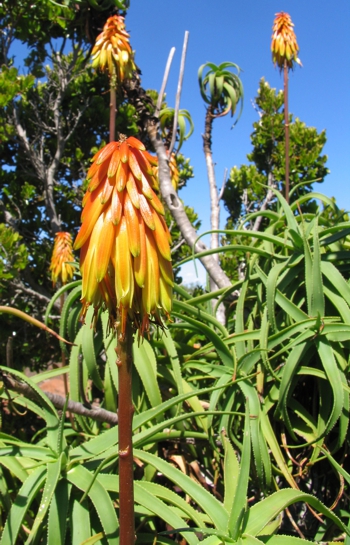
Aloiampelos striatula (Haw.) Klopper & Gideon F.Sm. var. caesia (Reynolds) Klopper & Gideon F.Sm. (= Aloe striatula var. caesia)
This aloe has a rambling growth form. Aloiampelos striatula var. caesia has more spreading, closely packed and more rosulate, shorter, greyish green leaves than A. striatula var. striatula. The leaf sheaths are also shorter and only obscurely lined. Racemes are narrow, cylindrical to cone-shaped, and relatively densely flowered. Flowers are short, straight, yellow, ± 30 mm long, and present from December to January. This rambling aloe grows among rocks on mountain tops within the winter snow belt. It only occurs in the west-central region of the Eastern Cape in the area between Queenstown, Cradock, and Middelburg, South Africa. It is restricted to the Albany Centre of Endemism.
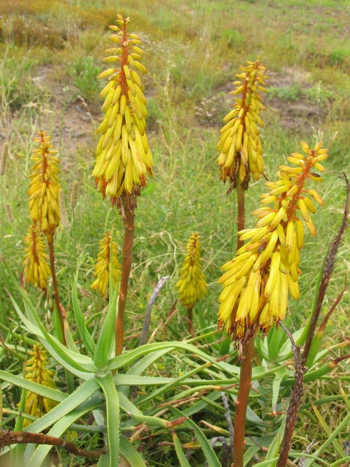
Aloiampelos striatula var. striatula (= Aloe straiatula var. striatula)
This rambling aloe is the most robust member of the genus Aloiampelos. The recurved, shiny, dark green leaves have leaf sheaths that are distinctly longitudinally green-lined. Racemes are cylindrical to cone-shaped and relatively densely flowered. Flowers are slightly curved, reddish orange, 40–45 mm long and clasp the peduncle (inflorescence stalk). Flowering occurs mostly between October and November. This aloe grows among rocks on mountain tops within the winter snow belt in one of the coldest parts of southern Africa. It is distributed in the higher areas of the eastern and northeastern parts of the Eastern Cape, South Africa, and in southern Lesotho, with a disjunct distribution in the southeastern Free State, South Africa and western Lesotho.
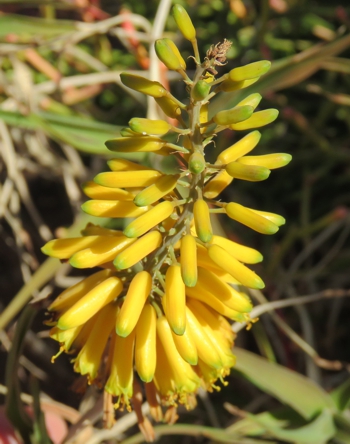
Aloiampelos tenuior (Haw.) Klopper & Gideon F.Sm. (= Aloe tenuior)
The fence aloe forms untidy shrubs, with a large subtuberous to woody rootstock. The erectly spreading leaves are blue-green and the leaf sheaths are not auriculate, but are obscurely lined, and often splits longitudinally. Elongated, rather densely flowered racemes with small, red, orange, or yellow cylindrical, straight flowers are mostly present from October to December. However, the flowering period is variable at different localities and appears to be dependent on rain. Aloiampelos tenuior is a very variable taxon and some of its extreme variants have been described as varieties, but these are generally not upheld. It grows in open country on sandy soil, rarely in valley bushveld, but sometimes on steep slopes. It occurs from the Port Elizabeth and Jansenville areas in the Eastern Cape into southern KwaZulu-Natal, with a disjunct distribution in northern KwaZulu-Natal at the Swaziland and Mpumalanga border, South Africa.
Plant Attributes:
Plant Type:
SA Distribution:
Soil type:
Flowering season:
PH:
Flower colour:
Aspect:
Gardening skill:
Special Features:
Horticultural zones
Plant Attributes:
Plant Type:
SA Distribution:
Soil type:
Flowering season:
PH:
Flower colour:
Aspect:
Gardening skill:
Special Features:
Horticultural zones
Plant Attributes:
Plant Type:
SA Distribution:
Soil type:
Flowering season:
PH:
Flower colour:
Aspect:
Gardening skill:
Special Features:
Horticultural zones
Plant Attributes:
Plant Type:
SA Distribution:
Soil type:
Flowering season:
PH:
Flower colour:
Aspect:
Gardening skill:
Special Features:
Horticultural zones
Rate this article
Article well written and informative
Rate this plant
Is this an interesting plant?
Login to add your Comment
Back to topNot registered yet? Click here to register.