


Trichodiadema stayneri
Introduction
Trichodiadema stayneri is a mat-forming succulent with bright mauve flowers and bristle-tipped leaves. It was presumed to be extinct because it was last recorded in 1960 but was recently rediscovered by Eastern Cape’s Aizoaceae enthusiast and ecologist Mr. Luc Strydom, 60 years later.
Description
Description
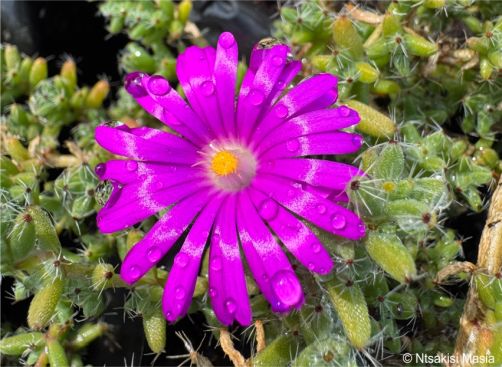
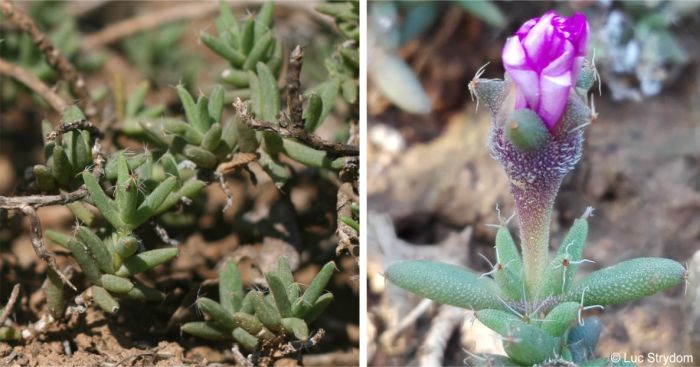
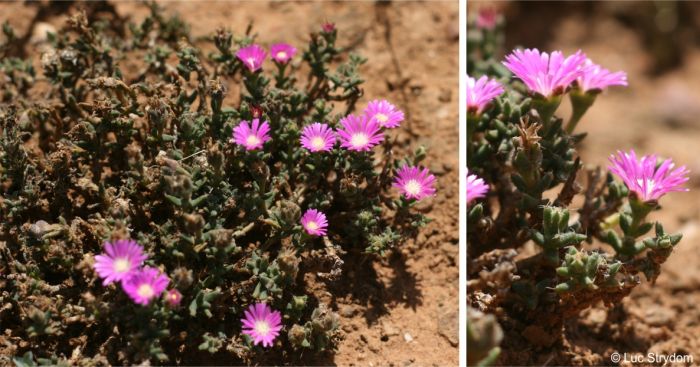
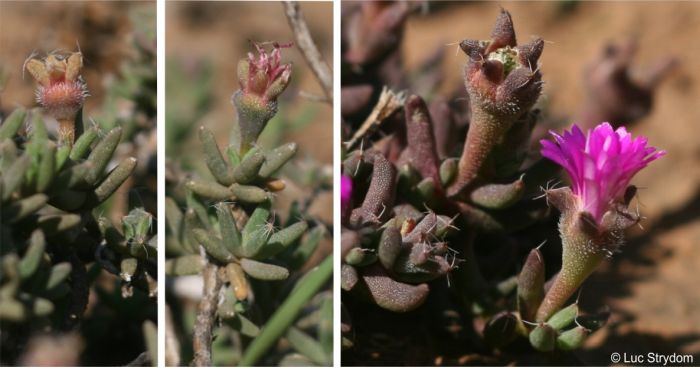
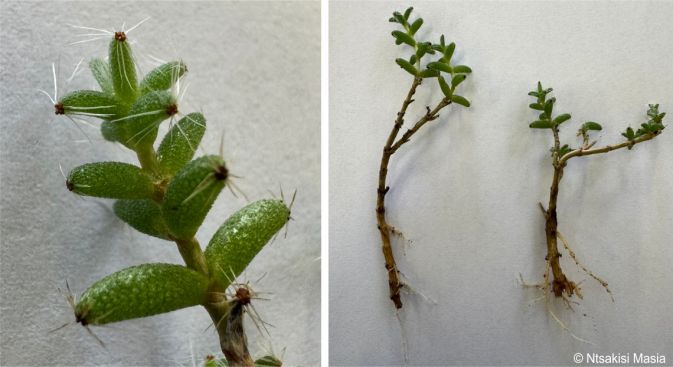
Trichodiadema stayneri is a low-growing, mat-forming, compact succulent shrublet 60 to 150 mm high, with thick and tuberous roots. Leaves are fleshy, almost cylindrical, oblong, 70–110 x 20 mm, tightly packed along the short stems and each tipped with a crown of hard, white hairs. The leaf surface is covered in rounded, cobblestone-like bladder cells, which sometimes disappear with age. The flowers are mauve-magenta, solitary, borne at the tips of the stems, measuring up to 20 mm in diameter. Flowering occurs from early spring to late summer (September to February). The fruit is a capsule, about 5 mm in diameter, enclosing tiny pear-shaped seeds.
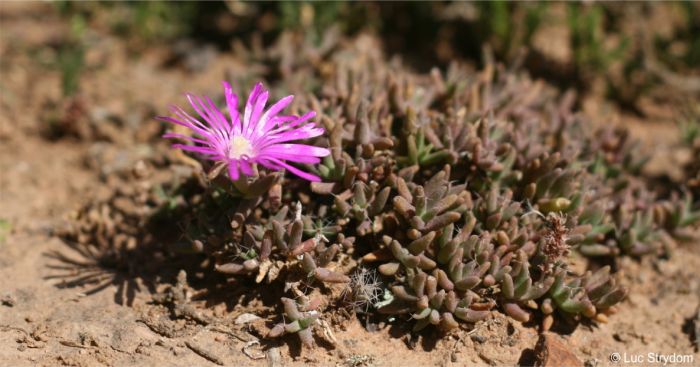
Trichodiadema stayneri can be distinguished from other species in the genus by its leaf tips consisting of a single row of cup cells and having fewer than 10 brittle bristles at the tips of the stems, which break off easily and are often missing from older leaves. Also, the flowers have a single row of magenta petals and the calyx base has some erect hairs which are not dense as in other species.
Conservation Status
Status
Stayner’s diadem vygie was assessed as Critically Endangered Possibly Extinct by the SANBI Red List of South African plants in 2016, because it had not been recorded since 1960. This species was known from one site on the outskirts of Kariega (formerly Uitenhage) which had disappeared due to urban and industrial development. Similar habitat in the area has since been searched, and it has been rediscovered and is thus not extinct, but is still regarded as Critically Endangered until its status is reassessed. The main threat it faces is habitat loss caused by urban and industrial development.
Seeds have been collected by the Millennium Seed Bank Partnership (MSBP) South Africa and banked in the Millennium Seed Bank UK as a back-up and for future restorations. Living collections are curated at Kwelera National Botanical Garden in the Eastern Cape, South Africa.
Distribution and habitat
Distribution description
Trichodiadema stayneri is a South African endemic confined to ancient alluvial plains along the Swartkops and Coega River valleys in the Eastern Cape Province, South Africa, growing in clay-rich soils of Enon and Kirkwood formation geology, where it experiences sporadic rainfall and little to no frost, although most rainfall is experienced in the late summer months.
Derivation of name and historical aspects
History
The name Trichodiadema refers to the small cluster of bristles or hairs borne on the leaf tips of these plants, and is derived from the Greek words trichos, meaning hair, and diadema, meaning crown. This species is named after former Karoo National Botanical Garden Curator and horticulturist, Mr. Frank Stayner (1907–1981) who made a single collection of it in 1960. The species was named and described by Louisa Bolus in 1961. Stayner’s specimen was the only known herbarium specimen of Trichodiadema stayneri until it was rediscovered, 60 years later, by ecologist and Aizoaceae specialist, Mr. Luc Strydom.
The Aizoaceae family, commonly known as vygies in South Africa, consists of 135 genera and approximately 1 800 species. Numerous species of the Aizoaceae family inhabit the Greater Cape Floristic Region, one of the world’s biodiversity hotspots. The genus Trichodiadema is composed of about 32 species which occur in Namibia and the Northern, Western and Eastern Cape Provinces of South Africa. Species in the genusTrichodiadema were included in the genus Mesembryanthemum until the German botanist, Martin Heinrich Gustav Schwantes, moved them into the new genus in 1926. The taxonomic name change was based on a number of morphological features, including the crown of hairs at the tip of each leaf.
Ecology
Ecology
Trichodiadema stayneri is adapted to a summer rainfall climate with little to no frost and sporadic rainfall. The bright pink flowers attract pollinators such as bees, moths and other insects. The capsules are hygrochastic, meaning they open when wet to release seeds. In the wild, seeds get dispersed during the rainy season as the capsules only open when wet. The seed coat is thin to encourage fast germination. The crown of hair on the leaf tips serves as protection against extreme sunlight.
Uses
Use
The tuberous root of several species of Trichodiadema, and possibly also Trichodiadema stayneri, is used by the Xhosa people to make imula which is a prepared yeast used for making bread, beer and most notably iqilika (honey beer). Similarly, the Afrikaans name kareemoer also refers to the use of these plants by Khoe people as a yeast to make honey beer. Trichodiadema stayneri does well as a pot plant and may be suitable to be trained as bonsai subject.
Growing Trichodiadema stayneri
Grow
Trichodiadema stayneri can be easily grown from stem cuttings and seeds, however, cuttings are most preferred as rooting is almost guaranteed at optimum conditions. Source cuttings from healthy plants in active growth. Take 5–7 cm long cuttings, remove the lower leaves and plant the stems in a well-drained sandy mixture, preferably 2 parts river sand and 1 part garden loam or 2 parts perlite and 1 part peat. Keep the cuttings moist and in a warm area away from direct sunlight until rooting is observed. Rooting takes place in two weeks. Transplant the rooted plants into individual nursery pots or bags in a sandy soil mix. Water twice a week, giving moderate amounts of water.
Trichodiadema stayneri has not yet been propagated from seed in Kwelera National Botanical Garden, however, the seeds of Trichodiadema species can be sown in autumn between April and May, in a soil mix of 2 parts fine river sand and 1 part potting soil. Spread the seeds on top of the soil in shallow seed trays filled with the sandy mix and cover the seeds with a thin layer of the sandy mix. Place the trays in a warm area away from direct sunlight. Water with a fine nozzle spray every second say. Germination takes place within 2 weeks.
Stayner’s diadem vygie is well-suited for gardens that experience hot summers and sporadic rainfall throughout the year. It can be planted as a ground cover to control erosion in a waterwise succulent garden, in a sunny position and could also be suitable as a container and bonsai subject.
References
- Chesselet, P. 2004. Mesembryanthemaceae (Aizoaceae) Class: Dicotyledonae (Angiosperms) Order: Caryophyllales. PlantZAfrica. Online. https://pza.sanbi.org/mesembryanthemaceae.
- Environmental and Social Advisory Services. Trichodiadema stayneri recently recorded. https://www.cesnet.co.za/publications/trichodiadema-stayneri-was-recently-recorded-by-environmental-consultant-and-botanist-luc-strydom. Accessed 6/11/2025.
- Goldblatt, P. & Manning, J. 2000. Cape Plants. A conspectus of the Cape flora of South Africa. Strelitzia 9. National Botanical Institute, Pretoria & Missouri Botanical Garden, Missouri.
- Smith, C.A. 1966. Common names of South African plants. Memoirs of the Botanical Survey of South Africa No. 35. Government Printer, Pretoria.
- Strydom, L. 2025. Observations of Trichodiadema stayneri. iNaturalist. Online. https://www.inaturalist.org/observations?iconic_taxa=Plantae&taxon_id=595674&user_id=lucstrydom&verifiable=any.
- Strydom, L. 2023. Yesterday, today and tomorrow? Veld & Flora 103(2):36-41. Available at https://www.cesnet.co.za/assets/publications/Veld-Flora-Reduced.pdf.
- Sukhorukov, A., Nilova, M., Kushunina, M., Mazei, Y. & Klak, C. 2023. Evolution of seed characters and of dispersal modes in Aizoaceae. Frontiers in Plant Science 14: 1-28. 10.3389/fpls.2023.1140069.
- Tyambetyu, O. 2010. Trichodiadema pygmaeum L.Bolus. PlantZAfrica. Online. https://pza.sanbi.org/trichodiadema-pygmaeum.
- Von Staden, L. 2016. Trichodiadema stayneri L.Bolus (Aizoaceae). National Assessment: Red List of South African Plants version 2024.1. https://redlist.sanbi.org/species.php?species=165-38.
Credits
Ntsakisi Masia
Kwelera National Botanical Garden
December 2025
Acknowledgments: the author extends gratitude to Mr Luc Strydom for providing information about the species and availing images on iNaturalist.
Plant Attributes:
Plant Type: Shrub, Succulent
SA Distribution: Eastern Cape
Soil type: Sandy, Clay, Loam
Flowering season: Spring, Early Summer, Late Summer
PH: Acid
Flower colour: Pink, Mauve/Lilac
Aspect: Full Sun
Gardening skill: Easy
Special Features:
 Drought resistant
 Good potplant
 Useful plant
 Feeds honeybees
Horticultural zones


Rate this article
Article well written and informative
Rate this plant
Is this an interesting plant?
Login to add your Comment
Back to topNot registered yet? Click here to register.