


Tulbaghia siebertii
Introduction
Tulbaghia siebertii is a small, threatened, deciduous geophyte with starry and bell-shaped white to pink flowers in summer, and delicate leaves with an aromatic alliaceous scent, found growing in shallow ground on the edges of rock sheets in seeps, high in the mountains of Limpopo and Mpumalanga.
Description
Description
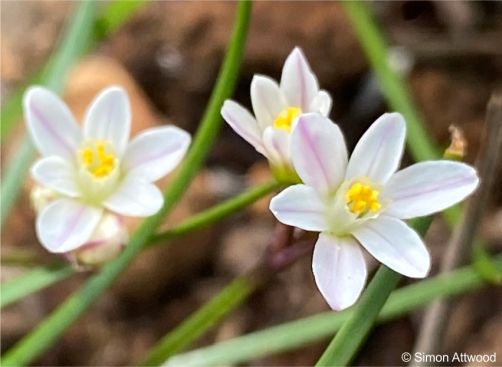
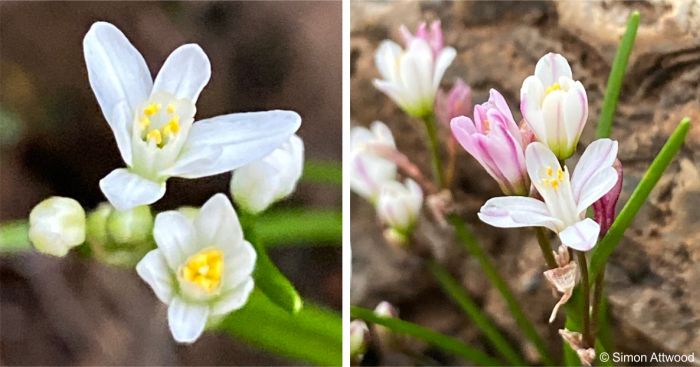
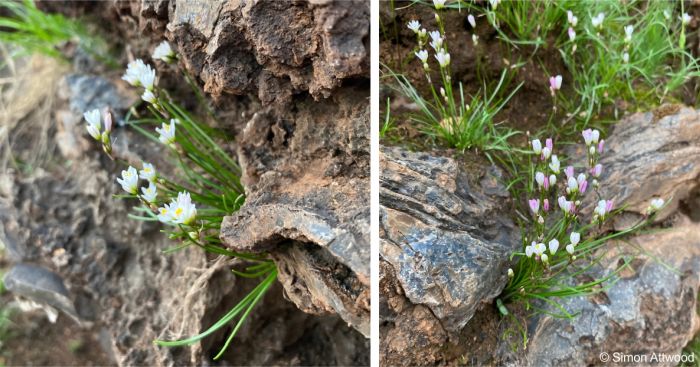
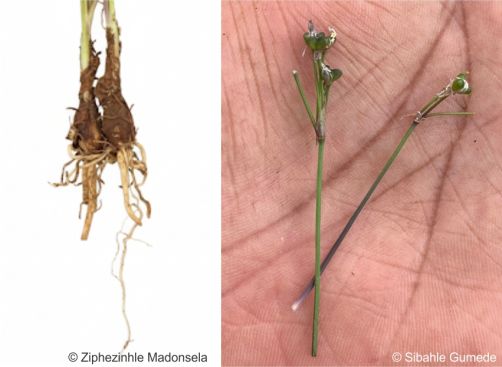
Tulbaghia siebertii is a small plant, 50–150 mm tall, and has a small corm-like rhizome, about 15 x 20 mm, with a few semi-succulent roots. Each plant has 3 to 6 delicate leaves that are shiny and light to dark green, with curled tips that are dark brown to black when dried. The leaves are erect to spreading. There are 2 modified leaves that are purplish brown supporting the flowers. The flower stalk is thin and shorter than leaves. It is whitish green at the bottom and greenish purple as it goes up, and bears 2 to 4 upward-facing flowers. Flowers are 5–7 mm long, starry, bell-shaped, unscented, and bisexual. The flowers last for a day. In the morning when they open up, they show white tepals, the outer tepals flare outward, and have a longitudinal pale pink to purple midline. Each tepal is 4 mm long and about 2 mm wide on the upper third. As the flower gets old they close and turn pinkish to purple. The corona is cylindrical and made up of 6 cylindrical filaments forming a small crown-like shape known as a pseudo-corona. The anthers (male part) are bright yellow, attached to the tip of a thread-like filament. The stigma (female part) is rounded and bears small rounded raised bumps on the surface (papillate), and extends beyond the anthers. The positioning of the anthers and stigma suggests that it is pollinated by insects. The ovary is shiny green, and develops into a fruit that is 3-chambered, resembling a bishop’s hat (mitriform). The dry perianth remains at the base. When the fruit capsule ripens it becomes dry and splits open, to reveal 2 mm long, elongated triangular, black seeds in each of the chambers.
Conservation Status
Status
Tulbaghia siebertii is assessed as Endangered (EN) by the Red List of South African Plants. It was initially assessed as Critically Endangered, but was then re-assessed as Endangered after a population assessment and count that was conducted in 2008, where it met the IUCN Red List criteria for an Endangered species. The populations in Limpopo are threatened by ongoing habitat loss and degradation due to overgrazing and construction of roads, and one of the subpopulations is threatened by mining. In Mpumalanga the only known population is threatened by illegal mining taking place in the area where it is growing.
Distribution and habitat
Distribution description
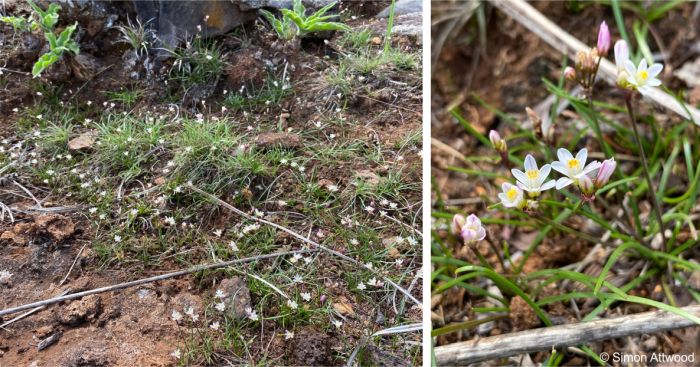
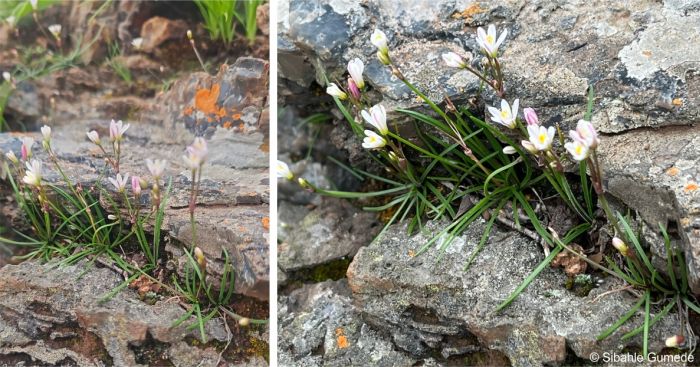
Tulbaghia siebertii is known to be highly localized, it has a small natural range and is adapted to and only occurs in a particular habitat. It is only known to be growing in 2 localities occurring on Leolo Mountain in Sekhukhune, Limpopo province, and one subpopulation in Pilgrims Rest, Mpumalanga. In both localities it is found in high altitude grassland. In Limpopo it is found growing in mineral-rich habitat, on the edges of norite rock sheets in clay soil. The population observed in Mpumalanga grows on dolomite rock sheets with a bit of clay soil. In its natural habitat in Limpopo, it grows together with species such as Crassula alba, Coleus neochilus and Xerophyta viscosa, while in Mpumalanga it grows with similar plants such as Merwilla plumbea, Coleus hadiensis and Xerophyta retinervis.
Derivation of name and historical aspects
History
The genus Tulbaghia is named after Ryk Tulbagh who was a Governor of the Cape of Good Hope from 1757 to 1771. Tulbaghia is one of more than 200 species he sent to Linnaeus, and this genus was described from the material that he had sent in 1769.
This species is named after Professor Stefan Siebert who collected the holotype specimen with Professor A.E. van Wyk in Sekhukhune, one of the centres of plant endemism in South Africa, during a floristic ecological survey. The reference specimen was collected in 1999 and was kept it the herbarium at the University of Pretoria until 2007, when it was first described by Canio Giuseppe Vosa as a new species. It was originally placed in the monotypic genus, Prototulbaghia and was named Prototulbaghia siebertii. The name Prototulbaghia is derived from the Greek word proto meaning first, combined with Tulbaghia, because it was thought to be a forerunner of Tulbaghia, bearing similarities to both Tulbaghia and Allium. The distinctive features of Prototulbaghia when compared to Tulbaghia are the pseudo-corona formed by staminal filaments and the hooked leaf. Other notable unusual differences when comparing it with Tulbaghia include its small size, rhizome that is corm-like, narrow almost cylindrical leaves and growth form that is different from most of the known Tulbaghia species. In 2016, this species was reclassified as Tulbaghia siebertii following a phylogenetic analysis that was done using plastid and nuclear DNA sequences, which confirmed its close relationship with the genus Tulbaghia.
Tulbaghia was included under the family Alliaceae with Allium. The Alliaceae family is now regarded as a subfamily of the Amaryllidaceae family.
Ecology
Ecology
Tulbaghia siebertii naturally grows at high altitude, it is able to survive strong winds and other adverse conditions including growing between sheet of bedrock. It survives drought and dry months by storing water in its small underground corm-like rhizome and semi succulent roots. In its natural habitat it grows amongst species in the family Lamiaceae that are known for emitting a pungent smell that repels pests.
Uses
Use
There are no recorded medicinal or cultural uses for Tulbaghia siebertii. This small plant species has appealing flowers that exhibit various colours and the leaves have a sweet aromatic smell. It is an ideal plant for rocky gardens and for small pots that can be grown in bright light indoors.
Growing Tulbaghia siebertii
Grow
Tulbaghia siebertii grows in the summer-rainfall region and prefers full sun to partial shade and a cool climate. Although it grows naturally in a region that experiences hot weather, because it is a high altitude plant, it requires the coolness that is provided by the altitude and frequent mist in its natural habitat.
In cultivation moderate watering is required, especially in the warm months when the plant is actively growing, but watering should be reduced when it enters dormancy. Overwatering can lead to damp conditions which can cause pest infestations such as slugs which are able to resist the strong scent, and fungal diseases relating to dampness.
Tulbaghia siebertii can be propagated both sexually and asexually.
Sexually, seeds of Tulbaghia siebertii can be collected in summer (December and January) once the capsules have turned from green to cream or whitish which shows they have dried. Seeds can be sown immediately after they are collected. Seeds should be sown in a growth medium that has good nutrient-content and good drainage, such as one consisting of a mixture of 2 parts of potting mixture and 1 part of river sand. Seeds take about 3 weeks to germinate. The seeds that are dispersed in the pots that plants are growing in germinate without any difficulty. The first germination shoot starts coiled and straightens up to form a new plant.
Asexually, this plant can be propagated by division. Bigger clumps can be divided into individual plants, it is important that extra caution is taken not to damage the bulb, especially the young and newly formed bulbs. Division is best done in spring when new growth commences. The divided individual plants can be transplanted to individual pots or bags.
References
- Attwood, S. 2024. Observations of Tulbaghia siebertii, Mpumalanga. iNaturalist. Online. https://www.inaturalist.org/observations/252612683 & https://www.inaturalist.org/observations/252703436.
- Grokipedia. Tulbaghia siebertii. https://grokipedia.com/page/tulbaghia_siebertii. Accessed 13/02/2026.
- Gumede, S. 2025. Observation of Tulbaghia siebertii, Thaba Chweu, Ehlanzeni, Mpumalanga. iNaturalist. Online. https://www.inaturalist.org/observations/326372501.
- iNaturalist. Wild Garlics (Genus Tulbaghia). https://www.inaturalist.org/taxa/119384–tulbaghia. Accessed on 15/02/2026.
- Operation Wildflower. Prototulbaghia siebertii. https://operationwildflower.net/index.php/albums/30-types/2-Bulbs/1185-prototulbaghia-siebertii-1185. Accessed 16/02/2026.
- Plants of the World online. Tulbaghia siebertii (Vosa) Mich.Moller & G.I.Stafford. https://powo.science.kew.org/taxon/urn:lsid:ipni.org:names:77155386-1. Accessed on 13/02/2026.
- Siebert, S.J. & von Staden, L. 2013. Tulbaghia siebertii (Vosa) Mich.Moller & G.I.Stafford. National Assessment: Red List of South African Plants version 2024.1. Accessed on 23/11/2025.
- Stafford, G.I., et al. 2016. The first phylogenetic hypothesis for the southern African endemic genus Tulbaghia (Amaryllidaceae, Allioideae) based on plastid and nuclear DNA sequences. Botanical Journal of the Linnean Society 181: 156–170.
- Struwig, M., Siebert, S.J., Andriessen, M. & Jordaan, A. 2016. Pollen morphology and folding of Prototulbaghia Vosa (Amaryllidaceae), South Africa. Botany Letters 163(1):41-46.
- Vosa, C., Siebert, S. & Van Wyk, B. 2011. Micromorphology and cytology of Prototulbaghia siebertii, with notes on its taxonomic significance. Bothalia 41(2):311-314.
- Vosa, C.G., Van Wyk, A.E., Siebert, S.J. & Condy, G. 2011. Prototulbaghia siebertii (Alliaceae). Flowering Plants of Africa 62:22–28.
Credits
Ziphezinhle Madonsela
Lowveld National Botanical Garden
March 2026
Acknowledgements: the author thanks Simon Attwood for providing images, location and knowledge for this article, and Sibahle Gumede for images taken during field work.
Plant Attributes:
Plant Type: Bulb
SA Distribution: Limpopo, Mpumalanga
Soil type: Clay, Loam
Flowering season: Spring, Early Summer, Late Summer
PH:
Flower colour: White, Pink
Aspect: Full Sun, Morning Sun (Semi Shade), Afternoon Sun (Semi Shade)
Gardening skill: Easy
Special Features:
 Attracts butterflies
 Drought resistant
 Fragrant
 Good potplant
Horticultural zones




Rate this article
Article well written and informative
Rate this plant
Is this an interesting plant?
Login to add your Comment
Back to topNot registered yet? Click here to register.