


Crassula perforata subsp. kougaensis
Introduction
Crassula perforata subsp. kougaensis is a dwarf cliff-hanger, with pendent branches densely covered in leaves and forming a 4-angled cylindrical body bearing an elongated to rounded inflorescence of yellowish flowers in midsummer. Easily propagated from stem cuttings, and best grown in containers.
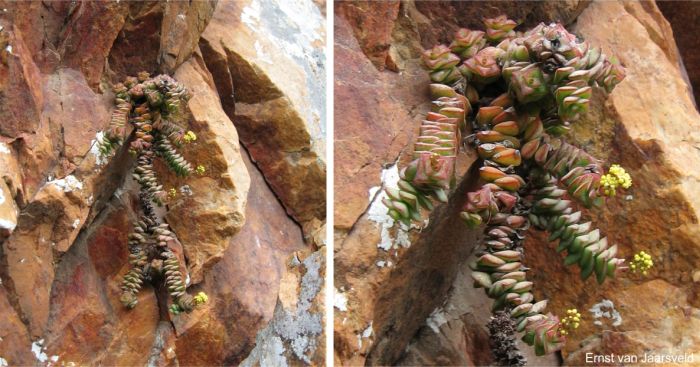
Fig. 1. A close-up of a Crassula perforata subsp. kougaensis, plant in flower, growing on an exposed, north-facing, quarzitic sandstone cliff at the Kouga Dam, Eastern Cape, December 2006.
Description
Description
The plants are dwarf, sparsely to moderately to densely branched, slow-growing, cliff-hanger shrublets, 80–150 × 40–80 mm. It has fibrous roots. The branches are flaccid, leafy, pendent, 0.8 mm in diameter (usually not visible owing to crowded leaves), grey; younger branches purplish, succulent. The young plants are cliff-hugging at first and becoming pendent with age. The leaves grow in opposite pairs (decussate), they are persistent, egg-shaped (ovate) to broadly egg-shaped 8–10 × 8–10 mm, fused at base, closely clasping around stem, forming a 4-angled column; blade 3–7 × 2.5–6.0 mm, boat-shaped (cymbiform) and keeled towards the tip. The leaf surface is smooth, grey- to bluish-green, becoming yellowish to reddish towards the base, with a waxy layer. The upper surface flattened to convex, the lower surface is rounded (convex). The leaf margin is entire, purplish red with excreting glands (hydathodes) along its margin, 0.4 mm apart, ending in a point; apices acute. The older leaves wither but remain on the stems. The inflorescence consists of an elongated to rounded thyrse, 6–10 mm in diameter, the peduncle curved, up to 5–8 mm long, with clasping bracts 1.0–1.5 mm long, amplexicaul at base. The calyx lobes triangular 0.5 × 0.4 mm long. The small flowers (corolla) 3.5 mm in diameter, tubular, pale yellow and the lobes are oblong, 2 × 1 mm long and shortly fused at base. The stamens are 1.75 mm long, the anthers versatile, 0.5 mm long, yellow. The nectary glands (squamae) are rectangular, 0.25 mm long. The fruiting follicles 1.5 mm long, tapering. The seed is pear-shaped, 0.25 × 0.20 mm with a rough surface. The plants flower from midsummer summer to autumn (January–May).
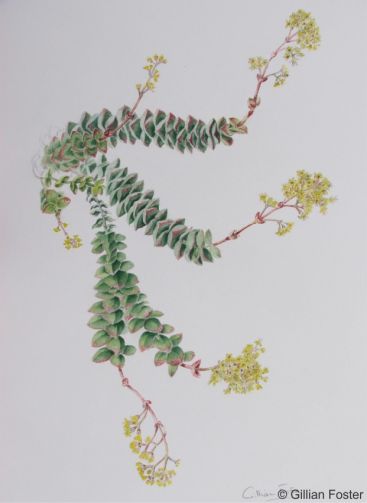
Fig. 2. Crassula perforata subsp. kougaensis illustrated by the British botanical artist Gillian Forster, from plants collected at the Kouga Dam in 2006.
Conservation Status
Status
Assessed as Least Concern (LC) by the Red List of South African Plants, it is widespread and not threatened. The plants are also safeguarded by their difficult to reach habitat and its distribution falls within a greater conservation region.
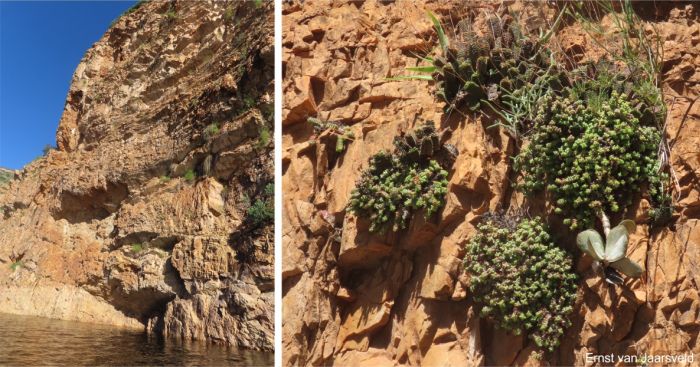
Fig. 3. Left – The exposed north-facing sandstone cliff face at Kouga Dam, habitat of Crassula perforata subsp. kougaensis. Right – Dense clusters of Crassula perforata subsp. kougaensis growing on a ledge at Kouga Dam, with Adromischus sphenophyllus, Crassula muscosa, Bulbine latifolia, Centella virgata and Haworthiopsis viscosa, after rain, April 2024.
Distribution and habitat
Distribution description
Crassula perforata subsp. kougaensis was first discovered on sheer, mineral-poor, usually exposed, north- and west-facing quarzitic sandstone cliffs along the eastern Kouga River (tributary of the Gamtoos River) in the Eastern Cape, South Africa. They have been recorded at altitudes up to 700 m above sea level. They have since been found on cliffs across the Kouga and Outeniqua Mountains.
Plants grow firmly rooted in crevices (often very small hairline cracks) or ledges, solitary, or in groups, sharing their habitat (socially) with other cliff-dwelling succulents. The geology consists of quarzitic sandstone of the Peninsula Formation (Cape Supergroup).
The climate is semi-arid, warm to hot in summer when temperatures can reach 40°C. The average daily maximum temperature is about 23–25°C and the average daily minimum for the region 10–12°C. Winters are cooler but frost is absent. Rainfall is in winter and summer, ranging from 300–400 mm per annum in the form of cyclonic winter rain or thunder showers.
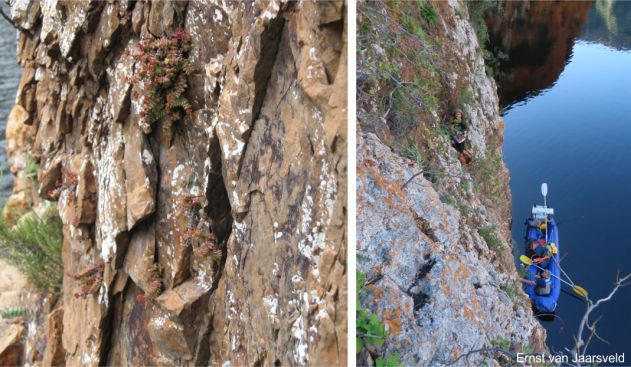
Fig. 4. Left – Plants of Crassula perforata subsp. kougaensis in habitat, growing on the sunny, exposed, mineral-poor, quarzitic sandstone cliff at Kouga Dam, among white lichens. Right – The north-facing cliffs at Kouga Dam are reached by rubber canoe, Cornell Beukes here on the cliff looking at Crassula perforata subsp. kougaensis in habitat, and Tiaan Combrink in the canoe, April 2024
The associated vegetation is named as Groot Thicket (AT3), part of the thicket biome.
At the Kouga Dam plants grow in association with other plants including Adromischus cristatus subsp. schonlandii, Aloe pictifolia, Centella virgata, Curio ficoides, Delosperma stenandrum, Cyrtanthus labiatus, Cotyledon tomentosa var tomentosa, Adromischus sphenophyllus, Coleus subspicatus, Crassula muscosa, Crassula perfoliata var. minor, Ceropegia baylisii (= Tromotriche baylissii), Haworthiopsis viscosa and various species of lichen.
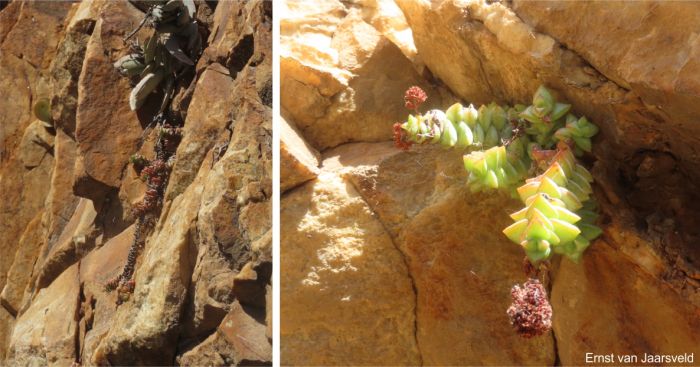
Fig. 5. Left – Crassula perforata subsp. kougaensis plant growing on a north-facing exposed cliff at the Kouga Dam with Crassula perfoliata var. minor. Right – A young Crassula perforata subsp. kougaensis plant in fruit growing on a ledge at the Kouga Dam.
Derivation of name and historical aspects
History
Crassula perforata subsp. kougaensis was named by Braam van Wyk and the author in 2009 in the journal Aloe from plants collected on an earlier expedition to Kouga Dam in April 1989, with Elaine Campher (NBG 510/89). The subspecific name kougaensis pertains to the Kouga River, habitat of this species. The species name perforata pertains to the perforated appearance of the stem running through the fused leaf pairs. The Afrikaans name sosatieplakkie or inrygertjie is appropriate as a sotatie, also known as a kebab and plakkie meaning a member of the crassula family. The name inrygertjie means ‘to thread in’, pertaining to the threaded appearance of the leaves. Since the first visit in 1989, many succulent plants new to science from this dam have been named and with at least 8 species endemic to the Kouga River and Dam. These plants can only be reached by boat and rock climbing.
Crassula perforata subsp. kougaensis belongs to section Perfilatae to which 7 species belong. These include: Crassula badspoortensis, C. fusca, C. macowaniana, C. perforata, C. sladenii, C. rupestris and C. brevifolia. Adrian Haworth, British succulent botanist, created this section in 1828 to accommodate the species with woody stems and leaves with obvolute vernation and a stalked inflorescence, and small tubular flowers. Plants in section Perfilatae are popular among succulent enthusiasts due to the ornamental appeal of their leaves. Of these species Crassula badspoortensis, C. sladenii, C. rupestris subsp. marnierana and C. perforata subsp. kougaensis are mostly obligatory cliff-dwellers.
Crassula perforata subsp. kougaensis is immediately distinguished from subsp. perforata by its dwarf stature, flexible and drooping stems of which the internodes are about 2 mm apart, tightly packed 4-ranked leaves forming a rectangular oblong body, and short rounded to elongate inflorescence (thyrse). In its habitat at the Kouga Dam, the two subspecies share their habitat (sympatric). However, no intermediates or hybrids have been observed. When grown in cultivation, plants retain their dwarf size. The Crassula perforata subsp. perforata is usually a much larger plant, about 600 mm tall, with woody stems, growing on the lower slopes.
Crassula perforata subsp. kougaensis can also perhaps be confused with C. rupestris subsp. marnierana another obligatory cliff-dweller from the Klein Karoo. The latter also with tightly packed leaves, however, the rounded inflorescence (thyrse) of larger white flowers and spreading pair of bracts immediately separates it from C. perforata subsp. kougaensis.
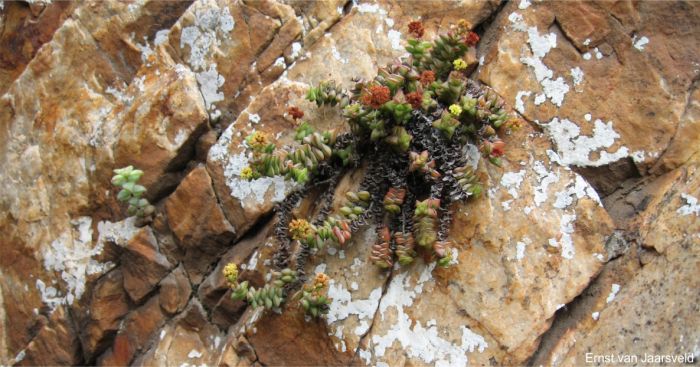
Fig. 6. A cluster of Crassula perforata subsp. kougaensis in flower and fruit, growing on a ledge at Kouga Dam, Eastern Cape.
Ecology
Ecology
Plants are slow growing, and long-lived perennials. This slow conservative growth can also be viewed as an adaptation to the mineral-poor quarzitic sandstone soil. The young seedlings usually grow solitary, starting of as a cliff squatter, but as the flaccid branches elongate they become drooping and it becomes a cliff-hanger. The succulent nature of leafy branches stores sufficient moisture enabling the plant so survive periods of drought.
The leaf orientation is spreading, and closely packed, forming an oblong, rectangular body about 8 mm in diameter, becoming distinctly purplish reddish during dry periods. This columnar feature is typical of many cliff-dwelling succulents functioning to minimise moisture loss, and can be viewed as an adaptation to the extreme xeric conditions of the cliff face. The reddish colour under dry conditions reduces penetration of light, another adaptation resulting from the extreme run-off in the sheer habitat.
The conspicuous diurnal yellowish flowers suggest a day-flying insect pollinator. Bluebottle flies have been observed visiting flowers in habitat.
After pollination the fruits (follicles) develop and when ripe, become dehiscent, with seeds spontaneously released. The tiny seeds are pear-shaped, 0.25 × 0.20 mm, with rough warty (verrucose) surface, ideal for establishment in crevices. The seeds are dispersed by thermal updrafts so commonly associated with exposed north facing cliffs.
The leafy stems often encountered with aerial roots, and stems will root when coming in close contact with crevices, an efficient vegetative backup strategy for surviving the harsh conditions on the cliff face. A detached branch will also root when landing on a crevice.
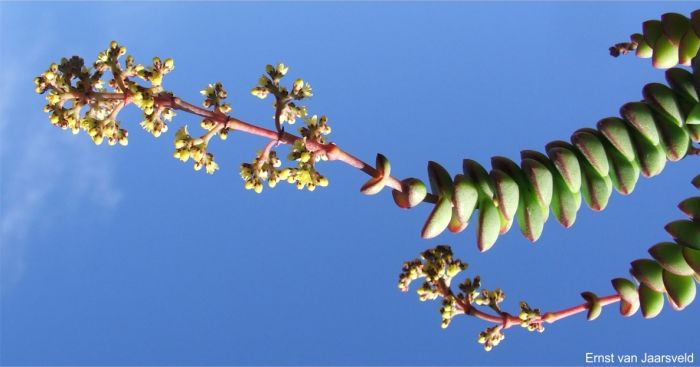
Fig. 7 Crassula perforata subsp. kougaensis in flower in the succulent nursery at Kirstenbosch National Botanical Garden.
Uses
Use
No known medicinal or cultural uses.
Growing Crassula perforata subsp. kougaensis
Grow
Crassula perforata subsp. kougaensis is grown for its ornamental value, and appealing compact shape. It is best grown in thicket gardens, on rockeries, but owing to its small size and competition from other plants, it is suggested to rather grow it in containers.
In regions outside of its habitat, ceramic containers under controlled climate conditions is the solution. It also grows well with other succulents in miniature succulent gardens. Grow in a gravely or sandy soil which drains well. Keep in full sun or dappled shade. Plants are easily propagated by stem cuttings and not difficult to root. The stems can simply be placed on the substrate and aerial roots will soon penetrate the soil. Avoid over watering. Water should be provided throughout the year, but sparingly.
Sow seed in autumn or spring in a shallow tray in a sandy mixture and keep moist. Germination is within 3 weeks and once large enough to handle, transfer to individual containers. Place container in a sunny or dappled shady position but with full light. The north sunny side (southern Hemisphere) of a building is ideal.
Plants are relatively disease free, except for stem and root rot caused by too much watering or poorly drained soil, and aphids, wine weevils, slugs and snails can sometimes be a problem.
References
- Mucina, L. & Rutherford, M.C. (eds) 2006. The vegetation of South Africa, Lesotho and Swaziland. Strelitzia 19. South African National Biodiversity Institute, Pretoria.
- Van Jaarsveld, E.J. & Van Wyk, A.E. 2009. Crassula perforata subsp. kougaensis, a new cliff-dwelling taxon from South Africa. Aloe 46(1): 22–23.
- Von Staden, L. & Turner, D. 2014. Crassula perforata Thunb. subsp. kougaensis Van Jaarsv. & A.E.van Wyk. National Assessment: Red List of South African Plants version 2024.1. https://redlist.sanbi.org/species.php?species=3835-946.
Credits
Ernst van Jaarsveld
Kirstenbosch National Botanical Garden (Retired)
Babylonstoren Farm (Current)
Extraordinary senior lecturer and researcher,
Department of Biodiversity and Conservation, University of the Western Cape
December 2025
Plant Attributes:
Plant Type: Shrub, Succulent
SA Distribution: Eastern Cape, Western Cape
Soil type: Sandy
Flowering season: Late Summer, Autumn
PH: Acid
Flower colour: Cream, Yellow
Aspect: Full Sun, Afternoon Sun (Semi Shade)
Gardening skill: Average
Special Features:
 Drought resistant
 Good potplant
 Indoor plant
Horticultural zones


Rate this article
Article well written and informative
Rate this plant
Is this an interesting plant?
Login to add your Comment
Back to topNot registered yet? Click here to register.