


Drosanthemum inornatum
Introduction
Drosanthemum inornatum is a summer-deciduous shrublet with soft flaccid stems. The leaves are green, linear and softy succulent. The flowers are solitary, dull or light pink, in spring. The leaves wither and die in early summer and the plants appear to be dead during the dry season. Occurring in southern Namibia and the Northern Cape, growing on dry, stony slopes in in various habitats. Grows well in containers.
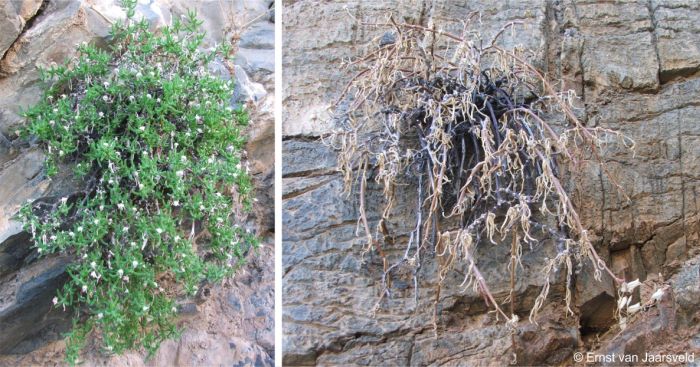
Fig. 1. LEFT Drosanthemum inornatum during the winter growing season, drooping from a dolomite cliff on the Aalwynberg, Hunsberg, southern Namibia. RIGHT Drosanthemum inornatum looking like a dead plant during the dry summer season, with pale persistent withered leaves and fruiting capsules.
Description
Description
Plants much-branched, long-lived, perennial, summer-deciduous shrublets with stems up to 500 mm long, forming ascending shrublets to 300 mm high or sometimes loose mats or pendent from cliffs. Main branch up to 8 mm in diameter. The roots are tuberous (main root or taproot), succulent, up to 5 mm in diameter. Branches 1.8–2.5 mm in diameter, 3.5 mm in diameter (basally up to 4 mm) at swollen nodes, at first green, with translucent papillate epidermis, becoming brownish, longitudinally fissured, becoming dark purplish brown, slightly articulated at nodes, soft and brittle, terete; nodes 7–25 mm apart. Leaves summer-deciduous, fleshy, green, spreading, pendent, subterete, linear, covered in warts (papillate), 12–18(–25) × 2 mm. The older leaves becoming purplish before they are shed. The upper leaf surface somewhat flattish with a rounded tip. The flowers are solitary, up to 20 mm in diameter, on pedicels 8–10 mm long. The floral receptacle is cup-shaped, 2–3 mm deep, 4 mm in diameter, bearing fleshy sepals with membranous wings. The floral petals are magenta to light pink, 8 × 1–1.5 mm. The stigmas (female portion) 5 mm long, warty (papillate). The nectar glands are green. The fruiting capsule is top-shaped, fragile, 5–6 mm in diameter, about 3–4 mm deep (open 9 mm in diameter, at top). The covering membranes are lacking and the valve wings broad, about 2 × 2 mm The seed 0.6 × 0.4 mm, light brown. Flowering is mainly in spring.
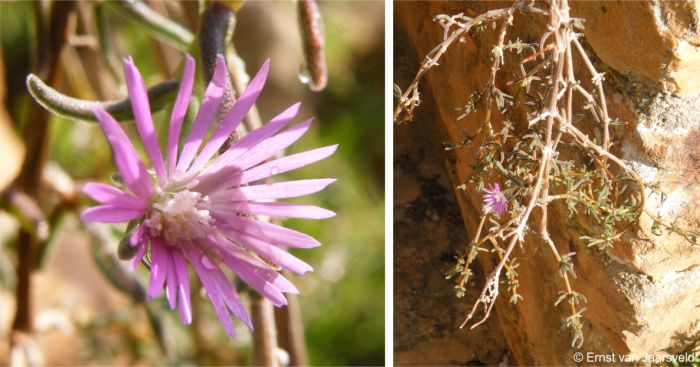
Fig. 2. Drosanthemum inornatum from the Aalwynberg in flower in the succulent nursery at Kirstenbosch National Botanical Garden in spring. Note the absence of staminodes in the flower, and the plant retained its pendent habit.
Conservation Status
Status
Locally common and not threatened, Drosanthemum inornatum is assessed as Least Concern (LC) by the Red List of South African Plants.
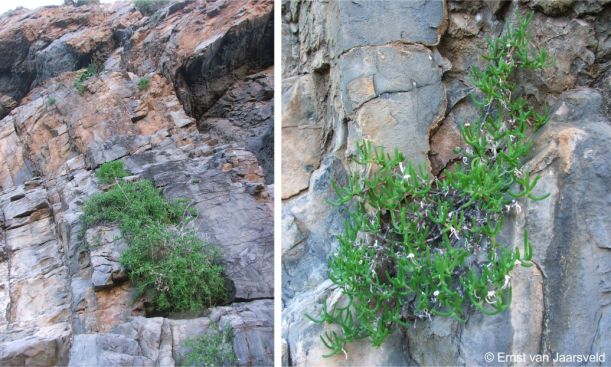
Fig. 3. LEFT The sheer dolomite cliffs of Aalwynberg in the Hunsberg of southern Namibia, one of the habitats of Drosanthemum inornatum, here during the winter growing season with a number of plants growing on the cliffs). RIGHT A plant growing on the cliffs of Aalwynberg.
Distribution and habitat
Distribution description
Drosanthemum inornatum occurs in southern Namibia and the Northern Cape of South Africa, on dry stony slopes in loam soils or quartzitic soils, also on cliffs. East of Rosh Pinah the plants grow on ledges and crevices on south-facing cliffs at altitudes from 800–1100 m. Here the geology consists of dolomite of the Port Nolloth Zone (Gariep Supergroup). Temperatures are warm during summer and mild to warm in winter, but fairly regularly cooled by fog from the Atlantic. The average daily maximum temperature is about 24°C and the average daily minimum temperature for the region 10°C. Winters are cooler but frost is absent. Rainfall occurs mainly in winter and about 50–75 mm per annum (mainly cyclonic winter rain). Regular fog provides extra moisture.
The associated vegetation near Rosh Pinah is Desert and Succulent Karoo and the associated plants in its dolomite cliff-face habitat at Konsertinaberg are Crassula sladenii, Crassula tomentosa var. tomentosa, Hartmanthus sp. and Tylecodon buchholzianus.
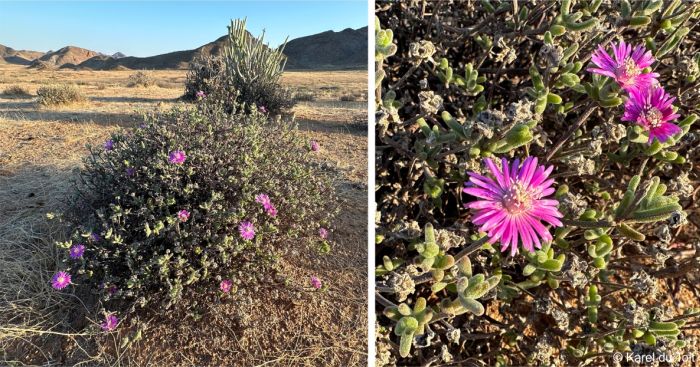
Fig. 4. Drosanthemum inornatum in flower in the Ai-Ais Richtersveld Transfrontier Park in autumn.
Derivation of name and historical aspects
History
Drosanthemum inornatum was named by Louisa Bolus in in 1928 as Trichodiadema inornatum from plants collected by Neville Pillans from the University of Cape Town. She later realised that it did not fit within the genus Trichodiadema and, rightfully so, transferred it to the genus Drosanthemum in 1964, in the Journal of South African Botany. The name inornatum pertains to its broom-like, unadorned appearance during the dry summer months, quite unlike most other members in the genus Drosanthemum.
There are 130 species of Drosanthemum, and Heidi Hartmann created 10 subgenera accommodating the various related plants within each sugenus. Our species D. inornatum belongs to the subgenus Decidua created by Heidi in 2014 in the Bradleya succulent magazine. The subgenus Decidua accommodates 5 species, all of which are summer-deciduous. These include: D. anemophilum, D. longipes, D. inornatum, D. deciduum and D. pauper. Two morphological features (other than being summer-deciduous) that distinguishes subgenus Decidua are the possession of cork in the lower part of the flower and fruit stalk, and the formation of white collars at the remaining bases of the leaves after they are shed. Not closely related to any other species of Drosanthemum.
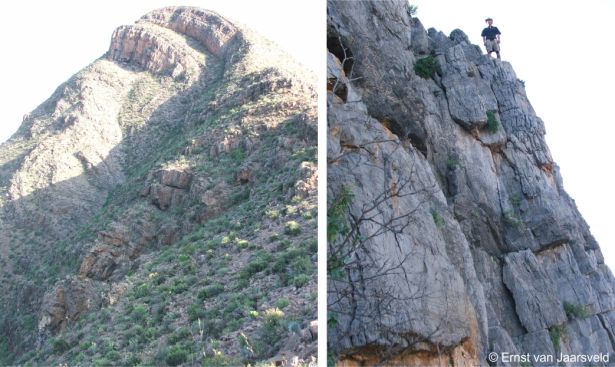
Fig. 5. The Konsertinaberg LEFT and the sheer cliffs of Aalwynberg RIGHT with the ecologist, Greg Nicolson standing on top, both in the Hunsberg, southern Namibia, consist of dolomite and are the habitat of Drosanthemum inornatum.
Ecology
Ecology
Plants grows in various habitats in dry karroid and desert vegetation. Plants observed growing on the dolomite cliffs near Rosh Pinah have pendent, leafy stems, growing from crevices and ledges. The pendent hanging habit of the Rosh Pinah form is retained in cultivation. The tuberous roots ensure good anchorage and long-term survival especially during the long dry summers. The stems are pendent, forming loose mats on ledges. Stems and leaves are soft and fragile, young stems with a fleshy, translucent layer.
The leaves are bright green, covered in dwarf wart cells (papillate) but become deciduous towards summer. The flowers are simple, in leaf axils. Flowering occurs in late winter and spring. The plants are pollinated by insects and the seeds dispersed by wash-out dispersal by rainwater, settling and germinating in crevices. The seed 0.6 × 0.4 mm, an ideal size for establishment in crevices.
Seeds ripen throughout spring and summer and are retained in the capsules until the first autumn rains.
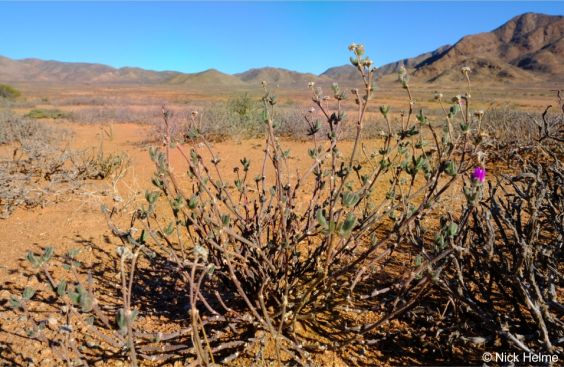
Fig. 6. Drosanthemum inornatum in the Richtersveld in spring.
Uses
Use
It is not known whether the plants are used medicinally. This is not a candidate for ornamental horticulture, but is more of a curiosity plant.
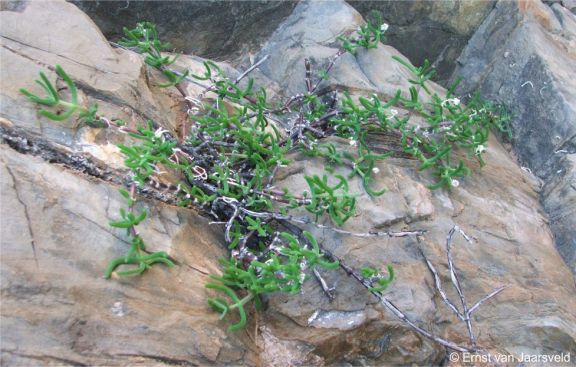
Fig. 7. Drosanthemum inornatum in the winter growing season drooping from a dolomite cliff on the Aalwynberg, Hunsberg, southern Namibia.
Growing Drosanthemum inornatum
Grow
This is a winter-rainfall desert species and outside of this dry habitat is best grown in a greenhouse under controlled conditions. It grows well in containers in well drained soil. For the Rosh Pina form, dolomitic lime can be added to its substrate. Compared to so many other species of Drosanthemum, it has little ornamental value and is grown by the succulent plant connoisseur as a curiosity plant. Plants require sufficient light and warmth during their growing season. Commence watering in autumn as soon as signs of the new leaves appear. Keep moist during winter and at flowering in spring reduce watering until all the leaves wither. Keep dry during the summer. Seed can be harvested as soon as the capsules dry and retained until autumn.
Propagate from cuttings or seed, in a sandy soil. Sow seed in autumn. Cover with a thin layer of sand. Germination is usually within 3 weeks. Prick out as soon as the plants are large enough to handle. The cuttings can be about 10 cm in length, and are best made after the new leaves appear. Plant in autumn in sand. Transfer to a container once well rooted.
References
- Christenhusz, M.J.M., Fay, M.F. & Chase, M.W. 2017. Plants of the World, an illustrated Encyclopedia of vascular plants. Kew Publishing, Royal Botanic Gardens, Kew.
- Clarke, H. & Charters, M. 2016. The illustrated dictionary of southern African plant names. Flora & Fauna Publications Trust, Jacana, Johannesburg.
- Du Toit, K. 2024-Apr. Observation of Drosanthemum inornatum, Ais-Ais Richtersveld Transfrontier Park. iNaturalist. Online. https://www.inaturalist.org/observations/212368444
- Hartmann, H.E.K. 1991. Mesembryanthema. Systematics, biology and evolution of some South African taxa. Contributions from the Bolus Herbarium. No. 13: 75–157.
- Hartmann, H.E.K. & Liede-Schumann, S. 2014. Two new subgenera and one new species in the genus Drosanthemum. Bradleya 32: 50-63.
- Hartmann, H.E.K. 2007. Studies in Aizoaceae: eight new subgenera in Drosanthemum Schwantes. Bradleya 25: 145–176.
- Helme, N. 2021-Aug. Observation of Drosanthemum inornatum, Ais-Ais Richtersveld Transfrontier Park. iNaturalist. Online. https://www.inaturalist.org/observations/93867538.
- Jackson, W.P.U. 1990. Origins and meanings of names of South African plant genera. University of Cape Town Printing Department, Cape Town.
- Mucina, L. & Rutherford, M.C. (eds) 2006. The vegetation of South Africa, Lesotho and Swaziland. Strelitzia 19. South African National Biodiversity Institute, Pretoria.
- Raimondo, D., Von Staden, L., Foden, W., Victor, J.E., Helme, N.A., Turner, R.C., Kamundi, D.A. & Manyama, P.A. (eds) 2009. Red list of South African plants. Strelitzia 25. South African National Biodiversity Institute, Pretoria.
- Van Jaarsveld, E.J. & Hammer, S. 2004. An unusual new species of Drosanthemum from Rooinek Pass in South Africa’s Western Cape. Cactus & Succulent Journal (US) 76,3: 202–204.
Credits
Ernst van Jaarsveld
Kirstenbosch National Botanical Garden (Retired)
Babylonstoren Farm (Current)
Extraordinary senior lecturer and researcher,
Department of Biodiversity and Conservation, University of the Western Cape
July 2026
Acknowledgements: the author thanks Nick Helme and Karel du Toit for making their images of Drosanthemum inornatum growing in the Richtersveld available via iNaturalist.
Plant Attributes:
Plant Type: Shrub, Succulent
SA Distribution: Northern Cape
Soil type: Sandy
Flowering season: Spring, Early Summer
PH: Acid, Alkaline, Neutral
Flower colour: Pink
Aspect: Full Sun, Morning Sun (Semi Shade), Afternoon Sun (Semi Shade)
Gardening skill: Challenging
Special Features:
 Drought resistant
 Good potplant
Horticultural zones


Rate this article
Article well written and informative
Rate this plant
Is this an interesting plant?
Login to add your Comment
Back to topNot registered yet? Click here to register.