


Eriosema dregei
Introduction
Eriosema dregei stands out as a surprising survivor along the coastline of Pondoland in the northern Eastern Cape and southern KwaZulu-Natal. This perennial plant grows in rocky soil and produces yellow to orange flowers. It exists in six to ten different locations and is declining because of ongoing habitat loss.
Description
Description
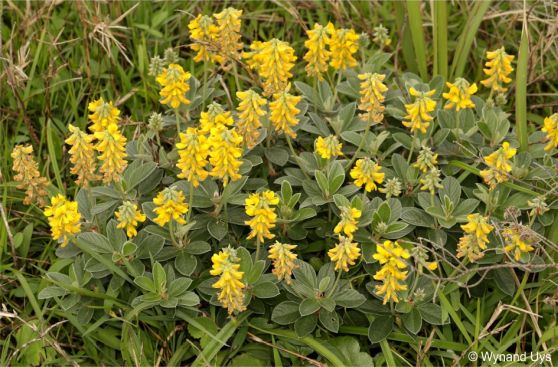
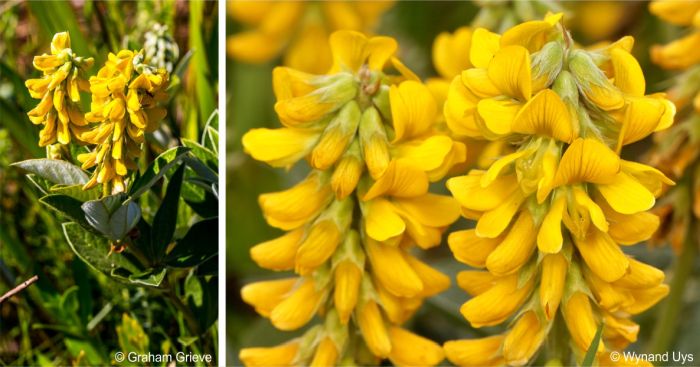
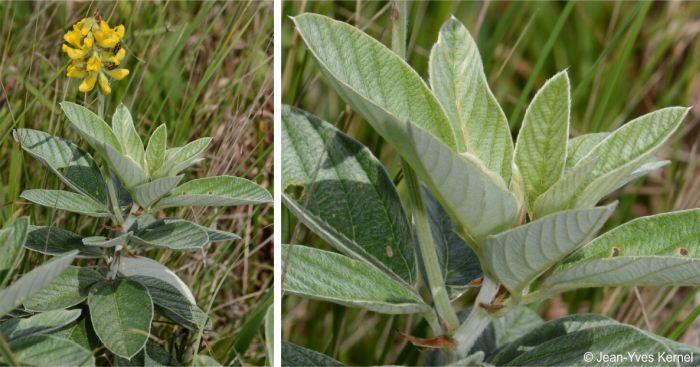
Eriosema dregei is a small, low-growing evergreen shrub that grows up to 400 mm tall. It has a woody underground rootstock producing 4-10 stems that grow upright, branching out from the base, giving the plant a bushy shape. They are covered with fine silver hairs, giving the stem a slightly rough texture. The leaves are trifoliolate, which means they have three leaflets. The leaflets are oval with a pointed tip and have a smooth texture. The upper surface of the leaf is covered with white hairs while the underside is densely covered with white to silver woolly hairs. The veins of the plant are a noticeable yellowish colour. The leaflets are vibrant green, and they grow 30-70 mm in length.
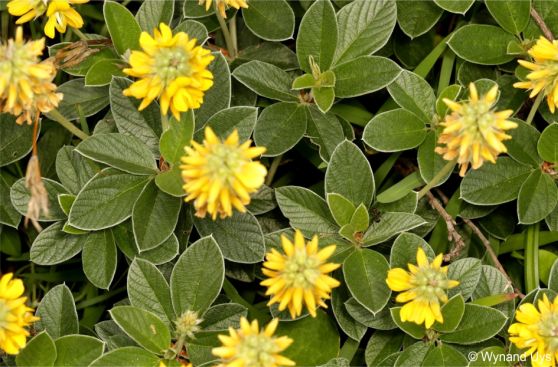
The plant produces yellow to orange flowers from late winter to spring. The flowers are formed in clusters; they grow where the leaves meet the stem and rise well above the foliage. Each cluster may contain up to 67 flowers. Each flower has 5 petals and a calyx densely covered with silver hairs. After flowering Eriosema dregei produces small, rounded pods covered with a mix of long reddish-brown hairs and short white hairs. When the fruit is ripe, it turns brown and often remains on the plant even after releasing the seeds. The seeds are oval, hard, pale chestnut brown and about 6 mm long.
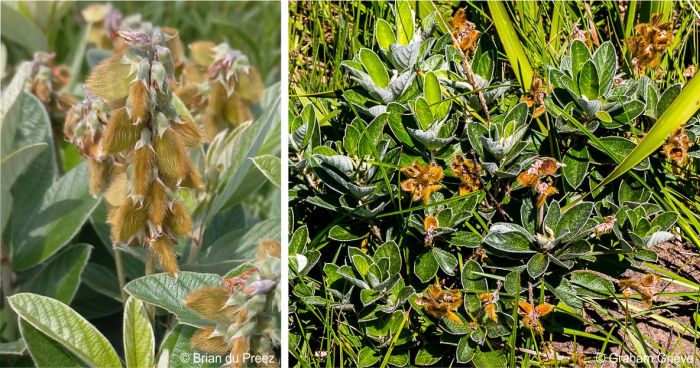
Eriosema dregei has consistently been confused with E. umtamvunense and E. luteopetalum. It differs from E. umtamvunense with its yellow to orange flowers (not red and yellow as in E. umtamvunense) and from E. luteopetalum it differs with its stem covered with fine silver hairs (not a golden-brown stem with short yellowish hairs as in E. luteopetalum).
Conservation Status
Status
Eriosema dregei is a rare species that is endemic to the Pondoland Centre of Endemism. It is currently assessed as Vulnerable (VU) on the Red List of South African Plants. It has a limited geographic area, existing in an area of 744 km2, where it occurs in six to ten different locations and is declining because of ongoing damage to and loss of its habitat throughout its range. About 50% of its habitat has been permanently changed, mainly because of farming, in particular sugarcane and macadamia farms, as well as urban expansion. In other places the habitat is degraded by invasive plants like Hakea sericea and Acacia longifolia. Some plants remain in remnant grasslands, both inside and outside protected areas. This grassland plant can live for long time with a generation length of at least 70 years. Because it has lost half of its habitat over the past 200 years, it is estimated that the population has decreased by 30% to 45%. Eriosema dregei is protected within the Mkhambathi, Umtamvuna and Red Desert Nature Reserves.
Distribution and habitat
Distribution description
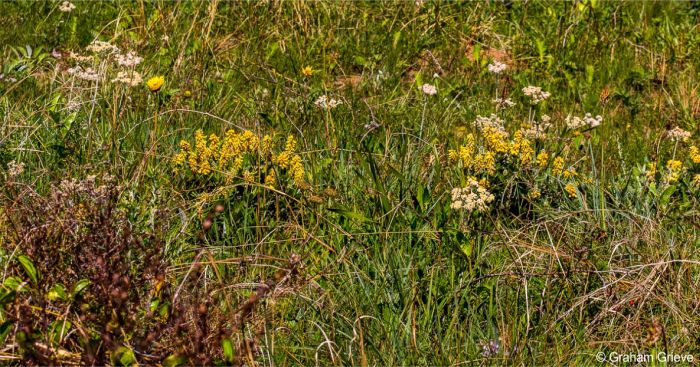
Eriosema dregei is native to South Africa, it is found only in the coastal dune and rocky riverine grasslands that are below 200 m in elevation, in the Pondoland Center of Endemism, and ranges between Port Edward in KwaZulu-Natal and Mkambati River Mouth in Eastern Cape. This plant grows in subtropical areas and is best suited to coastal grassland vegetation.
Derivation of name and historical aspects
History
The name Eriosema is derived from the Greek words erion, meaning ‘wool’ and semeia, meaning ‘standard’ or ‘sign’ which refers to the woolly hairs at the back of the standard petals. The species name dregei is a tribute to Johann Franz Drege (1794-1881), a German botanist and plant collector who did a lot of exploring in South Africa. Drege gathered many plant samples in the then Cape Province and KwaZulu-Natal areas, greatly adding to what we know about plants of southern Africa. Naming this species after him recognizes his role in discovering and collecting the original specimen.
Ecology
Ecology
During late winter to spring and into early summer (June to December), Eriosema dregei produces yellow to orange flowers that attract butterflies and bees. This plant thrives in grassland that often experience fires. Although the plant may be burned, it survives because it has a woody underground rootstock. After the fire it regenerates from the woody rootstock, with new shoots appearing in spring.
Uses
Use
Although there are no records of medicinal or cultural uses for Eriosema dregei, various communities in southern Africa use plants in the genus Eriosema in traditional medicine to help with coughs, colds and other breathing problems. They are thought to have anti-inflammatory effects which may help reduce pain and swelling. Besides the medicinal uses, these plants serve as natural dye; the roots produce a yellowish-brown hue.
Eriosema dregei may become popular as an ornamental plant because of its attractive flowers. It thrives in well-drained soil and full sun to partial shade.
Growing Eriosema dregei
Grow
Eriosema dregei can be propagated by seeds, cuttings and division.
Seeds need to be collected from pods once they turn brown. Sow the seeds in a soil mix that drains well and cover them lightly with soil. Keep the soil moist until the seeds germinate, which may take up to 6 weeks. Seedlings can be transplanted into new pots when they reach about 10 cm in height.
To propagate Eriosema dregei vegetatively, take stem cuttings in early spring. Each cutting should be around 8 cm long and lower leaves should be removed. Cuttings should be placed in a well-draining soil mix, and they must be kept warm. Roots will start to grow in about 8 weeks.
Eriosema dregei can also be propagated through division in early spring. The root system should be carefully dug up and a sharp knife used to split the plant into smaller sections. Each section should have roots, and they must be planted in a soil mix that drains well.
Eriosema dregei grows well in sunny areas with soil that drains well. It can adapt to various types of soil and does well in both acidic and alkaline conditions. Before planting, the soil medium must be deep, rich in nutrients and free of weeds. The best time to plant this species is during the rainy season. It needs a moderate amount of water during the growing season, but less during the dry season when it should be watered enough to keep the soil moist and not waterlogged. Light pruning to remove old or damaged stems in late winter will encourage new growth.
References
- Bredenkamp, C.L. 2019. A flora of the Eastern Cape Province, Volume 2. Strelitzia 41. South African National Biodiversity Institute, Pretoria.
- Du Preez, B. 2024. Observation of Eriosema dregei, Port Edward, KZN. iNaturalist. Online. https://www.inaturalist.org/observations/252717291.
- Grieve, G. 2020. Observation of Eriosema dregei, Red Desert Nature Reserve, KZN. iNaturalist. Online. https://www.inaturalist.org/observations/85338783.
- Grieve, G. 2021. Observation of Eriosema dregei, Port Edward, KZN. iNaturalist. Online. https://www.inaturalist.org/observations/102862815.
- Kernel, J.Y. 2024. Observation of Eriosema dregei, Port Edward, KZN. iNaturalist. Online. https://www.inaturalist.org/observations/256635460.
- Mtshali, H., Grieve, K. & von Staden, L. 2021. Eriosema dregei E.Mey. National Assessment: Red List of South African Plants version 2024.1. Accessed on 2026/07/31.
- Nichols, G. 2005. Growing rare plants: a practical handbook on propagating the threatened plants of southern Africa. Southern African Botanical Diversity Network Report No. 36.
- Pooley, E. 2005. A field guide to wild flowers KwaZulu-Natal and the eastern region. The Flora Publications Trust, Durban.
- Scott-Shaw, C.R. 1999. Rare and threatened plants of KwaZulu-Natal and neighbouring regions. KwaZulu-Natal Nature Conservation Service, Pietermaritzburg.
- Selepe, M. 2011. Synthesis and analysis of Eriosema isoflavonoids and derivatives thereof. Published Ph.D. Thesis, University of KwaZulu-Natal, Pietermaritzburg. http://researchspace.ukzn.ac.za/handle/10413/6409
- Stirton, C.H. 1986. The Eriosema squarrosum complex (Papilionoideae, Fabaceae) in southern Africa. Bothalia 16(1): 11–22.
- Uys, W. 2023. Observation of Eriosema dregei, Port Edward, KZN. iNaturalist. Online. https://www.inaturalist.org/observations/190322765.
- Zondi, L. 2019. Eriosema umtamvunense C.H.Stirt. (Fabaceae). PlantZAfrica. Online. https://pza.sanbi.org/eriosema-umtamvunense.
- Zondi, L., Mbalo, A., Mnembe, S. & Mvunyiswa, S. 2025-12. Eriosema luteopetalum C.H.Stirt. (Fabaceae). PlantZAfrica. Online. https://pza.sanbi.org/eriosema-luteopetalum.
Credits
Sihle Mvunyiswa
KwaZulu-Natal National Botanical Garden
August 2026
Acknowledgements: The author thanks Graham Grieve, Wynand Uys, Brian du Preez and Jean-Yves Kernel for providing the images via iNaturalist, and Lungisani Zondi for mentoring her.
Plant Attributes:
Plant Type: Shrub
SA Distribution: Eastern Cape, KwaZulu-Natal
Soil type: Sandy, Loam
Flowering season: Spring, Winter
PH: Acid, Neutral
Flower colour: Yellow
Aspect: Full Sun
Gardening skill: Challenging
Special Features:
 Attracts butterflies
 Feeds honeybees
Horticultural zones


Rate this article
Article well written and informative
Rate this plant
Is this an interesting plant?
Login to add your Comment
Back to topNot registered yet? Click here to register.