


Eriosema luteopetalum
Introduction
Recognized for its bright yellow flowers and soft golden stems, Eriosema luteopetalum is a striking perennial subshrub with a naturally limited range from Port Shepstone to Port Edward on KwaZulu-Natal’s south coast, which has been further reduced by urban development and agriculture, leaving only eight to ten known surviving populations.
Description
Description
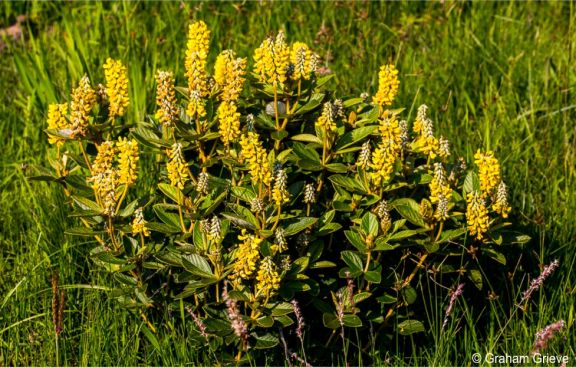
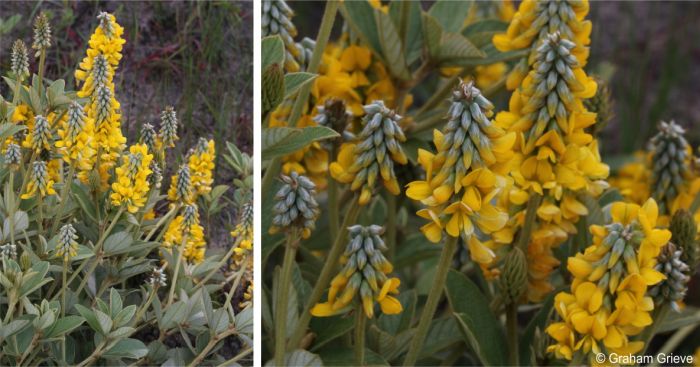
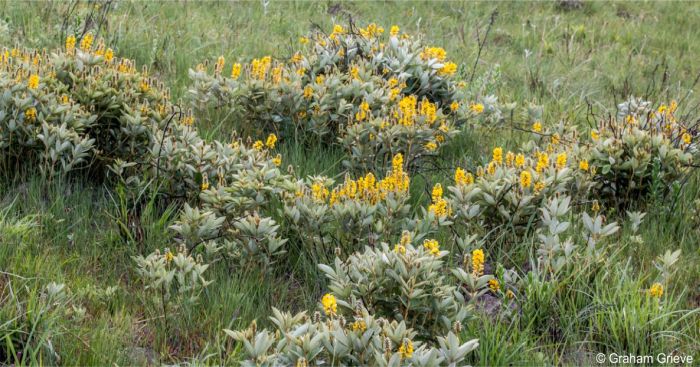
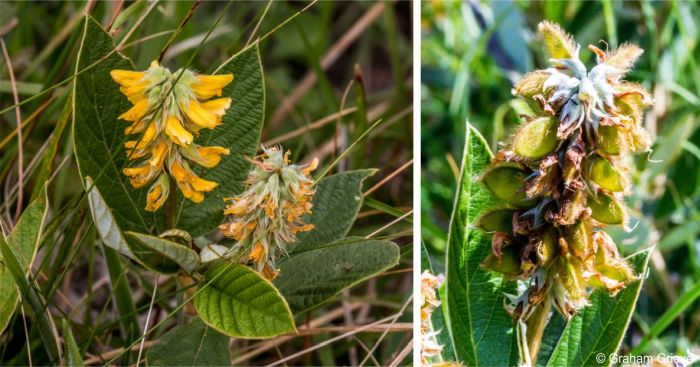
Eriosema luteopetalum is a small, evergreen, long-lived herb that grows from a woody base. It reaches 300–600 mm in height and forms a compact, upright, bushy shape. It grows slowly to moderately and retains its leaves throughout the year. The stems stand upright and branch at the base, creating a full appearance. They are covered with soft golden-brown hairs that lie flat against the surface, giving the stems a slightly rough texture. The leaves are made up of three leaflets. Each leaflet is oval to slightly spoon-shaped, usually 40–60 mm long and 30–40 mm wide, although inland plants often have narrower and more pointed leaflets. The upper surface of the leaf feels slightly rough, while the underside is densely covered with fine white hair. The veins are yellowish and very noticeable. At the base of each leaf are small, pointed, leaf-like structures called stipules, which are long-lasting and remain on the plant. The plant produces many flower clusters during the warm months, especially in spring. These clusters grow where the leaves meet the stem and rise well above the foliage. Each cluster may carry 24–45 flowers. The flowers are relatively large for the genus, greenish-yellow, and about 12–15 mm long. Small, boat-shaped bracts (modified leaves) sit beneath each flower and remain attached for a long time, adding to the plant’s showy appearance. After flowering, the plant develops small, rounded fruits covered with a mix of long yellowish hairs and short white hairs. As they ripen, the fruits turn brown and often remain on the plant even after releasing their seeds. The seeds are oval, hard, pale chestnut brown, and about 6 mm long.
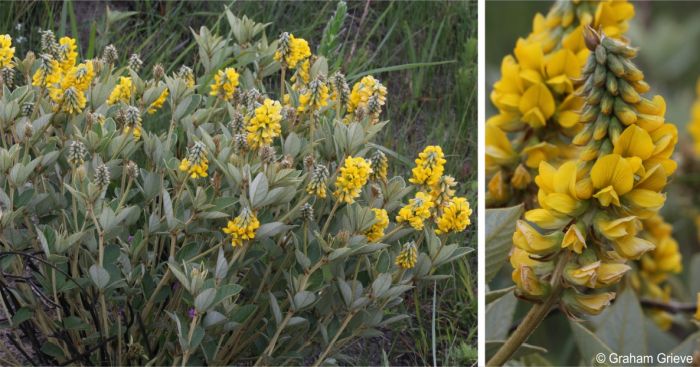
Eriosema luteopetalum is most often confused with Eriosema dregei, but E. dregei has silvery stems and leaves (not golden-brown), smaller flowers, and shorter bracts that fall off quickly. The upper surface of E. dregei leaves also have silvery hairs, while E. luteopetalum has short yellowish hairs. It can also be confused with Eriosema latifolium, which differs in having much smaller flowers, shorter stipules, and narrower flower spikes.
Conservation Status
Status
Eriosema luteopetalum is endemic to KwaZulu-Natal, South Africa, and is currently listed as Vulnerable (VU) on the Red List of South African Plants. It has a very restricted distribution between Port Shepstone and Port Edward, with an extent of occurrence (EOO) of 190–270 km² and an area of occupancy (AOO) of 34–48 km². Once locally abundant, the species now survives at only eight to ten locations, and its population is declining due to ongoing habitat loss and degradation. Approximately 66% of its natural habitat has been irreversibly transformed by urban expansion and agriculture, with a further 19% loss between 1990 and 2014. Remaining grasslands are also threatened by invasive alien plants, and one subpopulation along the R61 was lost due to herbicide use. The species occurs in Mbumbazi and Skyline provincial nature reserves and the Kongweni conservancy, but the continuing loss and degradation of habitat suggest that the population is declining.
Distribution and habitat
Distribution description
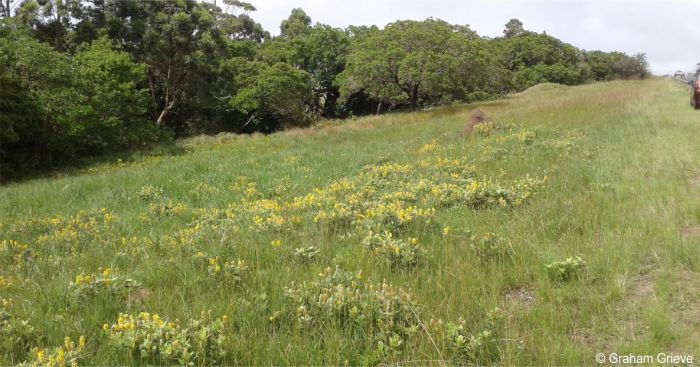
This species is endemic to southern KwaZulu-Natal and occurs in grassland between Port Shepstone and Port Edward. It is relatively common along the coast and appears to grow best on sandy soils in previously burnt grasslands, at altitudes ranging from 4 to 160 m.
Derivation of name and historical aspects
History
The scientific name Eriosema luteopetalum highlights its distinctive features. The genus name Eriosema is derived from the Greek words erion, meaning ‘wool’, and semeia, meaning ‘mark’ or ‘sign’, referring to the woolly hairs on the back of the standard petal. The species name luteopetalum comes from Latin luteo, meaning ‘yellow’ and petalum meaning ‘petal’, describing its bright yellow flowers. Eriosema luteopetalum belongs to the Fabaceae, a large and economically important family that includes legumes, peas and beans. The genus Eriosema comprises around 150 species of erect or climbing subshrubs or herbs, mostly in tropical regions, with about 100 species in Africa and 36 in South Africa. Species in this genus typically have 1- or 3-foliolate leaves, reflexed yellow flowers, and seeds with a long hilum flanked by a distinctive whitish, two-lobed structure, which is useful for identification.
Historically, the southern African Eriosema squarrosum complex was taxonomically challenging due to nomenclatural confusion and hybridization. Central to this complex is E. squarrosum, first described as Hedysarum squarrosum by Thunberg in 1800 and later reclassified into Eriosema by Walpers in 1839. Subsequent studies by Harvey, Baker, and Stirton clarified many of the species in this group. In 1981, C.H. Stirton described E. luteopetalum as a distinct species, alongside E. umtamvunense and E. rossii, and reinstated E. dregei, resolving long-standing confusion and establishing clear species boundaries within the complex.
Ecology
Ecology
During the warm months, Eriosema luteopetalum bears bright yellow to orange blooms that attract various pollinators, including bees and butterflies. This species is well suited to grassland environments frequently affected by fire. It regenerates from a woody rootstock after burning, with new shoots appearing in spring, ensuring its continued survival in these habitats. Moreover, E. luteopetalum contributes to soil stability and erosion control in areas receiving high rainfall. Its compact growth form and dense network of stems and leaves help bind the soil, particularly in open grasslands and along streambanks.
Uses
Use
Although there are no documented medicinal or economic uses for Eriosema luteopetalum specifically, many species in the Eriosema genus have traditional applications. Roots of species such as E. cordatum, E. salignum, and E. kraussianum, known in Zulu as uBangalala, are used to treat impotence and erectile dysfunction, typically prepared as hot-milk infusions or boiled root decoctions taken in small doses. Other medicinal uses across the genus include treatment of diarrhoea, orchitis (inflammation of the testicles), rabies, skin infections, conjunctivitis, coughs, and scabies. Some species, such as E. glomeratum, E. griseum and E psoraleoides, are mildly toxic and have been used in traditional fish poisoning.
Culturally, Eriosema plants are sometimes used in rituals; for example, among Sotho communities, certain species are mixed with other herbs to stimulate bulls in spring. While they are valued for their bright yellow flowers and compact bushy growth, Eriosema species are currently not commonly found in nurseries or widely cultivated for horticultural purposes, although they have potential as ornamental plants in gardens due to their showy flowers and ability to attract pollinators.
Growing Eriosema luteopetalum
Grow
Eriosema luteopetalum is not yet established in cultivation, but it can be successfully propagated from seed. The seeds have a hard coat that inhibits germination and should therefore be scarified by gently rubbing with sandpaper or soaking in warm water for 12–24 hours before sowing. Sow the scarified seeds in a well-drained, sterile medium such as a mixture of coarse sand and composted bark and treat with a fungicide to prevent pre- and post-emergence damping-off. Keep the medium evenly moist but not waterlogged. Germination usually occurs within two to three weeks under warm, humid conditions. Once seedlings develop their second set of true leaves, prick them out into small pots containing a similar, well-drained mix. Gradually harden them off before transplanting outdoors in early summer.
In cultivation, this species performs best in frost-free coastal areas with summer rainfall, reflecting its natural habitat along the KwaZulu-Natal coast. It prefers a sunny position in nutrient-rich, well-drained sandy or loamy soil. Water regularly during the growing season, particularly in dry periods, but allow the soil to dry slightly between watering to prevent root rot. Apply a balanced, slow-release fertilizer in spring to promote healthy growth and flowering. Light pruning of old or damaged stems in late winter encourages vigorous regrowth.
Because it forms a low, spreading subshrub with bright yellow flowers, E. luteopetalum is well suited for use in indigenous gardens, particularly in sunny borders, grassland displays, or as a feature plant in rockeries and along slopes where its dense growth can help stabilize soil. It combines well with other sun-loving indigenous species such as Themeda triandra, Helichrysum aureum and Hypoxis hemerocallidea, which share similar soil and light requirements. The species appears to be relatively pest free, though seedlings are susceptible to fungal damping-off if overwatered. With proper care and attention to drainage and light, Eriosema luteopetalum can become an attractive and ecologically valuable addition to indigenous landscapes.
References
- Grieve, G. 2025. Observations of Eriosema luteopetalum. iNaturalist. Online. https://www.inaturalist.org/observations?taxon_id=585353&user_id=graham_g.
- Mtshali, H. & Grieve, K. 2020. Eriosema luteopetalum C.H.Stirt. National Assessment: Red List of South African Plants version 2024.1. https://redlist.sanbi.org/species.php?species=451-30.
- Nichols, G. 2005. Growing rare plants: a practical handbook on propagating the threatened plants of southern Africa. Southern African Botanical Diversity Network Report No. 36.
- Pooley, E. 2005. A field guide to wild flowers KwaZulu-Natal and the eastern region. The Flora Publications Trust, Durban.
- Scott-Shaw, C.R. 1999. Rare and threatened plants of KwaZulu-Natal and neighbouring regions. KwaZulu-Natal Nature Conservation Service, Pietermaritzburg.
- Selepe, M. 2011. Synthesis and analysis of Eriosema isoflavonoids and derivatives thereof. Published Ph.D. Thesis, University of KwaZulu-Natal, Pietermaritzburg. http://researchspace.ukzn.ac.za/handle/10413/6409
- Stirton, C.H. 1986. The Eriosema squarrosum complex (Papilionoideae, Fabaceae) in southern Africa. Bothalia 16(1): 11–22.
- Zondi, L. 2019. Eriosema umtamvunense C.H.Stirt. (Fabaceae). PlantZAfrica. Online. https://pza.sanbi.org/eriosema-umtamvunense.
Credits
Lungisani Zondi, Ayabonga Mbalo, Siyamthanda Mnembe & Sihle Mvunyiswa
KwaZulu-Natal National Botanical Garden
December 2025
Acknowledgements: the authors thank Graham Grieve for providing the images used to illustrate this article, via iNaturalist.
Plant Attributes:
Plant Type: Perennial
SA Distribution: KwaZulu-Natal
Soil type: Sandy, Loam
Flowering season: Spring, Early Summer
PH:
Flower colour: Yellow
Aspect: Full Sun
Gardening skill: Average
Special Features:
 Attracts butterflies
 Drought resistant
 Feeds honeybees
Horticultural zones


Rate this article
Article well written and informative
Rate this plant
Is this an interesting plant?
Login to add your Comment
Back to topNot registered yet? Click here to register.