


Gardenia genus
Introduction
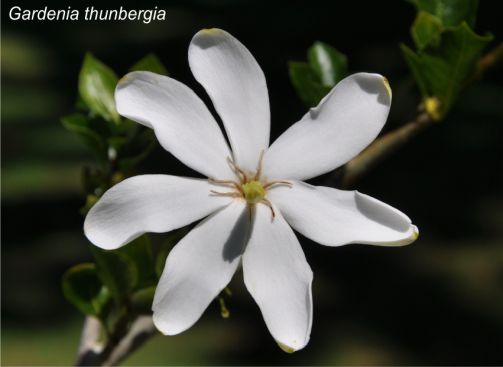
Gardenias, with their scented white flowers and spiralling corolla lobes, are native to forests, open grassland and bushveld of southern Africa. These showy plants bloom profusely, a flower lasting for 2–4 days and pollinated by hawkmoths (Agrius spp.).
Description
Description
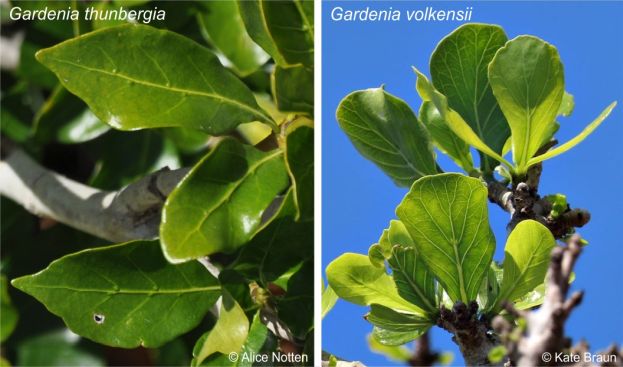
Gardenias are shrubs or small trees without spines. Leaves are simple, whorled or opposite, hairless (occasionally scabrid), except for distinct small hairy pockets (domatia) on the undersurface that cause a small swelling that is visible on the upper surface. Stipules ovate, protecting the bud. The showy flowers are usually solitary and bisexual. The foliaceous calyx is shortly tubular; corolla is a long, cylindrical tube, with 5–8, spreading lobes, spirally arranged. The fruit is ovoid to ellipsoid, stiff and leathery. The seeds are numerous, stuck together in a solid mass, embedded in pulp. Flowering time is from winter to late summer (July to February).
The genus Gardenia was named by English naturalist John Ellis (1710–1776), in honour of Alexander Garden (1730–1791), a Scottish doctor, botanist and zoologist who corresponded with Carl Linnaeus (1707–1778). The first South African species of this genus known to science, Gardenia thunbergia Thunb. was introduced to the Royal Botanic Gardens, Kew, in 1773.
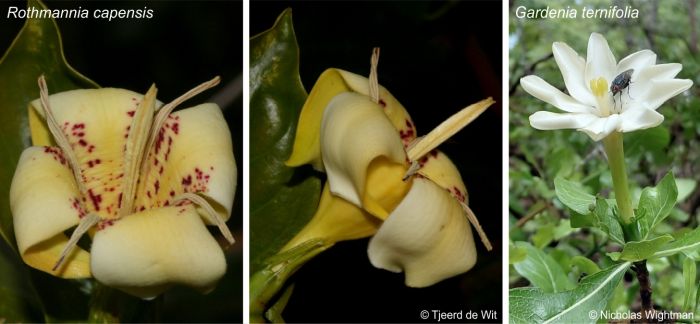
Gardenia is easily confused with Rothmannia Thunb. but it can be distinguished by its cylindrical corolla tube with fused stipules (connate), whereas Rothmannia is distinguished by its campanulate (bell-shaped) corolla tube and ovate stipules.
Conservation Status
Status
The genus Gardenia is not threatened globally. The southern African taxa are listed as either Least Concern or Not Evaluated by the Red List of South African Plants.
Distribution and habitat
Distribution description
Gardenia comprises ca. 143 species, with diversity in the tropical and subtropical regions of Africa and the Pacific Islands. In southern Africa, the genus is represented by ca. 7 taxa, with diversity in the coastal areas of aseasonal to summer rainfall, from the Eastern Cape to KwaZulu-Natal, and in the inland regions of Mpumalanga, Gauteng, and Limpopo, as well as parts of Eswatini.
Ecology
Ecology
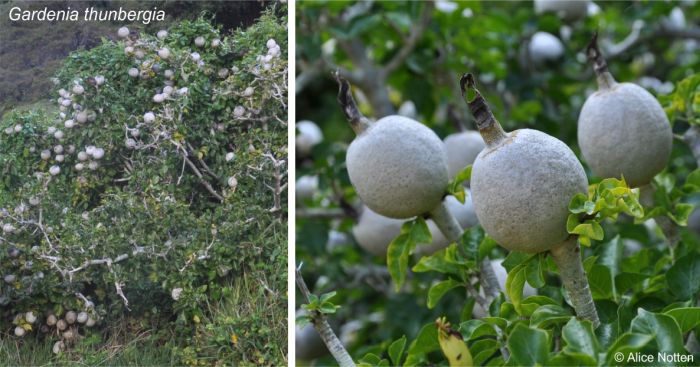
The hawkmoth (Agrius spp.) pollinates the flowers of Gardenia. The fruits usually have a hard and thick woody wall and do not burst, split open, or drop from the plants, and can remain attached for years. Gardenia thunbergia fruits are eaten and dispersed by elephants, large antelope, and buffalo, with seed coats strong enough to survive their digestive tracts and stay viable. In a garden situation, or where these animals are excluded, unless there is external human intervention, these seeds are not dispersed. Notten describes this intervention as labour-intensive, involving hammers or other heavy, blunt tools to break open the fruits, and then heavy-duty spoons to scoop out the seeds.
Uses
Use
The wood of gardenias is used to make utensils, fence homesteads and as fuel. Gardenias are planted at the gates of Zulu people's homes since they are believed to keep evil spirits away. The isiZulu common name of the plant (e.g. G. thunbergia) umValasangweni loosely translates to ‘close the gate’. Many gardeners grow gardenias for their attractive, scented white flowers, which attract hawkmoths (Agrius spp.). The leaves of one of the species, G. thunbergia, are believed to treat syphilis. The roots are widely used in African cultures to treat skin diseases, including lesions caused by leprosy.
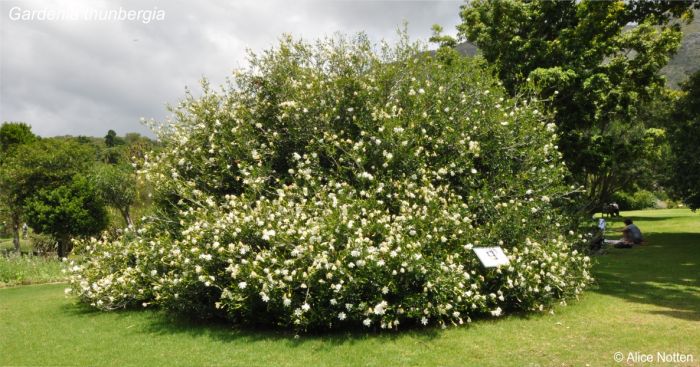
Growing Gardenia genus
Grow
Southern African gardenias can be propagated by seed and cuttings, and are easy to grow although slow-growing, needing well-drained loam soil with plenty of water in summer, best for warm temperate or subtropical climates and suitable for containers. See Gardenia volkensii, Gardenia cornuta, and Gardenia thunbergia for detailed cultivation and propagation advice.
Species
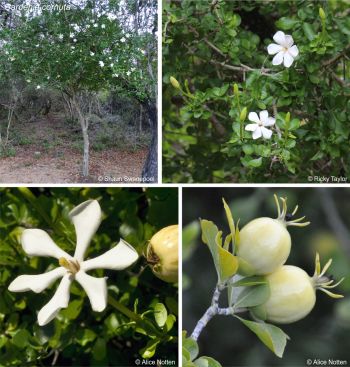
Gardenia cornuta Hemsl.
Tonga gardenia, Natal gardenia, horned gardenia (Eng.); wilde-appel, Tongakatjiepiering, Natalkatjiepiering (Afr.); unomphumela, umvalasangweni (isiZulu).
SA Tree No: 690.1
A small tree up to 5 m in height. Leaves arranged in whorls of three, clustered towards the ends of short, rigid branchlets, broadly obovate, measuring 20–50 x 15–27 mm, leathery, shiny light green on the upper side, dull green underneath, glabrous, with hairy pockets (domatia) present on the underside. The apex is very broadly tapering to a rounded tip, while the base narrows into a not-so-distinct petiole, up to 3 mm long. The margins are wavy and entire. Flowers are white, turning yellow as they mature, with a corolla tube up to 60 mm long and five spreading lobes. The calyx is tubular and foliaceous. The fruit is ovoid, measuring 45 x 38 mm, yellow, crowded with a persistent calyx (in profusion). Flowering occurs from late summer to early spring (Feb. to Aug.). It is recorded in low-altitude areas within the bushveld and thicket of northeastern KwaZulu-Natal, southern Mozambique, and the marginal regions of Mpumalanga. Young fruits are eaten by monkeys and Nyala (Tragelaphus sp.). Both fruit and roots are used as an emetic.
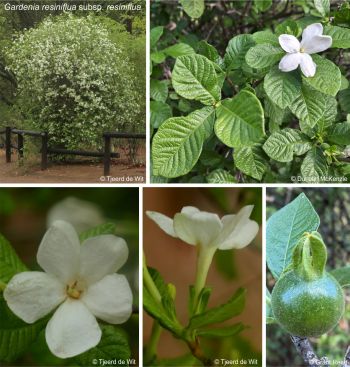
Gardenia resiniflua Hiern subsp. resiniflua
gummy gardenia (Eng.), harpuiskatjiepiering (Afr.)
SA Tree No:690.2
Shrub or small tree 3–7 m tall, with smooth, pale grey, slightly peeling bark. Leaves obovate, 20-80 mm long, apex pointed, veining conspicuous, velvety when young, becoming sparsely roughly hairy above, densely velvety below, in whorls of 3 on short, stiff side branchlets. Flowers white, about 30 mm long and 30 mm wide, solitary in the upper leaf axils, heavily sweet scented. Fruit small, yellowish-brown, ovoid to almost round, approximately 15 mm diameter, densely covered in short hairs, the calyx lobes remain attached to the fruit, like a crown. Flowering occurs in early summer (Nov. to Dec.), fruiting in late summer and autumn (Feb. to May). Occurs in bushveld, woodland and scrub, often along rivers, up to 1 300 m, in Limpopo and Mpumalanga in northern South Africa, and in Mozambique, Zimbabwe, Botswana, Malawi, Zambia and the DRC. The wood is suitable for carving and making utensils such as spoons. Fruits are used in tattoing. Leaves are browsed by buck. The name resiniflua means ‘with a flowing resin’ referring to the drops of yellow resin often found on the growing bud.
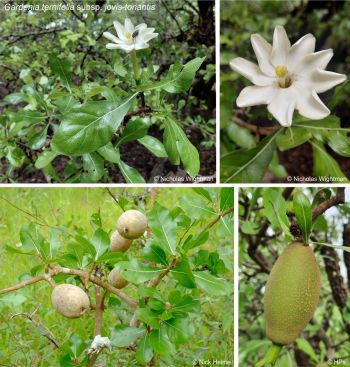
Gardenia ternifolia Schumach. & Thonn. subsp. jovis-tonantis (Welw.) Verdc. var. goetzei (Stapf & Hutch.) Verdc.
powder-bark gardenia (Eng.), poeierbaskatjiepiering (Afr.), tshiralala (Venda)
SA Tree No: 690.3
Shrub or small, spreading tree 3–5 m tall with smooth, powdery, grey or yellowish-brown bark. Leaves oblanceolate to obovate, apex rounded, roughly hairy on both surfaces and rough to the touch, in whorls of 3 on short, rigid side branchlets. Hair-tuft domatia are present on the leaves. Flowers are white, turning yellow with age, sweetly scented, up to 45 mm long and 40 mm wide, solitary at the ends of the branchlets. Fruits large, ovoid, 50 × 35 mm, velvety, yellowish-brown, crowned with the remains of the calyx, not ribbed. Flowering in spring and early summer (Sep. to Dec.), fruiting in late summer to winter (Feb. to Jun.). Occurs in wooded grassland, on rocky slopes and koppies, along streams and in vleis, and sometimes on termite mounds, in Limpopo in South Africa, and in Mozambique, Zimbabwe, Botswana, Namibia, Zambia, Malawi and in tropical Africa. The wood is hard and very fine-grained, yellow or pink. Seeds yield a black dye that is used for painting the skin. Branches are sometimes put on the roof to ward off lightning. The name ternifolia means ‘leaves in threes’, jovis-tonantis refers to ‘Jupiter the Thunderer’ and goetzii is named after German naturalist Walter Goetze (1872-1899).
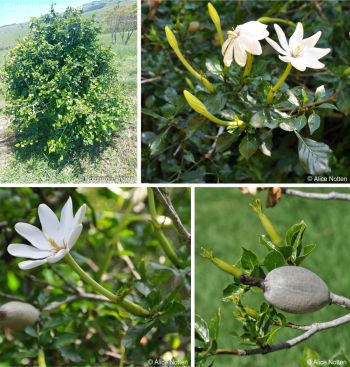
Gardenia thunbergia Thunb.
forest gardenia, white gardenia, wild gardenia (Eng.); witkatjiepiering, buffelsbal, boskatjiepiering, kannetjieboom (Afr.); umvalasangweni-wehlathi, umkhwakhwane (isiZulu); umkangazi, umkancaza, umkangana, isisende (isiXhosa).
SA Tree No:692
Shrub or small tree reaching up to 7 m in height. Leaves arranged in whorls of three to four, clustered towards the ends of branchlets; elliptic, measuring 75–150 mm by 38–100 mm; leathery with a glossy green appearance. Hairy pockets (domatia) are present on the underside of the leaves. The leaf apex is rounded and tapers finely, with a narrowed base attached to a slender petiole up to 26 mm long. The leaf margins are wavy and entire. Flowers are white, featuring a corolla tube up to 70 mm long with 8 (–9) spreading lobes. The calyx is tubular and foliaceous. The fruit is ovoid, approximately 90 x 55 mm, hard, with a persistent calyx. Flowering occurs from spring to late summer (Oct. to Feb.). Typically found in evergreen forests from the coast to the midlands, notably in the coastal region of Alexander Forest in the Eastern Cape to Kosi Bay in KwaZulu-Natal. Flowers attract hawk-moths (Agrius sp.). The root infusion is traditionally used as an emetic to treat biliousness and skin eruptions associated with leprosy.
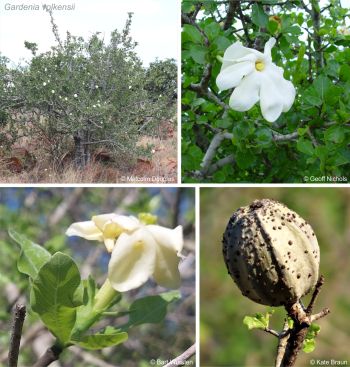
Gardenia volkensii K.Schum.
bushveld gardenia (Eng.); Transvaalkatjiepiering, bosveldkatjiepiering, kannetjieboom, stompdoring (Afr.); morala (Northern-Sotho, Tswana); umgongwane, umkhwakhwane-omkulu (isiZulu)
SA Tree No: 690.8 and 691 and 691.1
Small tree reaching up to 7 m in height. Leaves arranged in whorls of three, clustered near the ends of short, rigid branchlets. They are broadly ovate, measuring 30–75 x 25–40 mm, glossy dark green, often glabrous, rarely with the presence of hispid hairs on both sides. Hairy pockets (domatia) are present on the underside. The leaf apex is broadly tapering to a rounded tip, while the base narrows gradually into a slender petiole up to 26 mm long. Leaf margins are wavy and occasionally appear serrated. Flowers are white, turning yellow as they mature. The corolla tube can be up to 80 mm long, with 6(9) spreading lobes, opening at night. The calyx is tubular and foliaceous. The fruit is ellipsoid, measuring 110 x 100 mm, grey-green, and crowded with a persistent calyx. Flowering occurs from winter to summer (Jul. to Dec.). The species has been recorded in open woodlands and bushveld, from KwaZulu-Natal to tropical Africa.
Two subspecies of this species are recorded in southern Africa. They are separated based on their fruit morphology, although it is not always clear-cut, especially from preserved specimens. G. volkensii subsp. volkensii is distinguished from subsp. spatulifolia by its larger, white fruit with coarser ribs and conspicuous white dots (lenticels). G. volkensii subsp. volkensii var. saundersiae is diagnosed by its well-developed calyx lobes (15–25 mm long), whereas G. volkensii subsp. volkensii var. volkensii has calyx lobes up to 10–15 mm long.
References
- Boon, R. 2010. Pooley's trees of eastern South Africa, a complete guide. Flora & Fauna Publications Trust, Durban.
- Braun, K. 2025. Observations of Gardenia volkensii. iNaturalist. Online. https://www.inaturalist.org/observations/323979148 & https://www.inaturalist.org/observations/323694193.
- Bredenkamp, C.L. 2019. A flora of the Eastern Cape Province, Volume 2. Strelitzia 41. South African National Biodiversity Institute, Pretoria.
- Coates Palgrave, K. 2002. Trees of southern Africa. Struik, Cape Town.
- De Wit, T. 2022. Observation of Rothmannia capensis, Rietfontein, Gauteng. iNaturalist. Online. https://www.inaturalist.org/observations/123340263.
- De Wit, T. 2024. Observation of Gardenia resiniflua subsp. resiniflua, Phalaborwa, Limpopo, iNaturalist. Online. https://www.inaturalist.org/observations/251784203.
- Glen, H.F. 1983. Gardenia thunbergia Thunb. The Flowering Plants of Africa 47: t. 1863. South African National Biodiversity Institute, Pretoria.
- Global Biodiversity Information Facility, Gardenia thunbergia L.f. https://www.gbif.org/species/8233683. Accessed on 25 Nov. 2025.
- Helme, N. 2023. Observation of Gardenia ternifolia subsp. jovis-tonantis, K3, Zambia. iNaturalist. Online. https://www.inaturalist.org/observations/155596260.
- HPs. 2025-Feb. Observation of Gardenia ternifolia subsp. jovis-tonantis, Lilongwe, Malawi. iNaturalist. Online. https://www.inaturalist.org/observations/260256244
- Hutchings, A., Scott, A.H., Lewis, G. & Cunningham, A.B. 1996. Zulu medicinal plants: an inventory. University of Natal Press, Pietermaritzburg.
- Hyde, M.A., Wursten, B.T., Ballings, P. & Coates Palgrave, M. 2026. Flora of Zimbabwe: Gardenia resiniflua subsp. resiniflua. https://www.zimbabweflora.co.zw/speciesdata/species.php?species_id=155350.
- Hyde, M.A., Wursten, B.T., Ballings, P. & Coates Palgrave, M. 2026. Flora of Zimbabwe: Gardenia ternifolia subsp. jovis-tonantis var. goetzei. https://www.zimbabweflora.co.zw/speciesdata/species.php?species_id=155370.
- Joffe, P. 2001. Creative gardening with indigenous plants. Briza Publications, Pretoria.
- Manning, J. & Goldblatt, P. 2012. Plants of the Greater Cape Floristic Region 1: the Core Cape Flora. Strelitzia 29. South African National Biodiversity Institute, Pretoria.
- Maswoliedza, M. 2025. Rothmannia Thunb. (Rubiaceae) genus. PlantZAfrica. Online. https://pza.sanbi.org/rothmannia-genus.
- McKenzie, D. 2023. Observation of Gardenia resiniflua subsp. resiniflua, Maluleke, Limpopo. iNaturalist. Online. https://www.inaturalist.org/observations/190991627.
- Neuwinger, H.D. 2000. African traditional medicine: a dictionary of plant use and applications. MedPharm, Scientific Publishers, Stuttgart.
- Ngwenya, M. 2005. Gardenia cornuta Hemsl. (Rubiaceae). PlantZAfrica. Online. https://pza.sanbi.org/gardenia-cornuta.
- Notten, A. 2003. Gardenia thunbergia L.f. (Rubiaceae). PlantZAfrica. Online. https://pza.sanbi.org/gardenia-thunbergia.
- Palmer, E. & Pitman, N. 1972. Trees of southern Africa. Balkema, Cape Town.
- Pandela, N. 2025-Oct. Observation of Gardenia thunbergia, Pondoland, EC. iNaturalist. Online. https://www.inaturalist.org/observations/322362215.
- Rakotonirina, N., Rakouth, B. & Davis, A.P. 2012. A taxonomic revision of Madagascan Gardenia (Rubiaceae, Gardenieae). Nordic Journal of Botany 30(6): 712-728.
- Red List of South African Plants. Species list: Gardenia. https://redlist.sanbi.org/genus.php?genus=1412. Accessed 2026/03/17.
- Reed, G. 2026. Observation of Gardenia resiniflua subsp. resiniflua, Manicaland, Botswana. iNaturalist. Online. https://www.inaturalist.org/observations/339315843.
- Steyn, H. 2010. Gardenia volkensii K.Schum. (Rubiaceae). PlantZAfrica. Online. https://pza.sanbi.org/gardenia-volkensii.
- Swanepoel, S. 2020. Observation of Gardenia cornuta, Greater St Lucia Wetland National Park, KZN. iNaturalist. Online. https://www.inaturalist.org/observations/65763618
- Taylor, R. 2020. Observation of Gardenia cornuta, North Uthungulu, KwaZulu-Natal. iNaturalist. Online. https://www.inaturalist.org/observations/65638691.
- Wightman, N. 2025. Observation of Gardenia ternifolia subsp. jovis-tonantis, Mwinilunga, Zambia. iNaturalist. Online. https://www.inaturalist.org/observations/327150191.
- Wursten, B. 2025. Observation of Gardenia volkensii, Gorongosa National Park, Mozambique. iNaturalist. Online. https://www.inaturalist.org/observations/327697155.
Credits
Mulweli Maswoliedza
Foundational Biodiversity Science
National Herbarium
March 2026
Acknowledgements: Kate Braun, Tjeerd de Wit, Nicholas Wightman, Shaun Swanepoel, Ricky Taylor, Duncan McKenzie, Grant Reed, Nick Helme, HPs, Nonzuzo Pandela, Malcolm Douglas, Geoff Nichols, Bart Wursten and Alice Notten are appreciated for making their photographic images available.
Plant Attributes:
Plant Type: Shrub, Tree
SA Distribution:
Soil type:
Flowering season:
PH:
Flower colour:
Aspect:
Gardening skill:
Special Features:
Horticultural zones

Rate this article
Article well written and informative
Rate this plant
Is this an interesting plant?
Login to add your Comment
Back to topNot registered yet? Click here to register.