


Indigofera rostrata subsp. rostrata
Introduction
With its graceful sprays of pink flowers and soft silvery-green leaves, Indigofera rostrata is a hardy, eye-catching shrub that adds gentle colour and texture to dry, sunny landscapes. It is well suited to natural gardens and thrives with little attention.
Description
Description
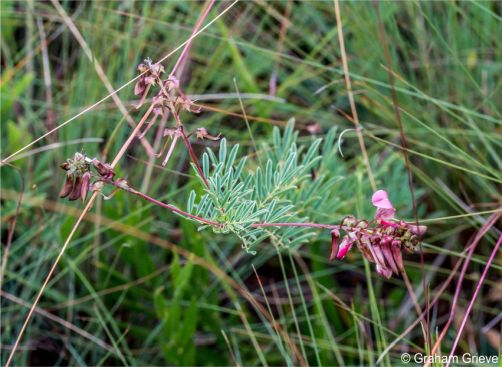
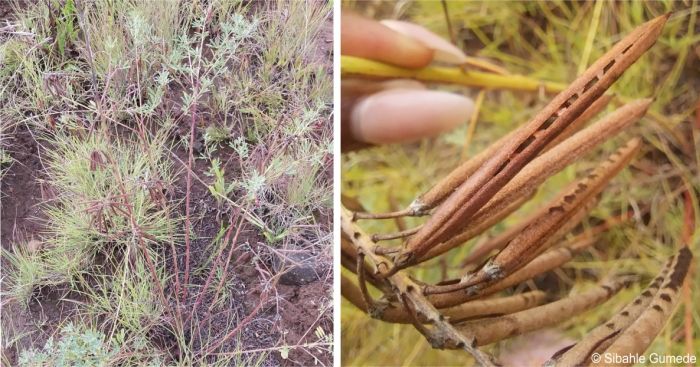
Indigofera rostrata subsp. rostrata is an erect, herbaceous, shrublet 0.5-1.5 m tall, with an unbranched stem that produces numerous leaves that are closely arranged along the stem. Leaf stalks are slender, leaves are pinnate with 5-13 leaflets up to 15 mm long x 7 mm wide, lance-shaped, with very short stalks, grey-green to bluish-green, and slightly hairy on both surfaces. The inflorescences are on stalks about 90-130 mm long, that stand out from the stem, each one a dense raceme of numerous pink to mauve, or crimson-red, pea-shaped flowers at the tip of the stalk. The flower buds are brown and hairy. After flowering it produces straight pods about 40 mm long and 2 mm wide, that contain a lot of hard brown seeds inside. Flowering occurs in summer (November to March).

Conservation Status
Status
According to the Red List of South African Plants, Indigofera rostrata is assessed as Least Concern (LC), meaning the wild population is currently not facing any threats.
Distribution and habitat
Distribution description
This Indigofera species occurs only in southern Africa, in South Africa, Lesotho, Mozambique and Eswatini. In South Africa, it occurs in the Eastern Cape, Limpopo, Free State, Mpumalanga, KwaZulu-Natal and Gauteng provinces. It grows in open grassland and bushveld, on rocky slopes, often in well-drained sandy or loamy soils.

Derivation of name and historical aspects
History
With approximately 750 species, the genus Indigofera is the third largest in the Fabaceae family. About 500 Indigofera species occur in Africa, of which ±200 occur in South Africa. The name Indigofera means ‘indigo bearing’, which is referenced from how certain species of Indigofera were used as a source of the purple dye, indigo. The species name rostrata is a Latin word meaning ‘beaked’, referring to the shape of the pods which are pointed and beak-like at the tip.
Ecology
Ecology
Indigofera species attract butterflies and other insects with proboscises to the plant when in flower. As seeds mature, the fruits dry up and snap open spontaneously and this is how the seeds are dispersed.

Uses
Use
This species is not so popular compared to other species such as I. tinctoria, I. jucunda, I. cordifolia, thus no information has been found regarding medicinal or cultural uses. It would make a beautiful garden plant with its showy pink summer flowers. Its growth form may not be ideal for some gardeners, but it can be planted in groups, and annual winter pruning might promote a more bushy growth habit.
Some Indigofera species have a lot of economic potential for green manure, soil stabilizers, forage crops, chemical compounds for pharmaceutical industry, poison, seed gums, traditional medicines, dyes, insecticides and horticultural ornamental.
Indigofera species are popularly used for indigo dye. The production of paints using indigo blue pigments has been dated to the 1st century. In West African countries, clothing dyed with indigo dye, symbolized wealth. The colonial North Americans referred to it as blue gold and considered it as a high value commodity. The clothing industry in central and southern America, used Indigofera suffruticosa for the extraction, whereas the Asians and Indians used Indigofera tinctoria for the same purpose.
Growing Indigofera rostrata subsp. rostrata
Grow
Indigofera rostrata prefers full sun, tolerates light frost, and grows best in summer-rainfall areas. It is drought-tolerant once established and suitable for water-wise gardens.
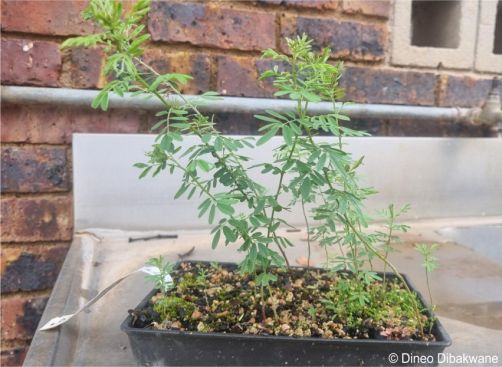
Seeds and tip cuttings of Indigofera rostrata were collected in early autumn and sowed in the beginning of summer in the same year. They were sowed in a 50:50 mix of river sand and potting soil. They germinated in 4 weeks. No seed treatment was done prior to seed sowing.
The tip cuttings were collected, put in a zip-lock bag, sprinkled with a little bit of water and kept away from direct sunlight. Two days after collecting the cuttings, they were dipped in hormone powder and planted in river sand. Unfortunately, they did not make it, they dried up and eventually died. Research with other Indigofera species show that this is very common. More trials will be done on new growth tip cuttings.
References
- Aiston, G. 2024-Jan. Observation of Indigofera rostrata ssp. rostrata, Umgungundlovu, KZN. iNaturalist. Online. https://www.inaturalist.org/observations/199374883.
- Bolus, L. 1896. Indigofera rostrata. Journal of Botany, British and Foreign. Vol. 34:28. West, Newman & Co., London.
- Bredenkamp, C.L. 2019. A flora of the Eastern Cape Province, Volume 2. Strelitzia 41. South African National Biodiversity Institute, Pretoria.
- Eswatini Flora Database. Indigofera rostrata. http://eswatinibiodiversity.com/flora/speciesinfo.asp?spid=3535. Accessed 18/11/25.
- Grieve, G. 2017-Dec. Observation of Indigofera rostrata ssp. rostrata, Mount Gilboa, KZN. iNaturalist. Online. https://www.inaturalist.org/observations/200162809.
- Grieve, G. 2017-Jan. Observation of Indigofera rostrata ssp. rostrata, Adam Kok memorial, KZN. iNaturalist. Online. https://www.inaturalist.org/observations/196975984.
- Gumede, S. 2024-Apr. Observation of Indigofera rostrata ssp. rostrata, Golden Gate Highlands National Park, Free State. iNaturalist. Online. https://www.inaturalist.org/observations/206634814.
- Kessler, L. 2012. Indigofera nigromontana Eckl. & Zeyh. (Fabaceae). PlantZAfrica. Online. https://pza.sanbi.org/indigofera-nigromontana.
- Papo, L. & Nkonki, T. 2016. Indigofera flabellata Harv. (Fabaceae). PlantZAfrica. Online. https://pza.sanbi.org/indigofera-flabellata.
- Plants of the World online. Indigofera rostrata subsp. rostrata. https://powo.science.kew.org/taxon/urn:lsid:ipni.org:names:77173108-1. Accessed 04/11/2025.
- Pooley, E. 2005. A field guide to wild flowers KwaZulu-Natal and the eastern region. The Flora Publications Trust, Durban.
- Raimondo, D., Von Staden, L., Foden, W., Victor, J.E., Helme, N.A., Turner, R.C., Kamundi, D.A. & Manyama, P.A. (eds) 2009. Red list of South African plants. Strelitzia 25. South African National Biodiversity Institute, Pretoria.
- Retief, E. & Meyer, N.L. 2017. Plants of the Free State inventory and identification guide. Strelitzia 38. South African National Biodiversity Institute, Pretoria.
- Schrire, B.D. 1992. New combinations and resurrected names in Microcharis and Indigastrum (Fabaceae—Papilionoideae). Bothalia 22(2): 165-170.
- Van der Merwe, T. 2025-Jan. Observation of Indigofera rostrata ssp. rostrata, Tzaneen, Limpopo. iNaturalist. Online. https://www.inaturalist.org/observations/259768038.
Credits
Dineo Dibakwane and Khanyisa Hlongwane
Walter Sisulu National Botanical Garden
December 2025
Acknowledgements: the authors thank Sibahle Gumede, Graham Greive, Garth Aiston and Troos van Der Merwe for making their images available on iNaturalist.
Plant Attributes:
Plant Type: Shrub
SA Distribution: Eastern Cape, Free State, Gauteng, KwaZulu-Natal, Limpopo, Mpumalanga
Soil type: Sandy, Loam
Flowering season: Early Summer, Late Summer
PH: Acid, Neutral
Flower colour: Red, Pink, Mauve/Lilac
Aspect: Full Sun, Morning Sun (Semi Shade), Afternoon Sun (Semi Shade)
Gardening skill: Average
Special Features:
 Attracts butterflies
 Drought resistant
Horticultural zones




Rate this article
Article well written and informative
Rate this plant
Is this an interesting plant?
Login to add your Comment
Back to topNot registered yet? Click here to register.