


Lobelia pinifolia
Introduction
Hardy, fine-leaved small shrub from the fynbos. Very rewarding since it can light up your garden over the warm summer months. More rewards are in store though for those giving it a light prune every year.
Description
Description
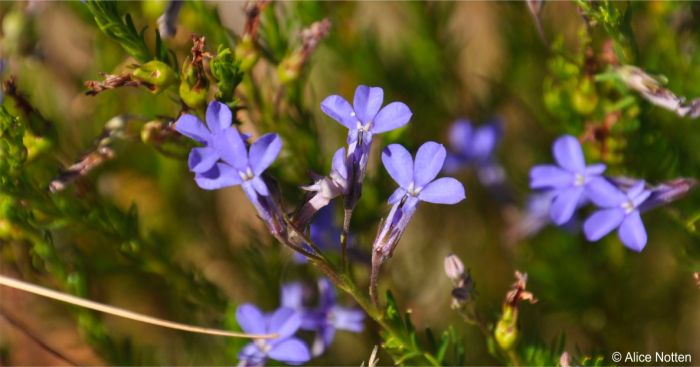
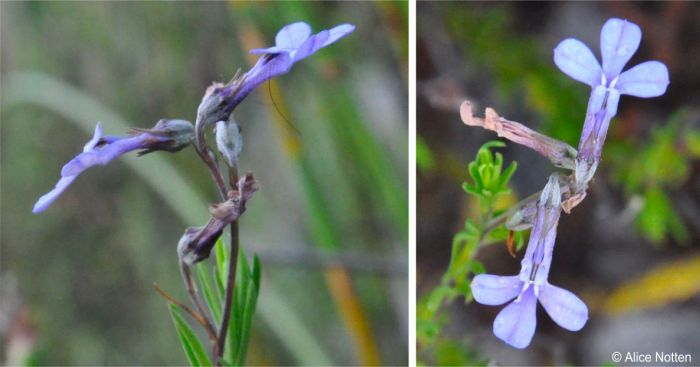
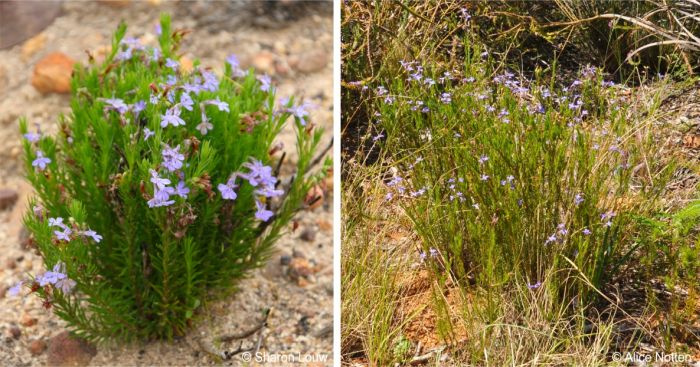
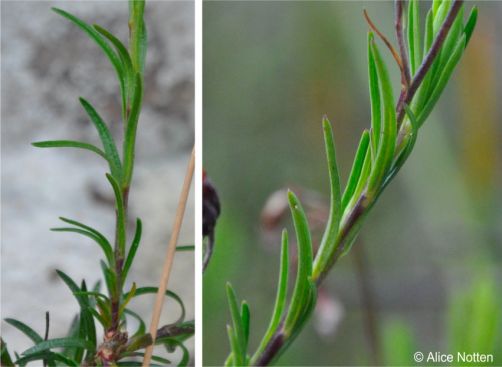
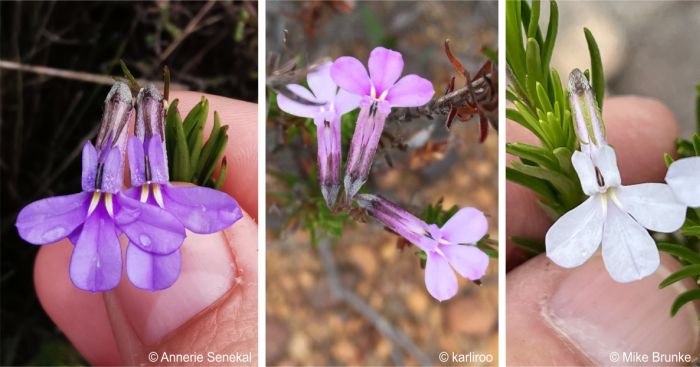
Erect shrublet up to 300-500 mm tall. Leaves dense, sessile, pointing upwards, narrow and rigid; margins entire and rolled back; 10-25 mm long and roughly 2 mm wide. The racemes of 3-10 flowers arise in the axils of the leaves; flowers are blue, pink, purple or white, with 5 petals, 3 larger ones at the bottom and 2 smaller ones above; and 2 sets of white-haired anthers. Flowering occurs almost throughout the year, but mainly in summer, from September to April.
Conservation Status
Status
Populations for this species are currently not under threat. This stability is the reason why it is afforded a conservation status of Least Concern (LC) according the SANBI Red List of South African Plants.
Distribution and habitat
Distribution description
The Lobelia pinifolia can be found in renosterveld and fynbos, on rocky sandstone slopes and flats, from Ceres southwards to the Cape Peninsula and westwards to Riversdale, between altitudes of 150-1 200 m.
Derivation of name and historical aspects
History
The generic name Lobelia honours M. de L’Obel, a Flemish botanist, traveller and plant collector (1538-1616). Upon completion of his studies in Leuven & Montpellier, he practiced medicine from 1571-1581 in Antwerp and Delft, where he was the doctor to William, the Prince of Orange. The outbreak of civil war in 1584, made him flee The Netherlands for England. He settled there for good, never going back once. In his newly adopted country he rose to become doctor and botanist to King James 1. Together with Pierre Pena, he collaborated to write Stripium Adversaris in 1571. This work describes about 1 500 species from the Netherlands, Switzerland (district Tyrol) and France (Montpellier-area). Two further works were produced: Plantaria Historia Stirpium in 1576, which featured more than 2 000 illustrations and Stirpium, seu, Plantraium Tam Exoticarum in 1591.
The species name pinifolia refers to the neede-like leaves which resemble those of the genus Pinus.
Ecology
Ecology
In the genus Lobelia the male reproductive organs mature first (protandrous), this is a strategy that ensures cross-pollination. The style (female organ) pushes through the tube that is formed by the fused anthers (male organs). This forces the ripe pollen out at the top where it is now available for collection by insects. Once the style has emerged fully, the stigmatic lobes separate and the female stage of the flower starts. The stigma is now ripe to receive pollen from another plant.
The specific pollinators for the species is not known, but a variety of bees, butterflies and beetles are seen visiting the flowers and effect pollination in the genus.
Uses
Use
The roots of Lobelia pinifolia have been used in remedies for skin disease, chronic rheumatism and gout. Several species of Lobelia have been used in traditional medicine where leaves are pounded and made into a concoction. This is to treat sore mouths, colds, to induce vomiting in stomach illnesses or are given to women just before child birth.
In a fynbos garden specifically there is room for this species as an ornamental as a decorative semi-herbaceous filler providing some colour during the hottest months of the year.
Growing Lobelia pinifolia
Grow
Lobelia pinifolia is mostly grown from cuttings, which can be done at any time of the year. Take semi-hardwood cuttings of between 40–60 mm long, make a cut below a node and dip in a rooting hormone for semi-hardwood material. Then place cuttings, using prepared holes for the size of the cuttings, in a well-draining medium consisting of equal portions milled bark and vermiculite or coarse river sand. Place cuttings in a mist-unit with a heated bench. Cuttings will root within 2–3 weeks. Harden-off the rooted cuttings for 2-3 weeks and before potting-up. Move the potted plants to a slightly shady area for 2–3 weeks, after which they can be moved into full sun.
The author has never grown this species from seed, but would treat it as a typical fynbos plant. Sow seed in autumn in a light, well-drained, acidic medium and cover lightly with a thin layer of fine sand or fine-milled bark. Treating the seed with smoke may enhance germination, however, according to the literature there is no significant difference in using smoke to improve seed-germination for lobelias. Water the seeds with a fine rose and ensure that the medium does not dry out or that seedlings get overwatered.
Lobelia pinifolia is ideally suited for mixed or border plantings and perfect for water-wise fynbos and renosterveld gardens. Plants in the wild often have a tatty appearance compared to those in cultivation. But this mountain-cliff can be crossed by ensuring that plants get a light prune every autumn. This should spruce them up considerably and raise their potential as prospective ornamental by quite a few notches. It will also ensure that its longevity is enhanced.
There are several species that share a habitat with the wild lobelia and make good companion plants in the garden. These may include: Leucospermum oleifolium, Leucospermum prostratum, Phylica ericoides, Oedera imbricata, Senecio halimifolius, Agathosma capensis, Agathosma serpyllacea, Lampranthus bicolor, Staberoha cernua, Serruria adscendens, Diosma oppositifolia, Pelargonium cucullatum, Pelargonium betulinum, Felicia filifolia and Felicia aethiopica.
No pests and disease have been recorded.
References
- Bean, A. & Johns, A. 2005. Stellenbosch to Hermanus. South African Wild Flower Guide 5. Botanical Society of South Africa, Cape Town.
- Bohnen, P. 1986. Flowering plants of the southern Cape. The Sill Bay Trust, Still Bay.
- Brown, N.A.C., Van Staden, J., Daws, M.I. & Johnson, T. 2003. Patterns in the seed germination response to smoke in plants from the Cape Floristic Region, South Africa. South African Journal of Botany 69(4): 514–525.
- Brunke, M. 2025-Sep. Observation of Lobelia pinifolia, Overberg. iNaturalist. Online. https://www.inaturalist.org/observations/313354547.
- Cupido, C. & Mannie, L-A. 2004-11. Lobelia. L. (Lobeliaceae). PlantZAfrica. Online. http://pza.sanbi.org./lobelia.
- Curtis-Scott, O., Goulding, M., Helme, N., McMaster, R., Privett, S. & Stirton, C. 2020. Field guide to the Renosterveld of the Overberg. Struik Nature, Cape Town.
- Germishuizen, S., Meyer, N.L., Steenkamp, Y. & Keith, M. (eds) 2006. A checklist of South African plants. Southern African Botanical Diversity Network Report No.41. SABONET, Pretoria.
- Jackson, W.P. 1980. Wild flowers of the Fairest Cape. Howard Timmins (Pty) Ltd. Cape Town
- Karliroo. 2020-Aug. Observation of Lobelia pinifolia, Silvermine Nature Reserve. iNaturalist. Online. https://www.inaturalist.org/observations/59564710.
- Louw, S. 2024-Oct. Observation of Lobelia pinifolia, Table Mountain National Park. iNaturalist. Online. https://www.inaturalist.org/observations/247786412.
- Manning, J. & Goldblatt, P. 2012. Plants of the Greater Cape Floristic Region 1: the Core Cape Flora. Strelitzia 29. South African National Biodiversity Institute, Pretoria.
- Maytham Kidd, M. 1983. Cape Peninsula. South African Wild Flower Guide 3. Botanical Society of SA, Cape Town.
- Raimondo, D., Von Staden, L., Foden, W., Victor, J.E., Helme, N.A., Turner, R.C., Kamundi, D.A. & Manyama, P.A. (eds) 2009. Red list of South African plants. Strelitzia 25. South African National Biodiversity Institute, Pretoria.
- Riley, H.P. 1963. Families of flowering plants of southern Africa. University of Kentucky Press, Kentucky.
- Senekal, A. 2023-Jul. Observation of Lobelia pinifolia, Silvermine Nature Reserve. iNaturalist. Online. https://www.inaturalist.org/observations/175677019.
- Trinder-Smith, T.H. 2003. The Levyns Guide to the plant genera of the south western Cape. Bolus Herbarium, UCT, Red Roof Design CC, Cape Town
Credits
Roger Oliver
Kirstenbosch National Botanical Garden
January 2026
Acknowledgements: images by Sharon Louw, Annerie Senekal, karliroo, Mike Brunke and Alice Notten.
Plant Attributes:
Plant Type: Shrub
SA Distribution: Western Cape
Soil type: Sandy, Loam
Flowering season: Early Summer, Late Summer, Sporadic/All year
PH: Acid
Flower colour: Blue, White, Pink
Aspect: Full Sun
Gardening skill: Easy
Special Features:
 Attracts butterflies
 Drought resistant
 Good potplant
 Medical plant
 Feeds honeybees
Horticultural zones


Rate this article
Article well written and informative
Rate this plant
Is this an interesting plant?
Login to add your Comment
Back to topNot registered yet? Click here to register.