


Mondia whitei
Introduction
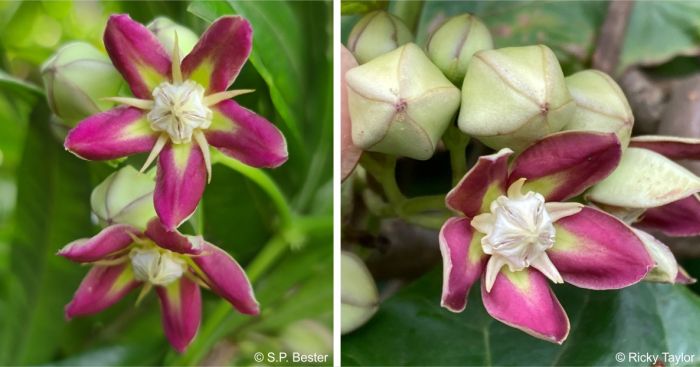
Mondia whitei, White's ginger, is a truly versatile and magical African herb – widely used medicinally and an excellent garden subject where a climber is needed to provide a shaded area.
Description
Description
Mondia whitei is a perennial, woody, rather robust and vigorous climber that grows from a large tuberous rootstock. The roots are aromatic and apparently taste like ginger or liquorice and have an aroma reminding one of vanilla. The leaves are attractive, large (100-300 x 50-150 mm), opposite, with a deeply notched heart-shaped base and 30-55 mm long stalks. The stipules are well developed and consist of frilly teeth.
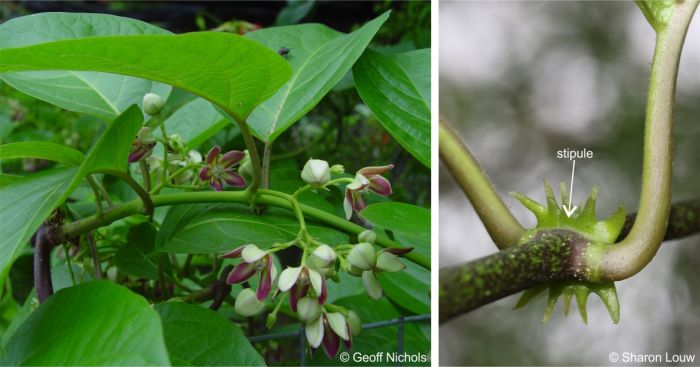
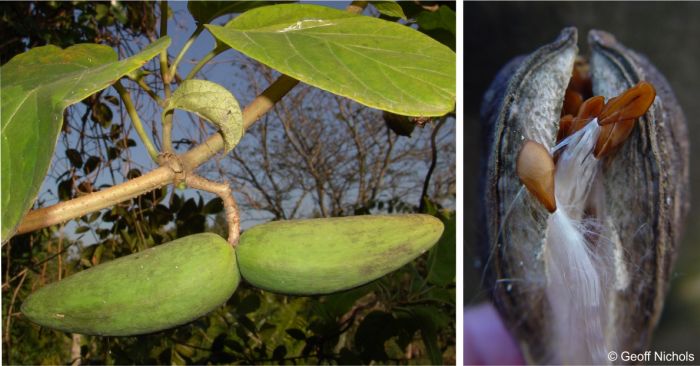
The flowers are borne in branched inflorescences; they are large and relatively short-lived (die after 3-4 days). The reddish-purple corolla lobes are ± 14 mm long and usually have a green margin. Plants flower during summer, from October to March in the species southern distribution region, and from May to August in the northern distribution region. The large fruits (75-100 x 44 mm) are almost woody and contain many seeds.
Conservation Status
Status
Mondia whitei is assessed as Endangered (EN) by the Red List of South African Plants. An endangered taxon has a very high risk of extinction in the wild. It has become rare in the wild throughout its distribution range and some subpopulations are believed to be extinct. The main threats to the species are over-harvesting of the tuberous rootstock for medicinal purposes and habitat loss caused by tree cutting, agriculture and drainage of wetlands. When the rootstock is harvested the plant is destroyed.
Mondia whitei is known to be extensively collected and sold for traditional medicine in South Africa. It was once regarded as fairly plentiful in the coastal districts of KwaZulu-Natal but has been reported as scarce in South Africa since the late 1800s. In Kenya it is among the most heavily exploited species and is reported to have disappeared from the central province due to both over-exploitation and an increase in demand for agricultural land.
It is reported to be extinct in the wild at seven sites in its main area of exploitation in South Africa, south of the Tugela River and at a further six sites between the Tugela River and Maputaland and in Limpopo. It is infrequently seen (rare) at the remaining sites and the population is estimated to have declined by 50% in the last 60 years.
Umondi is still found for sale in muthi shops in South Africa, but not all umondi in the market is Mondia whitei, because traders are substituting it with Cinnamomum zeylanicum, an indication of its scarcity. It is an extremely sought-after medicinal plant that has been critically over-exploited.
Various initiatives exist that strive to cultivate plants in order to satisfy the commercial demand and to reintroduce the species in the wild. Although Mondia whitei occurs in protected areas, there are concerns of bad management of reserves in some areas.
Distribution and habitat
Distribution description
Mondia whitei is endemic to southern, central, East and West Africa. In South Africa the plant is restricted to the coast and midlands in KwaZulu-Natal, and in Limpopo Province, and there are some records from Eswatini. From here the distribution extends northwards to South Sudan and west as far as Senegal.
Plants grow in dense bush in a variety of woodland and forest habitats. They have even been reported from shrubby swamp grassland. The species is frost-intolerant and favours moist tropical and subtropical situations. In South Africa plants are mainly found in swamp forest, occasionally in riverine and coastal forest, and in Afromontane forest.

Derivation of name and historical aspects
History
A farmer, A.S. White, from KwaZulu-Natal (at Fundisweni) sent roots to Kew via the Rev. Dr. J.C. Brown (Colonial Botanist at the Cape of Good Hope 1863-1866). He indicated that the plant was extensively collected by the Zulu people and used for promoting appetite or assisting digestion. Plants were successfully grown at Kew only after the third batch that was sent. When these plants eventually flowered J.D. Hooker realised that it was distinctly different to anything he knew. He placed it in a new genus, Chlorocodon, which refers to the bell-like green flowers. It was later moved to the genus Mondia which is derived from the Zulu name for the plant, umondi. The epithet whitei was given in honour of the farmer who first sent material to Kew.
The genus Mondia is endemic to the tropical and subtropical regions of Africa, and two species are recognised.
Ecology
Ecology
Umondi has some of the largest flowers in the sub-family Periplocoideae. They have a fruity but unpleasant scent which becomes stronger later in the afternoon. They are probably pollinated by flies.
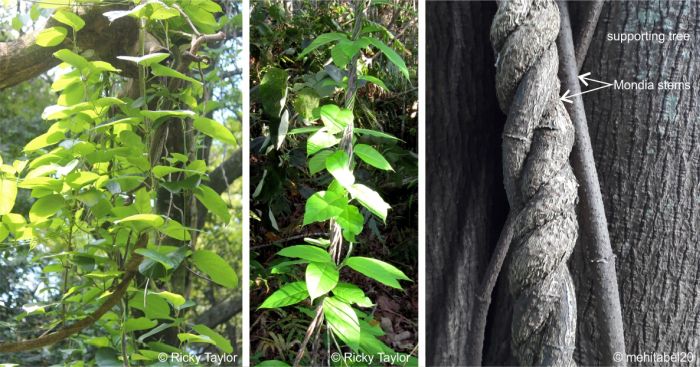
The plant grows as a climber with the basal portion of the stem usually leafless. The leaves and flowers mainly appear in the canopy of the supporting vegetation and are thus rarely noticed.
Uses
Use
Medicine: In South Africa the roots are used to stimulate the appetite, relieve flatulence and are chewed to relieve indigestion and stomach ache. Some people use the roots for making a tea that is used for the treatment of general pains and aches, others as a purgative, to treat body pain, abdominal pain, constipation, poor appetite and bilharzia, and even as an aphrodisiac. The dried leaves are powdered and mixed with food and taken daily as a supplement. The plant is also used as a symbol of peace, a sign of power, and for the treatment of hypertension, stroke, anaemia, asthma, hangover, mastitis and allergies. It is also taken to improve sleep, enhance urination, ease birth pains, and as mouth freshener and toothbrush.
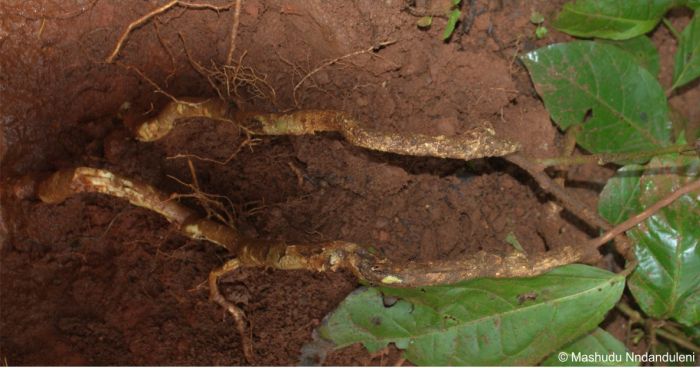
Food/Nutrition: The leaves serve as animal fodder and are consumed by humans as a vegetable. The early Portuguese in Angola boiled the leaves with butter or olive oil to substitute it for spinach. In South Africa the root is sometimes cooked with meat to enhance the flavour. The plant has great nutritional value as it contains the vitamins A, D, K and E, and the minerals, magnesium, zinc, iron, calcium and protein.
Flavourant/Drink: The bitter tasting roots have a vanilla odour and a sweet after-taste and are used to make a beverage similar to ginger beer. In West Africa, the roots are used to make an energizing drink for wedding parties when the roots are brewed in alcohol. Mondia can be used as a tea. It has a sweet vanilla-like flavour. The roots are said to taste bitter at first and then sweet.
Fragrance/spice: The vanilla-like odour of the plant may cause it to be regarded as a novel African fragrance or spice. The roots are said to taste like liquorice, or ginger. As a potential African spice, the scent and taste of the roots has variously been described as reminiscent of vanilla, ginger, marzipan, cinnamon and liquorice and may thus make a useful food-flavouring agent.
Poison: The seeds are believed to have once been used to make arrow poisons.
Fibres: Strong fibres may be obtained from the stems and woven into ropes.
Horticulture: The flowers are very attractive and highly recommended for cultivation.
Growing Mondia whitei
Grow
This species is easily cultivated from seed and cuttings. Seeds are collected as the fruit starts to split open – pick the seeds off from their parachute-like tuft of hairs before it opens. The seeds are best sown fresh, but they can be stored for about a year under normal room conditions. Use wood-ash from a fire mixed with the seed to prevent attack by insects. Seed in South Africa ripens naturally toward the end of the winter (August), just before the spring rains start.
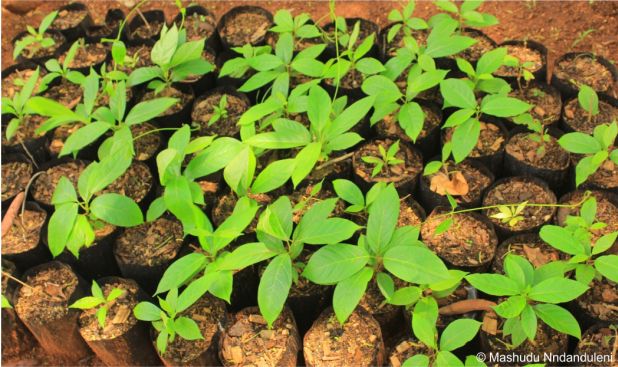
Sow fresh seed in spring when temperatures are warm. Fill seed-trays with compost and soil mixed in even amounts. Use a mixture of 50% seedling mix (or peat-moss or vermiculite) and 50% river sand. Sow seed and lightly cover with sand. Keep in a warm place that is moist at all times. Seedlings will germinate after ± 2(3-6) weeks. After germination protect the young plants from wind and sun and continue to water regularly – do not let the soil dry out completely. Seedlings grow rapidly in the growing season – up to 30 cm every 3-4 days.
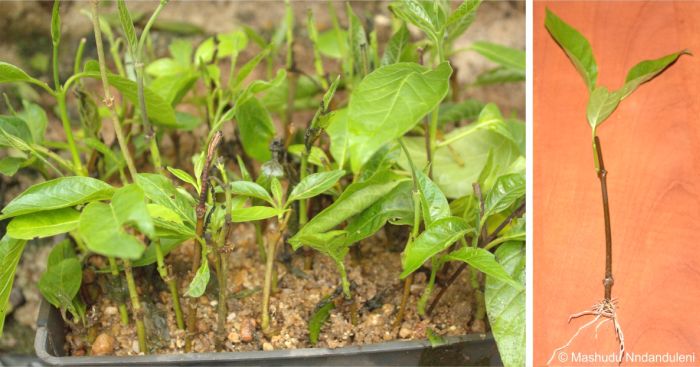
Mondia whitei is easy to grow and propagate from cuttings. Collect cuttings in the morning or on cool days, preferably from spring to late summer. Prepare cuttings measuring approximately 5–10 cm in length and treat them with a rooting hormone to stimulate root formation. Place the cuttings in a well-drained growing medium consisting of coarse river sand and milled bark and place them in a mist house. Monitor the cuttings regularly and remove any dead or fallen leaves to prevent disease. Rooting occurs within two weeks. Allow the cuttings to remain in the propagation medium for about one month to ensure adequate root development before potting.
The cuttings grow rapidly, and plants can reach approximately 1 m in height within three months. When long stems develop, train them onto supports early to prevent tangling. When plants reach about 15 cm in height, re-pot into larger bags or pots, or plant directly into the garden if possible. Ensure that plants are given sufficient growing space for healthy growth.
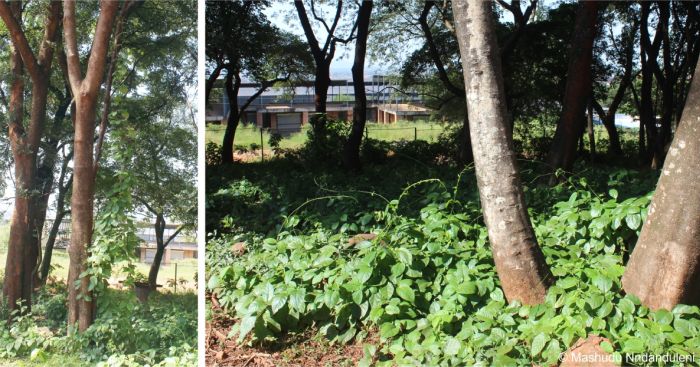
In the garden, plants are established from seed under the tree canopy and create a very pleasing display of the species in the garden. The plants that receive support in the garden climb much higher than those without support, with some plants observed to reach over 8 m tall in the garden. Plants that do not find suitable support are unable to climb, as their new growth requires a structure to attach onto in order to grow upwards.
Suitable areas to grow plants are usually restricted to lower, frost-free elevations. The maroon umbrella-shaped flowers splashed with yellow-green edging on the corolla lobes are arranged in attractive clusters. The coconut-scent encourages visiting insect pollinators, which are especially active in the early morning and evening. After fertilization the horned pods (follicles/fruits) develop which can reach the size of a man's outstretched hand. Undisturbed, these plants are remarkably long-lived. One specimen has been known to grow on the veranda of a hotel for 50 years.
Plants are commercially available from various nurseries at reasonable prices. Climate dictates the rate of growth. Make sure that the plants have enough room to grow.
References
- Botha, J., Witkowski, E.T.F. & Shackleton, C.M. 2001. An inventory of medicinal plants traded on the western boundary of the Kruger National Park. South Africa. Koedoe 44(2): 7-46.
- Crouch, N. 1998. Umondi - the versatile herb of Africa. Custos May: 24-25.
- Gelfand, M., Mavi, S., Drummond, R.B. & Ndemera, B. 1985. The traditional medical practitioner in Zimbabwe - his principles of practise and pharmacopoeia. Mambo Press, Gweru, Zimbabwe.
- Hutchings, A., Scott, A.H., Lewis, G. & Cunningham, A.B. 1996. Zulu medicinal plants: an inventory. University of Natal Press, Pietermaritzburg.
- Louw, S. 2025 Observation of Mondia whitei. iNaturalist. Online. https://www.inaturalist.org/observations/325829998.
- McCartan, S.A. & Crouch, N.R. 1998. In vitro culture of Mondia whitei (Periplocaceae), a threatened Zululand medicinal plant. South African Journal of Botany 64: 313-314.
- Mander, M., Mander, J., Crouch, N., McKean, S. & Nichols, G. 1995. Catchment action: Growing and knowing muthi plants. Share-Net, Howick.
- mehitabel20. 2020. Observation of Mondia whitei. iNaturalist. Online. https://www.inaturalist.org/observations/43915586.
- Nichols, G. 2005. Growing rare plants: a practical handbook on propagating the threatened plants of southern Africa. Southern African Botanical Diversity Network Report No. 36.
- Pooley, E. 2005. A field guide to wild flowers KwaZulu-Natal and the eastern region. The Flora Publications Trust, Durban.
- Ross, J.H. 1972. Flora of Natal. Botanical Survey Memoir No. 39. Government Printer, Pretoria.
- Ross, J.H. 1978. Mondia whitei. Flowering Plants of Africa 45: t. 1792
- Taylor, R. 2022. Observation of Mondia whitei. iNaturalist. Online. https://www.inaturalist.org/observations/107098988.
- Taylor, R. 2025 Observation of Mondia whitei. iNaturalist. Online. https://www.inaturalist.org/observations/329563516.
- Van Wyk, B.-E. & Gericke, N. 2000. People's plants, a guide to useful plants of southern Africa. Briza Publications, Pretoria.
- Venter, H.J.T., Verhoeven, R.L. & Bruyns, P.V. 2009. Morphology and taxonomy of Mondia (Apocynaceae: Periplocoideae). South African Journal of Botany 75: 456-465.
- Williams, V.L., Raimondo, D., Crouch, N.R., Cunningham, A.B., Scott-Shaw, C.R., Lötter, M. & Ngwenya, A.M. 2022. Mondia whitei (Hook.f.) Skeels. National Assessment: Red List of South African Plants version 2024.1. Accessed on 2026/01/03.
Credits
Stoffel Petrus Bester
National Herbarium, Pretoria
November 2009
Updated by Mashudu Nndanduleni
Thohoyandou National Botanical Garden
April 2026
Acknowledgements: images by S.P. Bester, Mashudu Nndanduleni, Geoff Nichols, Ricky Taylor, Sharon Louw and mehitabel20 – as credited.
Plant Attributes:
Plant Type: Climber
SA Distribution: KwaZulu-Natal, Limpopo
Soil type: Sandy, Loam
Flowering season: Early Summer, Late Summer
PH: Acid, Neutral
Flower colour: Purple, Red, Pink
Aspect: Shade, Morning Sun (Semi Shade), Afternoon Sun (Semi Shade)
Gardening skill: Easy
Special Features:
 Fragrant
 Good potplant
 Edible plant
 Medical plant
 Useful plant
Horticultural zones


Rate this article
Article well written and informative
Rate this plant
Is this an interesting plant?
Login to add your Comment
Back to topNot registered yet? Click here to register.