


Polhillia stirtoniana
Introduction
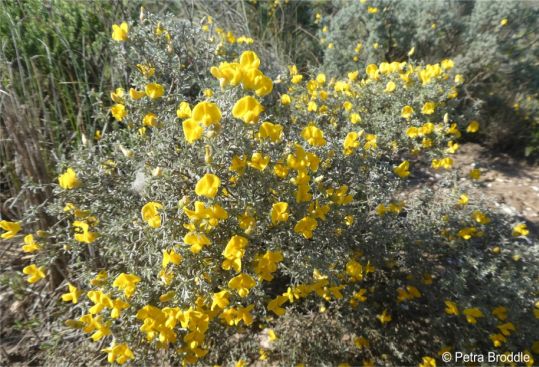
A newly described Renosterveld pea family plant, characterized by bright yellow flowers, silvery leaves and dense terminal branching that shapes it into a compact shrub with a closed canopy.
Description
Description
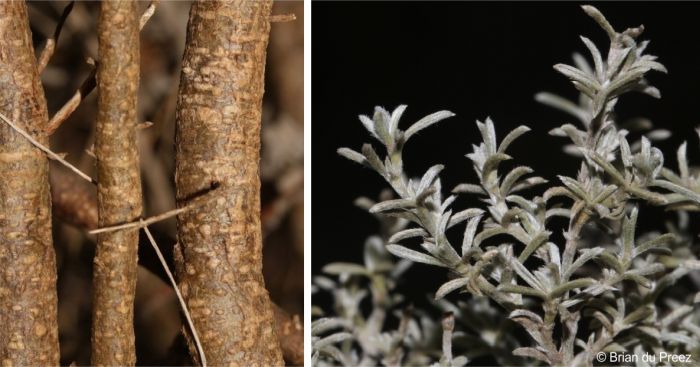
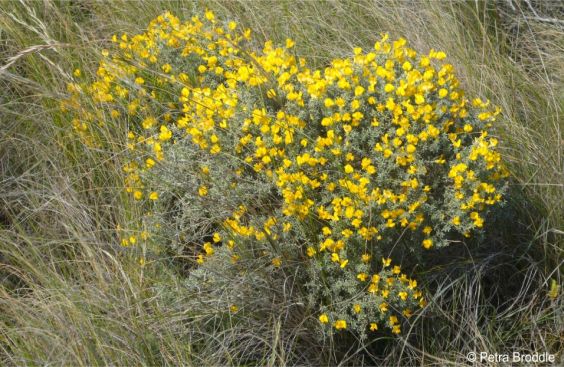
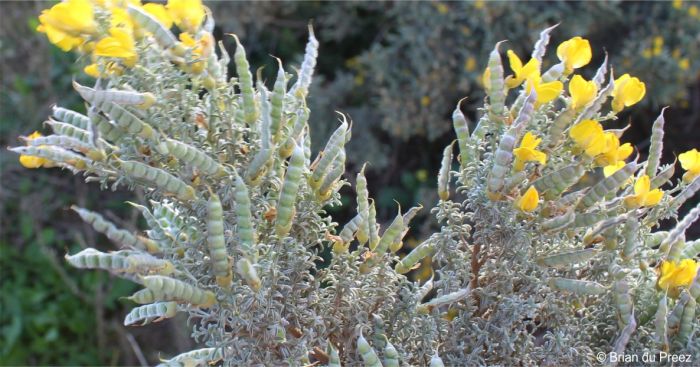
Polhillia stirtoniana grows upright, with a rounded shape, up to about 1 m in height. It often spreads wider than tall, forming a dense, bushy shrub. It has a woody rootstock and woody stems that form a dense, umbrella-like crown as it matures. Branches are greyish-brown, and the leaves are small, narrow, curved like a sickle, and covered with fine silvery hairs, giving the shrub a silvery appearance. Leaves stay tightly closed during dry weather and open slightly when it rains.
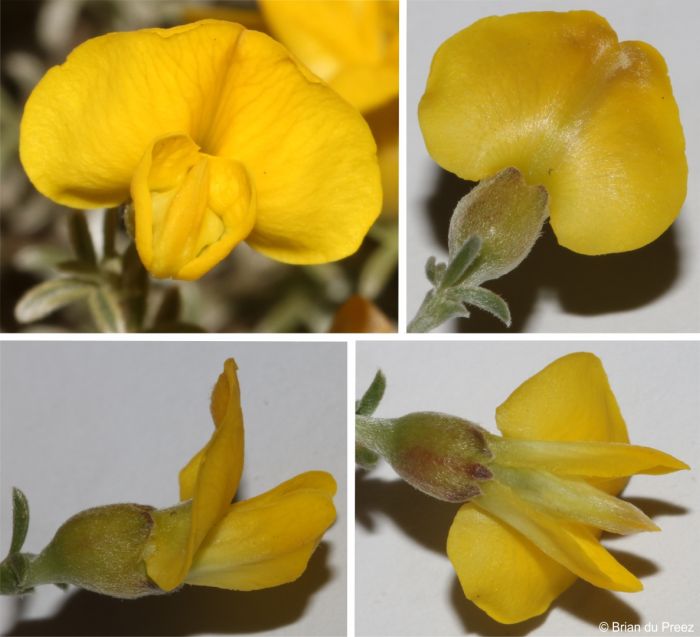
Flowers are bright yellow, small, around 9–11 mm long, with a greenish-yellow base covered with fine hairs and 1 or 2 flowers are produced per shoot. Pedicels are short, 1–2 mm long. Standard petal (the large upper petal) is hairy on the back surface. Calyx is up to 4 mm long, very hairy, and 2-lipped. It flowers in winter and spring (from June to September). Fruits are silky pods, pale olive-green, and do not split open when mature. Seeds are small, smooth, olive-green to dark brown, oval to kidney-shaped.
Conservation Status
Status
Described formally only recently, in 2021, this species has been proposed for listing as Near Threatened (Du Preez et al. 2021). The assessment is still under review and will be included in the 2026 Red List of South African Plants website update. Most of its natural habitat has been converted to agricultural land, with less than 20% of suitable habitat remaining. The species is currently known from 12 locations, all of which are experiencing ongoing decline due to the spread of invasive alien plants and the lack of fire.
Distribution and habitat
Distribution description
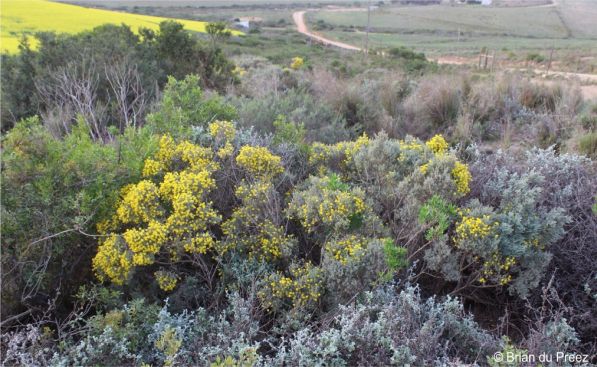
This species is endemic to the Overberg District, occurring from Potberg to Stromsvlei. It grows in Shale Renosterveld, typically in sheltered gullies and on cool, south-facing slopes, and is the most abundant species within its genus. Polhillia stirtoniana is distributed in a transitional area between the coastal winter rainfall region and the inland Karoo, where rainfall is more evenly spread across autumn and spring rather than concentrated in winter.
Derivation of name and historical aspects
History
The genus Polhillia is named in honour of Roger M. Polhill, a botanist at Kew Gardens and an expert on legumes. Polhillia belongs to the legume family (Fabaceae), which is one of the largest plant families containing about 750 genera and over 18 000 species worldwide (Wink 2003). The genus is endemic to the Cape Provinces and currently has 10 species.
Polhillia stirtoniana was previously included in Polhillia pallens but was sufficiently distinct to be recognized as a different species. The specific epithet stirtoniana honours Prof. Charles Howard Stirton for his enormous contributions to the study of Cape legumes, as well as his late wife, Dr Jana Stirton, who shared his passion for the diversity and conservation of the Overberg Renosterveld. This species was formally described in 2021 by Dr Brian du Preez, a botanist and specialist legume taxonomist.
Ecology
Ecology
Sickle renosterpea is a long-lived plant that sprouts from underground stems after fire or disturbance. It grows in abundance in sheltered gullies and on cool slopes. Flowers are pollinated by honeybees (B. du Preez, pers. comm. 2025).
Uses
Use
There are no documented traditional uses or known cultural associations for this species or the genus Polhillia.
Growing Polhillia stirtoniana
Grow
Polhillia stirtoniana can be propagated from seeds by removing them from the ripe pods and planting them in seed trays in autumn. The seeds have specific soil requirements, preferring shale-derived clay soils with the appropriate rhizobia present (B. du Preez, pers. comm., 2025). Like Polhillia ignota, a resprouter, they should also root easily from cuttings grown under controlled conditions. Additionally, plants require a cooler environment, as they naturally grow in sheltered locations.
References
- Broddle, P. 2020. Observations of Polhillia stirtoniana. iNaturalist. Online. https://www.inaturalist.org/observations/67394886 & https://www.inaturalist.org/observations/67698754.
- Curtis-Scott, O., Goulding, M., Helme, N., McMaster, R., Privett, S. & Stirton, C. 2020. Field guide to the Renosterveld of the Overberg. Struik Nature, Cape Town.
- Du Preez, B. 2016. Observation of Polhillia stirtoniana. iNaturalist. Online. https://www.inaturalist.org/observations/11304642.
- Du Preez, B. 2017. Observations of Polhillia stirtoniana. iNaturalist. Online. https://www.inaturalist.org/observations/37706935, https://www.inaturalist.org/observations/37553086 & https://www.inaturalist.org/observations/37753140.
- Du Preez, B., Dreyer, L.L. & Stirton, C.H. 2021. A monograph of the genus Polhillia (Genisteae: Fabaceae). South African Journal of Botany 138: 156–183.
- Jackson, W.P.U. 1990. Origins and meanings of names of South African plant genera. University of Cape Town Printing Department, Cape Town.
- Wink, M. 2003. Evolution of secondary metabolites from an ecological and molecular phylogenetic perspective. Phytochemistry 64: 3–19.
Credits
Hlengiwe Mtshali
Threatened Species Programme
January 2026
Acknowledgements: images by Petra Broddle and Brian du Preez.
Plant Attributes:
Plant Type: Shrub
SA Distribution: Western Cape
Soil type: Clay, Loam
Flowering season: Spring, Winter
PH: Acid
Flower colour: Yellow
Aspect: Morning Sun (Semi Shade)
Gardening skill: Average
Special Features:
 Feeds honeybees
Horticultural zones


Rate this article
Article well written and informative
Rate this plant
Is this an interesting plant?
Login to add your Comment
Back to topNot registered yet? Click here to register.