


Lotononis lotononoides
Introduction
Lotononis lotononoides is not a well-known species, but, this evergreen shrub still has something to offer even when it is not in flower. Its distinctive grey foliage makes it an excellent choice for a mixed bed or shrubbery.
Description
Description
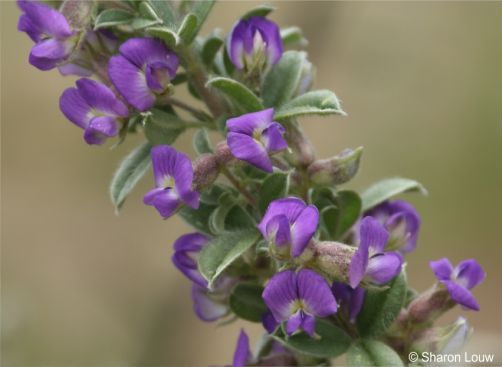
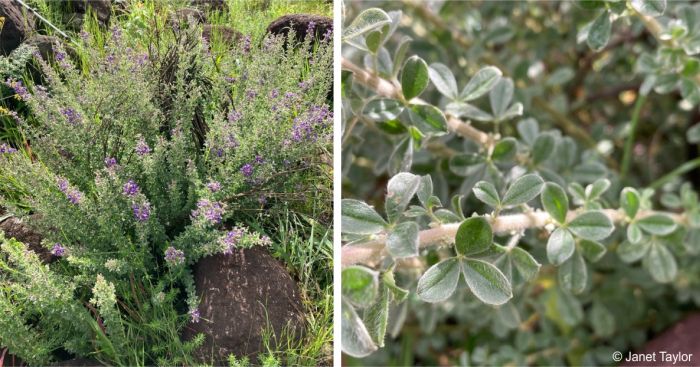
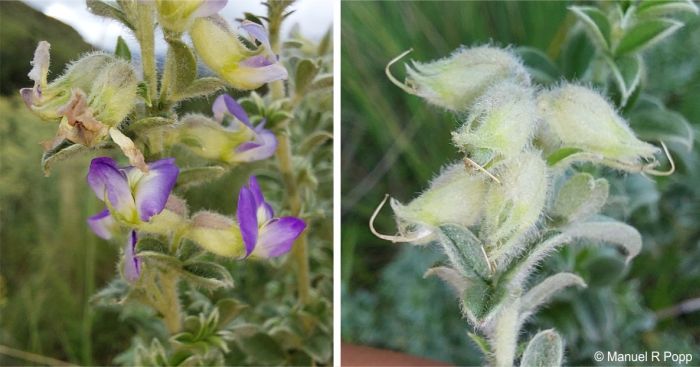
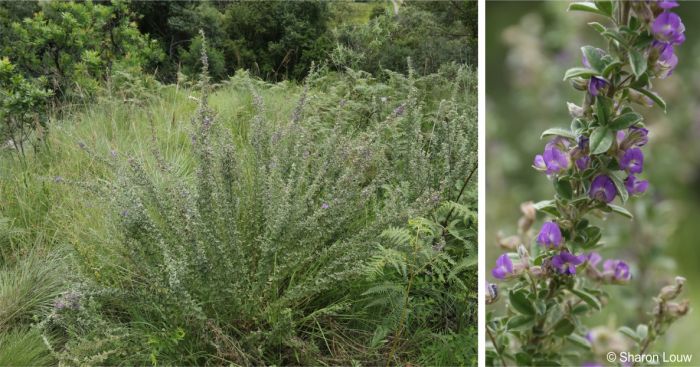
Lotononis lotononoides is a perennial shrublet that grows up to 1.2 m tall. Young plants have sparsely arranged stems, but the older a plant gets, the more dense it becomes. The leaves are trifoliolate and hairy. The leaflets are oval and about 20 x 8 mm long, and have a hair-like tip that is recurved. Flowers are dark blue, with a yellowish or creamy white centre, and they grow up to about 10 mm. The calyx, stipules and the flower stalks are all hairy. The large, uppermost petal of the flower is blue, with darker shades of blue in vertical lines and it is white at the base. The flowers only develop in the axils of the leaves (the angle where a leaf or branch grows from the main stem) towards the tips of the branchlets. The fruits are hairy as well and they have a hair-like tip at the end. Flowering time is in summer, from December to April.
Conservation Status
Status
According to the Red List of South African Plants, the conservation status for Lotononis lotononoides is Least Concern (LC), meaning it is considered at low risk of extinction and that the wild population is growing well.
Distribution and habitat
Distribution description
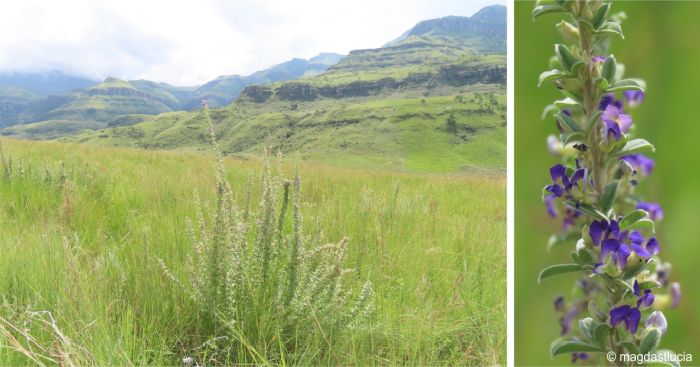
The genus Lotononis is indigenous to southeastern Europe (Bulgaria and Greece and Turkey), as well as in Africa (Ethiopia, Malawi, Angola, Zimbabwe and South Africa). Lotononis lotononoides only occurs in the southern region of Africa, in Lesotho and in South Africa, where it occurs in Eastern Cape, Free State and KwaZulu-Natal provinces. It grows in moist rocky grassland in the Drakensberg, at an altitude of 1 500-2 650 m above sea level, sometimes in colonies.
Derivation of name and historical aspects
History
The genus Lotononis previously consisted of about 150 species, before some were reclassified into other genera. It currently consists of about 99 species of woody or herbaceous herbs and shrublets. The name Lotononis is actually a combination of two genus names, Lotus and Ononis. The species name means ‘resembling Lotononis’. Lotononis lotononoides was first described as Buchenroedera lotononoides by Scott Elliot in 1891, from a specimen collected by Drège in the Eastern Cape of South Africa. It was reclassified and given its current accepted name, Lotononis lotononoides, by the botanist Ben-Erik van Wyk, in 1991.
The genus Lotononis falls under the Fabaceae which is also known as the pea, bean or legume family, and it ranks as the third-largest family of flowering plants, after Orchidaceae and Asteraceae. It consists of ±770 genera and more than 19 000 species worldwide. The word Fabaceae is derived from the Latin word faba which means ‘bean'. Members of this family are found across a broad range of habitats and exhibit a wide variety of growth forms, including annuals, perennials, shrubs and trees. Plants in this family are easily identified by their fruits and compound leaves. The fruits are pods and they split open along the seams when the seeds are mature.
Other noteworthy southern African members of this family include Aspalathus linearis (rooibos tea), Erythrina lysistemon (common coral tree or lucky bean tree), Elephantorrhiza elephantina (elephant's root or elandsboontjie), Vachellia and Senegalia (thorn trees, both previously known as Acacia).
Ecology
Ecology
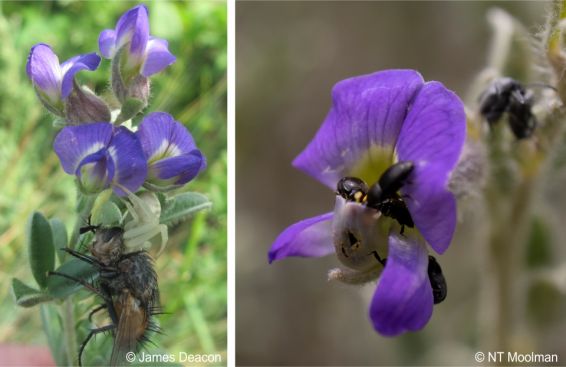
The pollination biology of Lotononis lotononoides has not yet been studied. Various insects, including beetles, spiders and flies have been observed visiting the flowers in habitat and could be possible pollinators, especially the flies. It is possible that the flowers emit an unpleasant smell that attracts flies. Some beetles visit flowers to eat the petals and not necessarily to pollinate the flowers. The possibility that they might be pests is not rulled out.
As for most Fabaceae species, the pods dry out over time and split open when the seeds are mature.
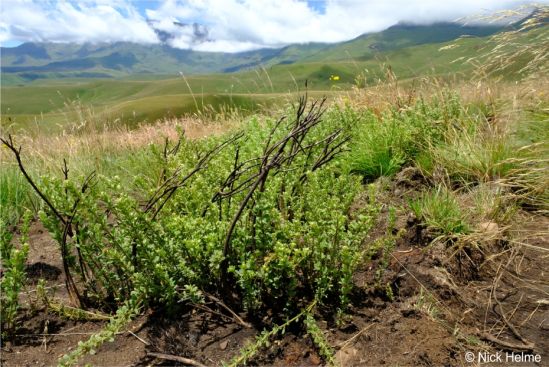
Resprouting plants growing among the charred remains of burned stems have been observed in habitat. Their woody rootstock allows them to survive grass fires.
Uses
Use
Lotononis lotononoides has a lot of potential in the horticultural industry. The fact that it is hardy, evergreen, and has beautiful foliage and flowers, fulfils some of the desired characteristics for plants that are in high demand for gardening.
Growing Lotononis lotononoides
Grow
Lotononis lotononoides grows well in summer-rainfall areas, prefers full sun and can take a little bit of frost.
The seeds of Lotononis lotononoides were collected in the Drakensberg, in early autumn and sowed in the beginning of summer in the same year. A mixture of 50:50 of river sand and potting soil was prepared, put in seedlings trays and the seeds were sowed. The seeds were not treated and it took them 3 weeks to germinate.
Tip cuttings were also collected in the Drakensberg, placed in a clear zip-lock plastic bag, sprinkled with a little bit of water to keep the plants moist and kept in a cooler box. Upon returning to the botanical garden, they were lightly dipped in hormone powder and planted in washed river sand. Unfortunately, they did not survive. More trials will be done on new growth tip cuttings.
References
- Deacon, J. 2021. Observation of Lotononis lotononoides, Kamberg, KwaZulu-Natal. iNaturalist. Online. https://www.inaturalist.org/observations/70868065.
- Helme, N. 2021. Observation of Lotononis lotononoides, Giant’s Castle, KwaZulu-Natal. iNaturalist. Online. https://www.inaturalist.org/observations/105254406.
- Lock, J.M. 1989. Legumes of Africa. A check-list. Royal Botanic Gardens, Kew.
- Louw, S. 2025. Observation of Lotononis lotononoides, uThukela District Municipality, KwaZulu-Natal. iNaturalist. Online https://www.inaturalist.org/observations/261351945.
- magdastlucia. 2025. Observation of Lotononis lotononoides, uThukela District Municipality, KwaZulu-Natal. iNaturalist. Online. https://www.inaturalist.org/observations/261844717.
- Moolman, N.T. 2025. Observation of Lotononis lotononoides, Okhahlamba Drakensberg, KwaZulu-Natal. iNaturalist. Online. https://www.inaturalist.org/observations/261610808.
- Pooley, E. 2003. Mountain flowers, a field guide to the flora of the Drakensberg and Lesotho. Natal Flora Publications Trust, Durban.
- Popp, M.R. 2022. Observation of Lotononis lotononoides, Sisonke, KwaZulu-Natal. iNaturalist. Online. https://www.inaturalist.org/observations/106922897.
- Raimondo, D., Von Staden, L., Foden, W., Victor, J.E., Helme, N.A., Turner, R.C., Kamundi, D.A. & Manyama, P.A. (eds) 2009. Red list of South African plants. Strelitzia 25. South African National Biodiversity Institute, Pretoria.
- Taylor, J. 2022. Observation of Lotononis lotononoides, uThukela District Municipality, KwaZulu-Natal. iNaturalist. Online. https://www.inaturalist.org/observations/104657986.
- Van Wyk, B.-E. 1991. A synopsis of the genus Lotononis (Fabaceae: Crotalarieae). Contributions from the Bolus Herbarium 14.
Credits
Dineo Dibakwane
Walter Sisulu National Botanical Garden
January 2026
Acknowledgements: images by James Deacon, Janet Taylor, magdastlucia, Manuel R Popp, NT Moolman, Nick Helme and Sharon Louw.
Plant Attributes:
Plant Type: Perennial, Shrub
SA Distribution: Eastern Cape, Free State, KwaZulu-Natal
Soil type: Sandy, Loam
Flowering season: Early Summer, Late Summer
PH: Acid, Neutral
Flower colour: Blue
Aspect: Full Sun
Gardening skill: Average
Special Features:
Horticultural zones




Rate this article
Article well written and informative
Rate this plant
Is this an interesting plant?
Login to add your Comment
Back to topNot registered yet? Click here to register.