


Crassula inopina
Introduction
Crassula inopina is a cluster-forming spreading succulent, bearing four-ranked leafy branches and conspicuous rounded inflorescences in midwinter, of bi-coloured flowers with white petals that form a sharp contrast with the fleshy purple carpels. It grows on steep rocky slopes and low cliffs in the Olifantsberg, Worcester region in the Western Cape. It grows well in containers as a potted plant in Mediterranean-climate gardens.
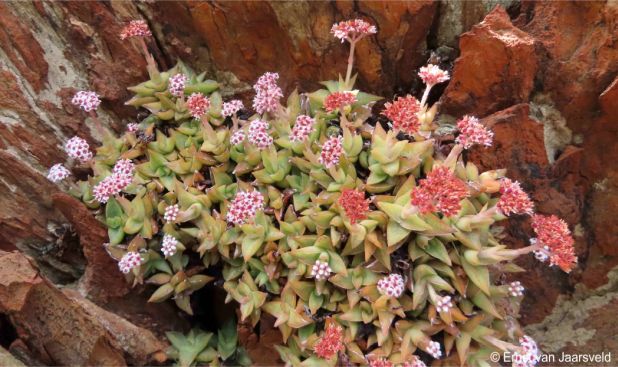
Fig. 1. Crassula inopina in flower in its north-west facing rocky Malmesbury shale habitat, on the farm De Breede Rivier, Worcester, Western Cape. Note the white flowers with their bright magenta carpels that turn a darker maroon colour with age.
Description
Description
Perennial, much-branched, evergreen succulent, branching from the base and higher up, forming dense to loose cushions up to 200 mm in diameter. Branches elongate with up to 5-12 pairs of functional leaves and when in flower, can be up to 70-120 mm tall, the old leaves persistent. The roots fibrous. The branches recline to becoming ascending, 50-120 mm long, 2-4 mm in diameter at base, the internodes not visible to scarcely visible 3-8 mm apart. The surface is smooth at first, green becoming brownish. The leaves grow in opposite pairs (decussate), firm, 4-ranked, ascending spreading, constricted towards the heart-shaped base, sessile, distinctly succulent, triangular-ovate, becoming smaller upwards, 15–25 × 8–15 mm; upper surface light greyish green, shallowly channelled, the surface smooth dotted purplish, the lower surface boat-shaped to rounded (convex). The leaf margin pointed (acute) with a dense row of translucent, stiff, recurved hairs, the leaf tip drawn to a sharp point (acuminate), the tip often incurved mucronate. The inflorescence is a terminal, rounded thyrse with 1-8 dichasia and sessile 5-merous flowers and distinct peduncles, 35-50 mm long 2 mm diam. at base and with 3 pairs of oblong triangular bracts. The calyx lobes ovate triangular 1 x 0.8 mm long with a row of short cilia along margin, apices acute, ending in a translucent mucro. The flowers (corolla) tubular about 2.5 mm long and about 4 mm wide in fully opened flowers. The petals panduriform, not fused at the base, white, 2.3 mm long and 1 mm wide, the lobes spreading, each with an indistinct sub-terminal shortly pointed dorsal appendage. The carpels bright magenta turning a darker maroon colour with age. The stamens 2 mm long with maroon filaments and fused to base of petals. The seed is pear-shaped, brown minutely striate tuberculate, 0.5 x 0.3 mm. Flowering time is in midwinter (June and July).
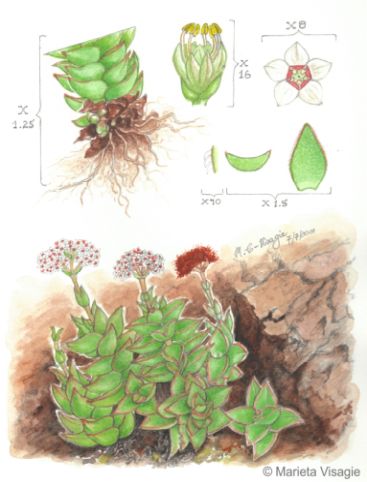
Fig. 2. An illustration of Crassula inopina by botanical artist Marieta Visagie, depicted growing in its shale cliff habitat on the farm De Breede Rivier near Worcester, Western Cape.
Conservation Status
Status
Crassula inopina has not yet been assessed for the Red List of South African Plants. Current data indicates that it is a Rare species, with a restricted distribution.
Distribution and habitat
Distribution description
Crassula inopina is only known from the southern foothills of the Olifantsberg, on the farm De Breede Rivier, northwest of Worcester, Western Cape Province, South Africa. It grows in rock fissures on partly weathered rocky outcrops. The geology consists of Malmesbury shale and conglomerate. The plants have been recorded at an altitude of between 326 and 440 m above sea level. Rainfall is mainly during winter with an annual mean precipitation of 370 mm. Rainfall usually occurs from May to August.
Crassula inopina grows on exposed, north-facing, steep rocky slopes and low cliffs and often also under the protection of overhangs and in crevices. The stems lengthen to about 100 mm when growing in shade and resemble a form of Crassula perforata.
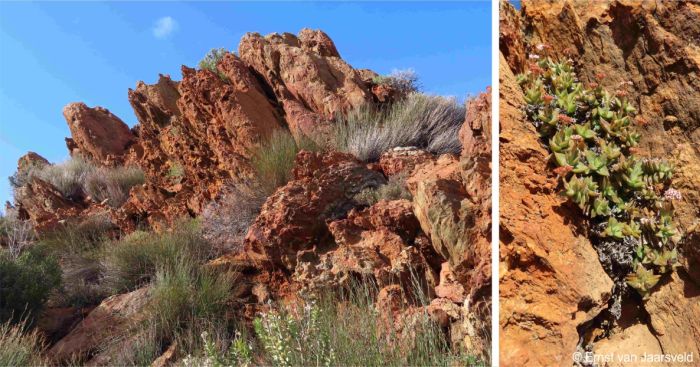
Fig. 3. LEFT The north-west facing, rocky Malmesbury shale habitat of Crassula inopina, on the farm De Breede Rivier, Worcester, Western Cape. RIGHT Crassula inopina growing in a crevice, in habitat.
The vegetation consists of a mixture of Breede Shale Renosterveld (Fynbos Biome) and elements of Succulent Karoo. It is part of the unique winter-rainfall mosaic vegetation of the mountains and intermontane valleys in the Worcester area, mainly determined by the geology.
Crassula inopina plants grows in full sun or sometimes in the shade of shrubs in its habitat. Common species sharing its habitat include Aloe microstigma, Crassula rupestris, Passerina obtusifolia and Restio gaudichaudianus. Other associated common plants in its habitat include Dodonea viscosa subsp. angustifolia, Euclea undulata, Capeochloa arundinacea, Chrysocoma ciliata, Drimia capensis, Dicerothamnus rhinocerotis, Eriocephalus africanus, Euryops rehmannii, Felicia filifolia subsp. schaeferi, Aizoon africana (= Galenia africana), Heterolepis aliena, Oedera genistifolia, Oedera squarrosa, Othonna perfoliata (= O. amplexifolia), Pteronia incana, Pteronia paniculata, Anthospermum aethiopicum, Agathosma ovata, Thesium subnudum, Selago glutinosa, Wahlenbergia tenella and Roepera flexuosa (= Zygophyllum flexuosum). Succulents are commonly encountered in exposed rocky outcrops. These include Adromischus filicaulis subsp. marlothii, Crassula atropurpurea var. muirii (= C. atropurpurea var. rubella), Crassula rupestris, Conophytum ficiforme, Delosperma pageanum, Drosanthemum hallii, Drosanthemum hispidum, Euphorbia mauritanica, Mesembryanthemum longistylum, Pelargonium carnosum, Pelargonium rapaceum, Ruschia caroli and Tylecodon paniculatus. Fern species include Cheilanthes capensis and annual species such as Cineraria lobata occur. Geophytes include Boophone disticha, Eriospermum capense, Freesia refracta, Lapeirousia pyramidalis, Xenoscapa fistulosa, Oxalis pes-caprae and Oxalis convexula.
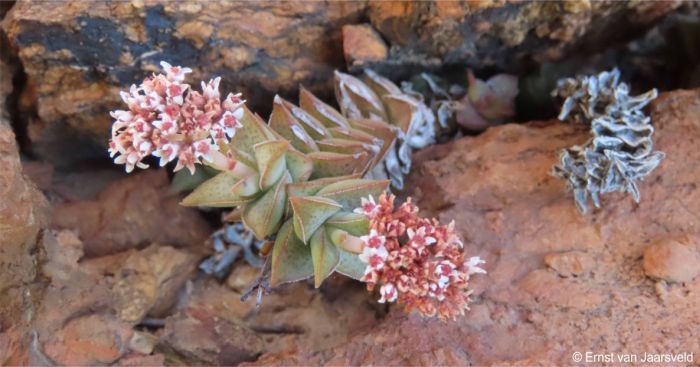
Fig. 4. Crassula inopina in flower growing in a crevice in its rocky Malmesbury shale habitat. Note the rouned inflorescence, and 4-ranked, glaucous succulent leaves with dots on the surface and a row of stiff hairs on the margins.
Derivation of name and historical aspects
History
Crassula inopina was named by Anso Le Roux and the author in 2024 in Bradleya, a British magazine specialising in succulents. The plant was unexpectedly discovered on 1 July 2021 during a visit to a farm just west of Worcester, hence the name inopina, meaning ‘unexpectedly’. The purpose of the visit was to examine the prospect of replanting illegally collected Conophytum ficiforme on a shale hill (Malmesbury group, Cape Supergroup). This species of Crassula was noticed growing on the north-facing cliffs (Malmesbury Group). Superficially it resembled a form of Crassula capitella, however on closer inspection, the features of the inflorescence, namely the rounded thyrse, flowers with bright magenta carpels, and short, reflexed styles render this species comparable to Crassula socialis and Crassula intermedia. Plants were also gathered by the author for the Babylonstoren succulent collection as well as material pressed and dried for the Compton Herbarium. The plants were then given to the botanical artist Marieta Visagie who prepared the plate depicted in this PlantZAfrica article.
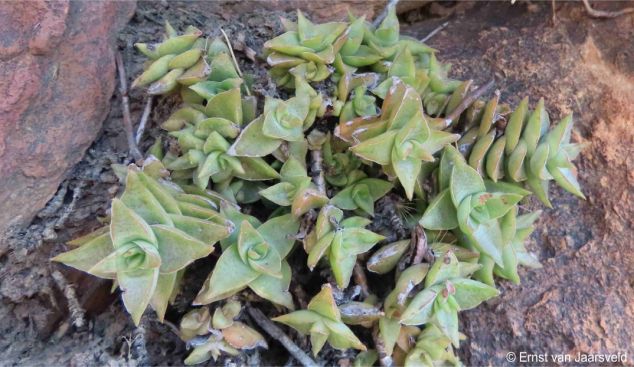
Fig. 5. Crassula inopina growing in a crevice in its rocky Malmesbury shale habitat on the farm De Breede Rivier. Note the 4-ranked, glaucous, succulent leaves.
South Africa is rich in diversity of succulent plants and especially plants in the family Crassulaceae which is represented by 5 genera, Adromischus, Cotyledon, Crassula, Kalanchoe and Tylecodon, of which the genus Crassula is the largest with about 150 species and with clear centres of diversity in the semi-arid winter-rainfall region of South Africa (Western Cape and western parts of the Northern Cape). The southern African members of the genus Crassula was revised by Toelken in 1977 and later again written up by him for the Flora of Southern Africa in 1985. Toelken divided the group into 20 sections and this new species clearly belongs to section Rosulares, which in southern Africa represents 25 species.
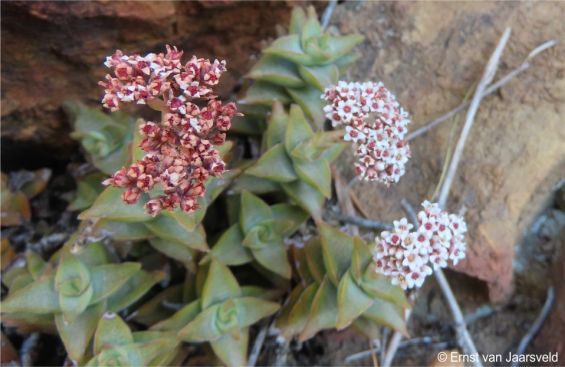
Fig. 6. Crassula inopina in flower in habitat, note the rounded inflorescence and bi-coloured flowers, the magenta carpels becoming dark maroon and white petals turning brown with age.
Ecology
Ecology
These are cluster-forming plants with spreading ascending branches, however on steep rocky slopes and in vertical cliff habitats, the plants become drooping. The stems are flaccid becoming sub-pendulous. The leaves are ascending spreading, glaucous, closely packed, and 4- ranked, and an adaptation to the xeric conditions of the cliff face. Plants are long-lived perennials.
The inflorescence is a round-topped thyrse, conspicuous in autumn and winter (April–June) bearing white and purple bi-coloured flowers pollinated by insects. The fruits (follicles) are dehiscent, the seed spontaneously released and dispersed by wind. Seeds are dispersed in time for spring rains, maximising establishment.
The leafy stems and branches when becoming detached will root when landing on a suitable habitat.
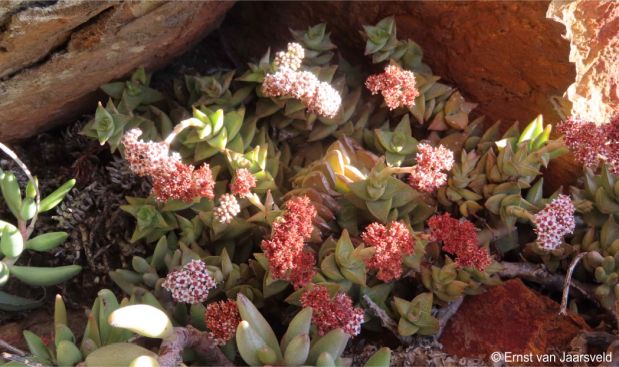
Fig. 7. Crassula inopina in flower in a shady crevice in its rocky Malmesbury shale habitat on the farm De Breede Rivier, Worcester, Western Cape.
Growing Crassula inopina
Grow
Crassula inopina with its compact growth four ranked succulent leaves and rounded bi-coloured flowerheads is an appealing succulent with ornamental value. It is best grown in a container but can also be grown in succulent karoo or dry Mediterranean-climate gardens, on rockeries among rocks and free from competition from non-succulent plants..
It grows well in containers with a gravelly substrate which drains well. It also grows well with other succulents in miniature succulent gardens where conditions can be controlled. Keep in full sun or dappled shade. Plants are easily propagated by stem cuttings and not difficult to root. Avoid over watering. Water should be provided throughout the year, but sparingly.
Sow seed in autumn or spring in a shallow tray in a sandy mixture and keep moist. Germination is within 3 weeks and once large enough to handle, transfer to individual containers. Place containers in a sunny or dappled shady position but with full light. The sunny, north side (southern Hemisphere) of a building is ideal.
Plants are relatively disease free, except for stem and roots that will rot with too much watering. Aphids, wine weevils, slugs and snails can sometimes be a problem.
References
- Eggli, U. (ed.) 2003. Illustrated handbook of succulent plants: Crassulaceae. Springer, Berlin.
- Le Roux, A. 2018. The vegetation ecology of the Witteberg and Dwyka Groups south of Worcester, Western Cape Province, South Africa. University of South Africa, Pretoria.
- Mucina, L. & Rutherford, M.C. (eds) 2006. The vegetation of South Africa, Lesotho and Swaziland. Strelitzia 19. South African National Biodiversity Institute, Pretoria.
- Rowley, G. 2003. Crassula: a growers guide. Cactus & Co. Vista, California.
- Smitheman, J. & Perry, P. 1990. A vegetation survey of the Karoo National Botanical Garden Reserve, Worcester. South African Journal of Botany 56(5):525-541.
- Toelken, H.R. 1977. A revision of the genus Crassula in southern Africa. Contributions from the Bolus Herbarium No.8. Bolus Herbarium, University of Cape Town.
- Toelken, H.R. 1985. Crassulaceae. Flora of Southern Africa 14: 1–244.
- Van Jaarsveld, E.J. & Le Roux, A. 2024. Crassula inopina, a new cliff-dwelling succulent species from Worcester, Western Cape, South Africa. Bradleya 42: 179–185.
- Van Jaarsveld, E.J. & Van Wyk, A.E. 2009. Crassula perforata subsp. kougaensis, a new cliff-dwelling taxon from South Africa. Aloe 46(1): 22–23.
Credits
Ernst van Jaarsveld
Kirstenbosch National Botanical Garden (Retired)
Babylonstoren Farm (Current)
Extraordinary senior lecturer and researcher,
Department of Biodiversity and Conservation, University of the Western Cape
April 2026
Acknowledgements: the author thanks Anso Le Roux for arranging the field trip and co-authoring this species, Louis Steenkamp the owner of the farm on the lower slopes of Olifantsberg, Streicher Moller for his assistance in the field and Marieta Visagie for her illustration.
Plant Attributes:
Plant Type: Succulent
SA Distribution: Western Cape
Soil type: Sandy
Flowering season: Winter
PH: Acid, Neutral
Flower colour: Purple, White
Aspect: Full Sun, Afternoon Sun (Semi Shade)
Gardening skill: Average
Special Features:
 Attracts butterflies
 Drought resistant
 Good potplant
 Indoor plant
Horticultural zones



Rate this article
Article well written and informative
Rate this plant
Is this an interesting plant?
Login to add your Comment
Back to topNot registered yet? Click here to register.