


Calpurnia reflexa
Introduction
Calpurnia reflexa, commonly known as Sotho laburnum or Free State golden pea, is a shrub to small tree bearing attractive bright yellow flowers in summer. It is a member of the legume family, and endemic to southern Africa with a limited distribution.
Description
Description
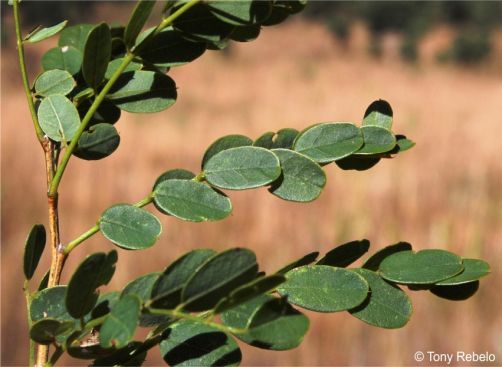
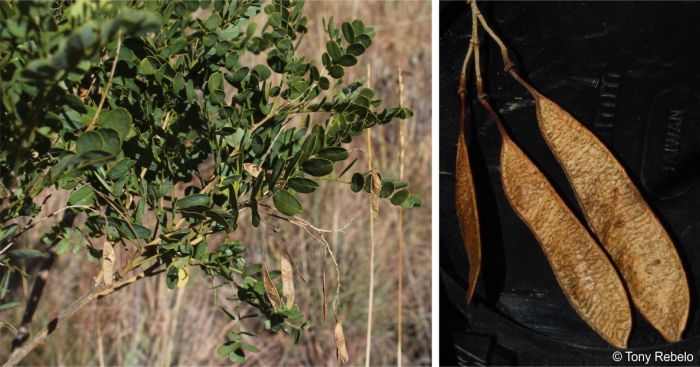
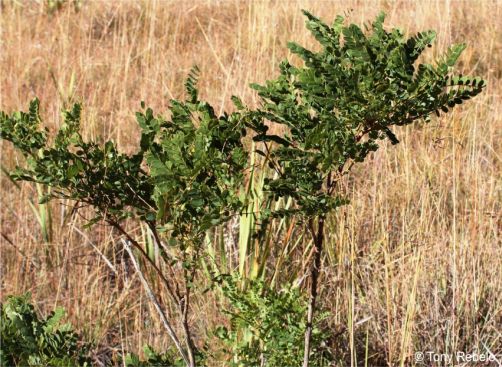
A small tree or shrub that grows up to 4 m tall. The bark is brown or grey. The leaves are green, alternate and 30 to 100 mm long, compound, with up to 12 leaflets in pairs and a terminal leaflet. The leaflets are oval shaped (ovate) with a fine bristle at the tip, and the petiole is up to 25 mm long. Immature leaves are slightly hairy becoming almost hairless as they mature. The young stems are also covered with fine hair. The flowers are bright yellow, pea-like and arranged in clusters of 10-30 flowers. The flower stalk and calyx are slightly hairy. The petals have different shapes, and are of the papilionoid type, with a standard petal, wing petals and keel petal. The calyx lobes and standard petal bend backwards at the tip (reflexed), distinguishing it from other Calpurnia species. Flowering occurs in early to mid-summer, from October to January. The fruits are dry, straw-coloured, flat, pods up to 45 mm long and 10 mm wide, containing 1–3 seeds and remain closed at maturity, in mid-summer (January).
Conservation Status
Status
This species is assessed as Rare by the Red List of South African plants, because it has a highly restricted distribution, occurring at fewer than 10 sites in only two provinces in South Africa and in Lesotho, making it of conservation concern, although it is not regarded as threatened.
Distribution and habitat
Distribution description
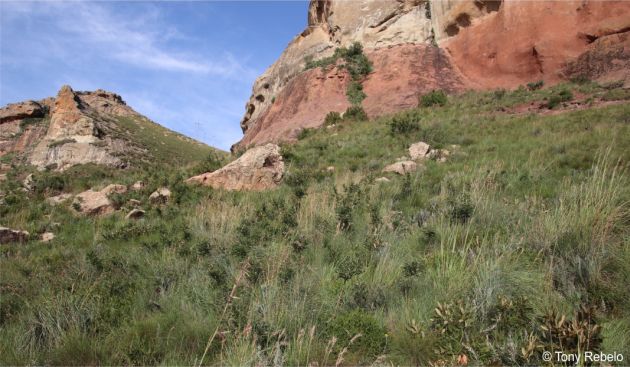
Calpurnia reflexa is a mountain plant, and native and endemic to southern Africa, found in South Africa and Lesotho. In South Africa, it occurs at high-altitude, above 1 800 m, in the mountain regions of the eastern Free State and the northern Eastern Cape. It grows in forest, thicket and different types of grassland, particularly on sheltered mountain slopes and moist mountain habitats. Its distribution extends into the highlands of Lesotho and is usually in small, scattered populations.
Derivation of name and historical aspects
History
The genus Calpurnia, commonly known as the African laburnum, is a small group of shrubs and trees in the Fabaceae. The plants are recognised by their distinctive pea-shaped yellow flowers and flat seed pods, known as legumes. The genus name was given by the German botanist Ernst Heinrich Friedrich Meyer (E. Mey.), he named it after the Roman poet, T. Julius Calpurnius. The name was chosen because plants in the genus Calpurnia are closely related to and thus similar to those in the genus Virgilia, which was named after the Roman poet Virgil, and it was thought that Calpurnius imitated Virgil’s work. The names of the two plant genera therefore reflect their close botanical relationship. Most Calpurnia species are endemic to southern Africa, one species, Calpurnia aurea, the best-known species, is more widespread with a wide distribution, occurring in southern, eastern and central Africa, as well as parts of southern India. Calpurnia sericea (mountain calpurnia), which is closely related to Calpurnia reflexa, occurs in grassland and among rocks in the Eastern Cape, Free State, KwaZulu-Natal, Mpumalanga and in Lesotho and Eswatini; and Calpurnia woodii (woolly calpurnia), is also a rare species with a limited distribution that occurs in bushveld and grassland in KwaZulu-Natal.
The species name reflexa is a Latin word meaning ‘bent backward’ or ‘turned back’, which describes backward-curving lobes of the calyx which is unique in Calpurnia. The common name Free State Golden-pea refers to the plant’s occurrence in the Free State province and its bright golden-yellow flowers, which resemble those of pea plants. Sotho Laburnum refers to the plant's occurrence in regions traditionally associated with the Sotho people and its resemblance to European laburnum trees, which produce hanging clusters of bright yellow flowers.
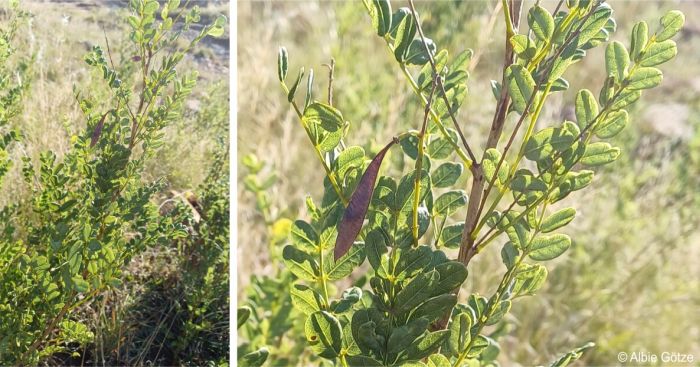
Ecology
Ecology
The bright yellow flowers of Calpurnia reflexa attract bees and other insects providing pollen and nectar.
Uses
Use
The plant is not known in cultivation, but, like its better known relative Calpurnia aurea, may make an good ornamental plant and be valued for its attractive golden yellow flowers.
The branches of Calpurnia reflexa are used by the Basotho people primarily as a construction material to make light rafters for traditional huts, and are a source of firewood for domestic fires. The leaves of some species of Calpurnia are known to have insect-repelling properties.
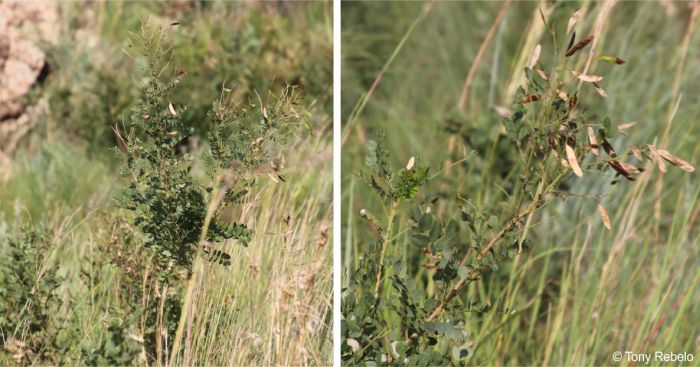
Growing Calpurnia reflexa
Grow
There is no information on the propagation and cultivation of Calpurnia reflexa due to its limited distribution, however other species in the genus are grown from seeds sown in spring or summer. Seeds are first soaked in hot water and treated with fungicides that combat pre- and post-emergence damping off. Seedlings are pricked out as soon as the first pair of true leaves develop. C. reflexa typically grows in moderately moist grasslands and mountain ravines, where there’s adequate soil moisture and protection from harsh climatic conditions.
References
- Backer, C.A. 1936. Verklarend woordenboek plantennamen. Noordhoff, Groningen.
- Beaumont, A.J., Beckett, R.P., Edwards, T.J. & Stirton, C.H. 1999. Revision of the genus Calpurnia (Sophoreae: Leguminosae). Bothalia 29(1): 5–23.
- Boon, R. 2010. Pooley's trees of eastern South Africa, a complete guide. Flora & Fauna Publications Trust, Durban.
- Bredenkamp, C.L. 2019. A flora of the Eastern Cape Province, Volume 2. Strelitzia 41. South African National Biodiversity Institute, Pretoria.
- Coates Palgrave, K. 1983. Trees of southern Africa. Struik, Cape Town.
- Götze, A. 2024. Observation of Calpurnia reflexa, Witsieshoek, Free State. iNaturalist. Online. https://www.inaturalist.org/observations/256529013.
- Kamundi, D.A. & Raimondo, D. 2013. Calpurnia reflexa A.J.Beaumont. National Assessment: Red List of South African Plants, version 2024.1. Online. https://redlist.sanbi.org/species.php?species=378-20.
- Moteetee, A., Moffett, R.O. & Seleteng-Kose, L. 2019. A review of the ethnobotany of the Basotho of Lesotho and the Free State Province of South Africa (South Sotho). South African Journal of Botany 122: 21-56.
- Rebelo, T. 2013. Observation of Calpurnia reflexa, Golden Gate National Park, Free State. iNaturalist. Online. https://www.inaturalist.org/observations/10870577.
- Rebelo, T. 2019. Observation of Calpurnia reflexa, Golden Gate National Park, Free State. iNaturalist. Online. https://www.inaturalist.org/observations/27164005.
- Retief, E. & Meyer, N.L. 2017. Plants of the Free State inventory and identification guide. Strelitzia 38. South African National Biodiversity Institute, Pretoria.
- Van Wyk, A.E. (Braam) & Van Wyk, P. 2013. Field guide to trees of southern Africa, edn 2. Struik, Cape Town.
- World Flora Online. Calpurnia reflexa A.J.Beaumont. http://www.worldfloraonline.org/taxon/wfo-0000581557. Accessed 15 June 2026.
Credits
Sharlotte Kwenaite
Free State National Botanical Garden
August 2026
Acknowledgements: The author thanks Tony Rebelo and Albie Gotze for making their images available on iNaturalist and granting permission to utilise them.
Plant Attributes:
Plant Type: Shrub, Tree
SA Distribution: Eastern Cape, Free State
Soil type: Loam
Flowering season: Early Summer
PH: Acid, Neutral
Flower colour: Yellow
Aspect: Full Sun, Morning Sun (Semi Shade), Afternoon Sun (Semi Shade)
Gardening skill: Challenging
Special Features:
 Feeds honeybees
Horticultural zones


Rate this article
Article well written and informative
Rate this plant
Is this an interesting plant?
Login to add your Comment
Back to topNot registered yet? Click here to register.