


Rosettea princeps
Introduction
Rosettea princeps is an outstanding garden plant with magnificent flowers and decorative foliage. It is easy to grow, and is ideal for the water or vlei (marsh) garden, or for a permanently damp spot.
Description
Description
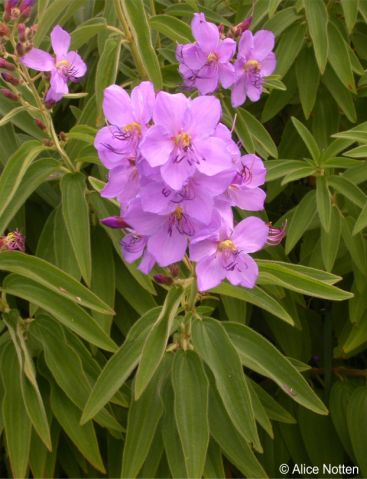
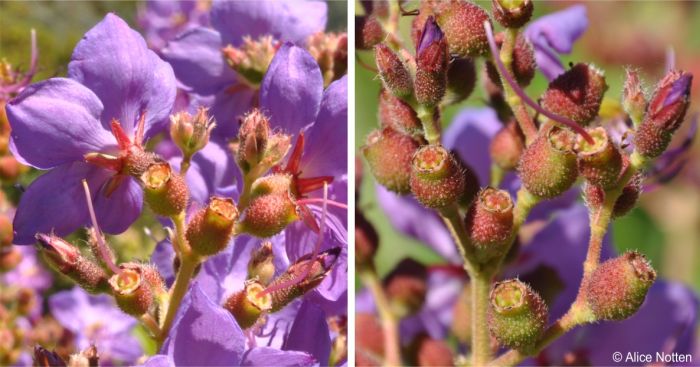
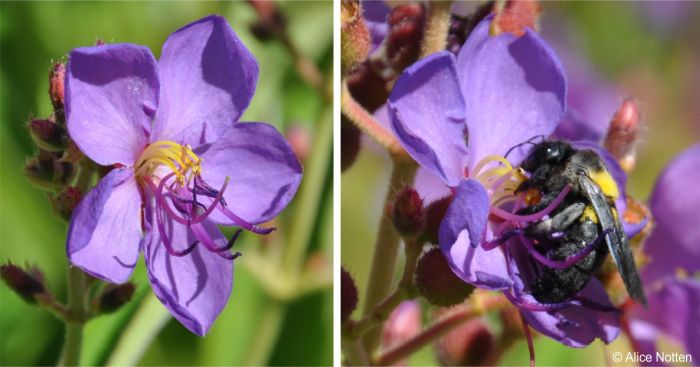
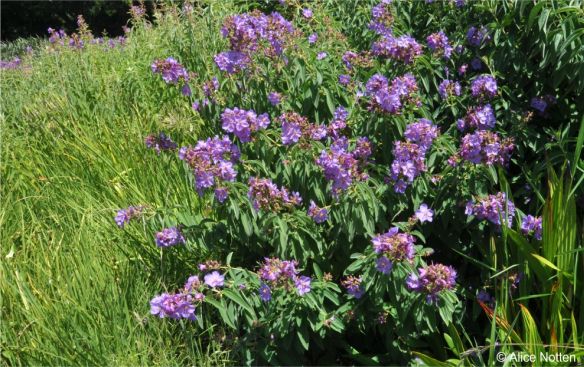
Rosettea princeps is a soft, herbaceous shrub, 1.0 to 3 m tall. Young stems are angular and the whole plant is covered in short, bristly hairs. The leaves are velvety, large, 30-145 x 10-55 mm, egg-shaped to lance-shaped, dark green above and paler to whitish underneath with 5 conspicuous veins from the base. Old leaves turn red. The flowers are large, ± 60 mm diameter, purple, lilac or occasionally white, produced in showy terminal panicles. At Kirstenbosch they are in flower from mid to late summer until autumn, whereafter they are cut back and allowed to go dormant during winter. Further north in more tropical climates, they continue flowering through winter into spring. The calyx is a ± 10 mm long tube with 5 lobes, dark reddish pink, covered in clusters of bristly hairs and knobby bumps, the calyx persists after the petals have dropped off but the calyx lobes fall off. The spectacular inflorescence is multi-toned; the dark reddish pink calyx encloses the dark purple bud that opens to the paler purple to lilac, 5-petalled flowers with their purple and yellow stamens and purplish pink style. The fruit is a capsule that develops inside the persistent calyx, releasing masses of very small seeds.

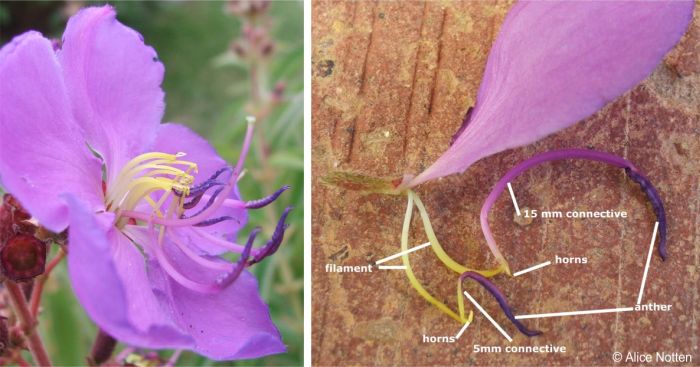
Rosettea princeps has unusual stamens: firstly, when in bud, they are bent downwards and the anthers are partly hidden inside pockets between the calyx and ovary; secondly, when mature, the anthers shed their pollen through an apical pore; and thirdly, and more easily observed by a person without a dissecting microscope, the stamens are unequal. Looking at a flower, it appears as if the two types of stamens are easy to spot and very clearly different - there is a bunch with what appear to be yellow anthers curving downwards on the top half of the flower, and a bunch with purple anthers curving upwards on the lower half. In fact, the yellow bits are not anthers at all, but an appendage on the filament. It also looks as if there are many stamens, butthere are only 10 stamens, attached just inside the rim of the calyx, in two rows: 5 alternate with the petals while the other 5 are attached opposite the petals. Why it looks as if there are more than 10 is because each stamen is made up of two parts: the ± 10 mm long yellow filament and the dark purple anther that is attached to the filament by a pinkish purple, jointed connective. At the point where the connective joins the filament there are two short, yellow horns-these are what appear to be yellow anthers. The actual anthers are dark purple and ± 10 mm long and crinkled when mature. All the anthers are fertile.The stamens of the opposite row have 5 mm long connectives-you can see them clustered in the middle of the flowers directly under the yellow filaments and horns. The stamens of the alternate row have longer 15 mm connectives-they are the large claw-like structures in the lower half of the flower. The style is ± 30 mm long, purplish pink with a yellow stigma.
Two varieties are recognised, the typical variety and var. candolleana which is distinguished by the bristles on the calyx tube being less dense, about 1.5 mm long, and not obscuring the calyx tube whereas in the variety princeps the bristles on the calyx tube are relatively dense and more or less obscure the calyx, especially the lower half when young and the bristles are about 2.5 mm long. The inflorescence is usually lax in var. candolleana and condensed in var. princeps.
Conservation Status
Status
Rosettea princeps is not threatened, it is assessed as Least Concern (LC) on the Red List of South African Plants.
Distribution and habitat
Distribution description
Rosettea princeps occurs in marshy places, along streambanks and at the fringe of forests in KwaZulu-Natal and Limpopo in South Africa, and in Eswatini, Botswana, Namibia, Mozambique, Zimbabwe, Zambia, Malawi, Angola, DRC, Tanzania, Ethiopia and Cameroon.
Derivation of name and historical aspects
History
Rosettea princeps was previously placed in the genus Dissotis, named for its stamens of two different types, from the Greek dissos meaning two-fold. The genus name Rosettea commemorates the Portuguese botanist Rosette Batarda Fernandes (1916–2005), who made a huge contribution to the taxonomy of African Melastomataceae. The species name princeps means most distinguished in Latin; perhaps the botanist who named it considered it to be the most distinguished species in its genus, on account of its long flowering period and showy inflorescence; princeps also means princely, which is possibly why it earned the common epithet royal. Its common name wild tibouchina refers to its close resemblance to the many cultivars of Tibouchina, some now called Pleroma and sometimes still called by the even older name Lasiandra, that originate in South America and are grown in gardens all over the world. Rosettea belongs in the Melastomataceae, a family of 169 accepted genera and ± 3000 species that occur in the tropical and subtropical regions of the world, particularly in South America. In South Africa, the family is represented by 5 indigenous species in 3 genera: Antherotoma debilis, A. naudinii and A. phaeotricha, Argyrella canescens and Rosettea princeps and 5 introduced species in 3 genera: Heterocentron subtriplinervium, Melastoma malabathricum and Pleroma granulosum, P. gsemidencandrum and P. urvilleanum.
The genus Rosettea was first published in 2020 after phylogenetic studies on the African Melastomataceae and of Dissotis and its allies in particular, found that Dissotis and Antherotoma were polyphyletic, with more than one common ancestor. The authors proposed 5 new genera, the reinstatement of two genera and redefined Dissotis to reflect the new data. The South African species affected by these changes are Dissotis princeps that is now Rosettea princeps, and Dissotis canescens that is now Argyrella canescens. The genus Rosettea consists of 21 accepted species that occur in tropical and southern Africa with only one in South Africa.
Ecology
Ecology
Rosettea princeps is pollinated in an unusual way. The anthers are tube-like, with a single pore at the tip, and the pollen is shed, a few grains at a time, through the pore, rather like salt out of a shaker. However, the pollen grains come out only when the flower is buzzed at a particular frequency, by a Carpenter Bee (Xylocopa sp.). The bee holds onto the anthers, then buzzes loudly. It is vibrating its wing muscles, without moving its wings, and creating resonating vibrations that loosen the pollen grains. The pollen is dusted on the bee, which moves on to another flower with its pollen load. This is buzz pollination. It allows the plant to guard its pollen, preventing it from being stolen by insects that are not pollinators and give little bits at a time to the right insect.
Uses
Use
The roots were formerly used to fatten calves. Certain people are said to have eaten the roots as an aphrodisiac. In KwaZulu-Natal it was eaten as a vegetable in times of starvation. This species is used in traditional medicine, probably in the same way as Argyrella canescens which is also eaten in times of famine, and the leaves, stems and roots are used to make a brew to prevent the development of certain unpleasant symptoms caused by drinking beer made from the new season's mealies, and the leaves are used to treat dysentery and diarrhoea.
Growing Rosettea princeps
Grow
This handsome species is fast, easy and rewarding to grow provided it is planted in fertile, well-watered soil in a sunny position. It can be allowed to dry out completely and go dormant during winter and cut back almost to ground level and it will resprout strongly in the spring. It survives the wet Cape winters without difficulty and in tropical climates can be left unpruned and growing through the winter, but regular, heavy pruning keeps it neater and more bushy. It is cut back by frost but resprouts in the spring, and would probably not survive outdoors in climates colder than USDA Zone 9.( -7 to -1°C or 20 to 30°F).
Rosettea princeps is a must for any kind of water garden, planted in damp soil e.g. in the overflow from a pond or beside a stream. It can be planted in the regular garden or herbaceous border but to perform at its best it must be well-watered. It makes a good container plant but must be well fed and well watered.
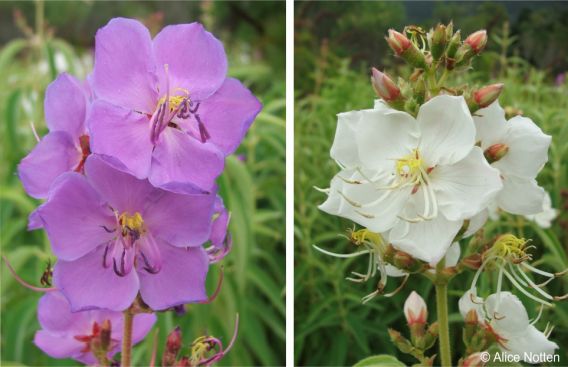
Propagate by seed sown in spring or early summer. At Kirstenbosch, because they root so easily, we tend to propagate this species only by cuttings. We cut the plants back during winter and take stem cuttings from the resprouting spring growth in spring to early summer (Sept-Nov). Treat them with rooting hormone and place under mist and they root easily in approx. two weeks. Vegetative propagation also allows us to keep the white and purple colour forms distinct and separate.
References
- Dyer, R.A. 1952. Dissotis princeps. The Flowering Plants of Africa 32: t. 1250.
- Fabian, A. & Germishuizen, G. 1982. Transvaal wild flowers. Macmillan, Johannesburg.
- Fox, F.W. & Norwood Young, E. 1982. Food from the veld: edible wild plants of southern Africa. Delta Books, Cape Town.
- Gibson, J.M. 1975. Wild flowers of Natal: coastal region. Trustees of the Natal Publishing Trust Fund, Durban.
- Plants of the World Online. Melastomataceae Juss. https://powo.science.kew.org/taxon/urn:lsid:ipni.org:names:30374374-2. Accessed 3 Feb 2026.
- Pooley, E. 1998. A field guide to wild flowers of Kwazulu-Natal and the eastern region. Natal Flora Publications Trust, Durban.
- Raimondo, D., Von Staden, L., Foden, W., Victor, J.E., Helme, N.A., Turner, R.C., Kamundi, D.A. & Manyama, P.A. (eds) 2009. Red list of South African plants. Strelitzia 25. South African National Biodiversity Institute, Pretoria.
- Smith, C.A. 1966. Common names of South African plants. Memoirs of the Botanical Survey of South Africa No. 35. Government Printer, Pretoria.
- Veranso-Libalah, M.C., Stone, R.D. & Kadereit, G. 2020. Towards a complete phylogeny of African Melastomateae: Systematics of Dissotis and allies (Melastomataceae). Taxon 69(5):946–991.
- Wickens, G.E. 1975. Melastomataceae. Flora of Tropical East Africa.
Credits
Alice Notten
Kirstenbosch National Botanical Garden
February 2026
This article replaces Dissotis princeps published in January 2006.
Plant Attributes:
Plant Type: Perennial, Shrub
SA Distribution: KwaZulu-Natal, Limpopo
Soil type: Loam
Flowering season: Late Summer, Autumn
PH: Acid, Neutral
Flower colour: Purple, White, Mauve/Lilac
Aspect: Full Sun
Gardening skill: Easy
Special Features:
 Edible plant
 Medical plant
 Useful plant
 Wet sites
Horticultural zones


Rate this article
Article well written and informative
Rate this plant
Is this an interesting plant?
Login to add your Comment
Back to topNot registered yet? Click here to register.