


Senna italica subsp. arachoides
Introduction
Senna italica subsp. arachoides is a multi-purpose plant species that has long been used in the treatment of a variety of infections throughout its range.
Description
Description
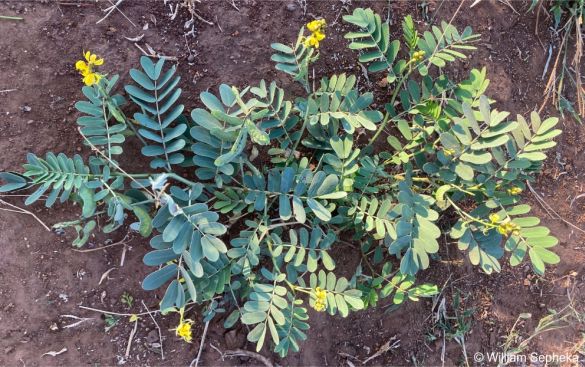
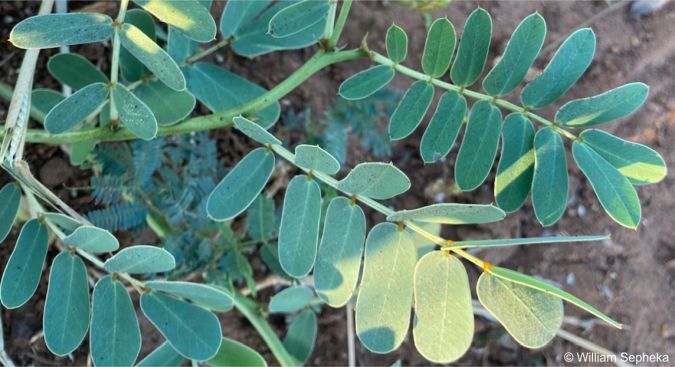
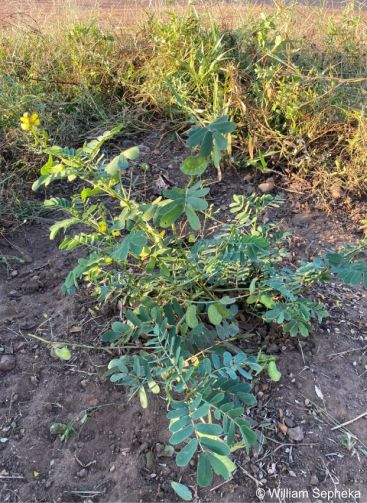
Senna italica subsp. arachoides is a deciduous, perennial herb or small shrub growing up to 600 mm tall, often with prostrate stems. The plant is woody throughout. Stems are solid, usually less than 2 m tall. The stems, or young twigs, are glabrous or sparsely glabrous and sparsely to densely hairy. Leaves arranged spirally, compound with 4–6 pairs of leaflets; stipules narrowly triangular to ovate-triangular, 3–9 mm long, early deflexed, somewhat persistent; petiole 15–25 mm long; leaflets oblong-obovate or narrowly elliptical to elliptical, 10–65 × 5–15 mm, base cuneate, unequal, apex rounded to obtuse, shortly hairy on both sides. There is a small reddish gland between each leaflet pair on the rhachis.
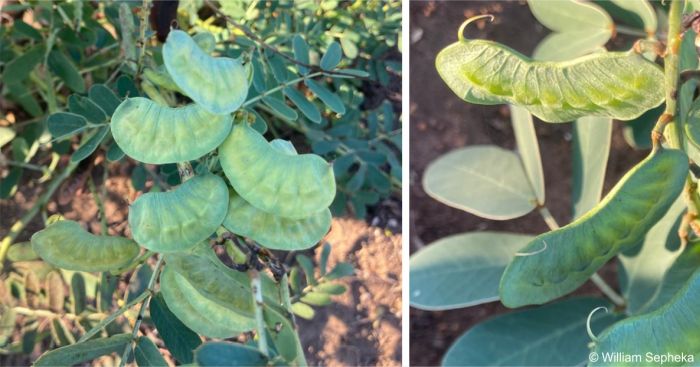
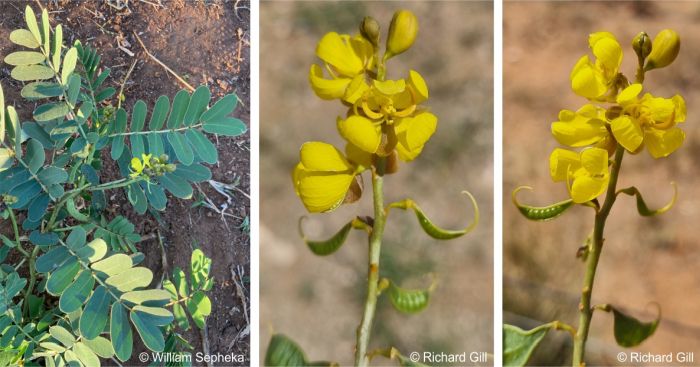
The flowers are erect, axillary raceme 20–250 mm long, up to 20-flowered; bracts rhombic to ovate, shortly pointed, up to 5 mm long. Flowers bisexual, zygomorphic, 5-merous; sepals unequal, oblong-elliptical, up to 10 mm long, obtuse at apex; petals obovate, up to 13 mm long, yellow; stamens 10, the 2 lower ones largest, 5 medium-sized, 3 short and sterile; ovary superior, with short, stiff hairs, style up to 6 mm long. Fruit is a flattened, oblong pod 25–60 × 15–20 mm, with a ridge running along the middle of each valve, tip upcurved, dehiscent by 2 valves, many-seeded. Seeds oblong-ovate, compressed, 6–7.5 × 1.5–2.5 mm, with a small areole on each face. Senna italica subsp. arachoides flowers during the summer months, normally from October to March. The flowering is heavily influenced by moisture and usually peaks during the rainy season. In moist conditions, flowers can appear throughout the year. The flowers are a vibrant yellow, typically featuring five petals that catch the eye of pollinators. These bright petals are complemented by green sepals, which serve as protective leaf-like structures for the flower bud. The stamens are numerous, ensuring a generous supply of pollen for pollination. At the centre lies the pistil, the crucial structure responsible for ovule development. The plant produces attractive, flat, curved pods in spring, from mid-August to late September. The seeds have an elliptical line or depression and are wrinkled or rugose. Seeds are usually olive, green, or black.
Conservation Status
Status
Senna italica. subsp. arachoides is assessed as Least Concern (LC) by the Red List of South African Plants. This taxon was not selected in any one of the four screening processes for highlighting potential taxa of conservation concern for detailed assessment and was hence given an automated status of Least Concern.
Distribution and habitat
Distribution description
The natural distribution of Senna italica subsp. arachoides is Namibia, Botswana, Eswatini, Zimbabwe, Mozambique and South Africa, where it is found in the Northern Cape, Free State, KwaZulu-Natal, Gauteng, Limpopo, Mpumalanga and Northwest provinces. Senna italica subsp. arachoides thrives in dry, open woodland, scrubland, and savanna. It prefers well-drained, sandy, rocky, or gravelly soil and is commonly found in disturbed areas, such as roadsides, abandoned gardens, and nearby homes. It grows in areas ranging from sea level to 1 850 m. The plant is drought-tolerant and thrives in warm temperatures. It is a deciduous perennial that flowers primarily during the rainy season, though it can flower year-round under moist conditions.
Derivation of name and historical aspects
History
Senna italica subsp. arachoides was originally described as Cassia arachoides in 1822, a name bestowed by William Burchell, and arachoides meaning ‘like the genus Arachis’ because he considered it to be similar to Arachis hypogaea, the peanut. It was placed as a subspecies of Cassia italica by Brenan and later moved into the genus Senna by Lock in 1988. Thus the current name combines the original describer, Burch. for Burchell, with the combining author, Lock. The genus Senna, is named after the Arabic name for the medicinal pods, sana. The specific epithet italica was given by Miller in 1768, likely as a historical or taxonomic convention, despite it being native to Africa and Asia, not Italy.
Ecology
Ecology
Senna species are pollinated by a variety of bees, especially large female carpenter bees. They rely on buzz pollination and some, within that, on ricochet pollination, which is a secondary pollen presentation where the pollen is not deposited on the pollinator's body by direct contact with the anthers. The flowers have two sets of stamens: feeding stamens, which are longer, and pollinating stamens, which are smaller. Due to buzz pollination, the pollen from the pollinating stamens gets thrown from the anthers and ricochets against the petals multiple times before it settles on the dorsal side of the pollinating bee. The roughness on the petal walls causes the pollen to slow down its speed. The ricocheting effect alone cannot ensure effective pollen dissemination. It is aided by static charges, wherein the flying bees become positively charged owing to the friction in the air, and the pollen becomes negatively charged, because of which they naturally get attracted to the bees' bodies. The pollinator bee ends up carrying the pollen and gets to feed on the pollen, which is on the feeding stamens.
Natural pollination in Senna primarily involves wind and insect activity. As the wind blows, it can carry pollen from one flower to another, while insects like bees and butterflies actively transfer pollen as they forage.
Uses
Use
Senna italica and the subsp. arachoides have a rich history in traditional medicine worldwide. This plant species has long been used in the treatment of many infections, including sexually transmitted infections, constipation, skin diseases, snakebite, malaria, diarrhea, general intestinal diseases, anthrax, pneumonia and diabetes. This multi-purpose plant is also used in the treatment of ethno-veterinary illnesses, gall-sickness and heartwater of domestic animals. Throughout its range, the leaves, pods and mature seeds of Senna italica subsp. arachoides are used as a purgative. They are taken, usually as a decoction or maceration, to cure stomach complaints, fever, jaundice, venereal diseases and biliousness, as an abortifacient and against intestinal worms. The leaves, either fresh, or dried and pulverized, are used as a dressing for skin problems such as burns and ulcers. Tea made from flowers is used as a purgative and to induce labor. Maceration of the roots is taken to cure colic and influenza, and boiled roots are used as a wound dressing. A root infusion is used as eye drops for sore eyes. The roots are also used in treatments of indigestion, liver complaints, gall bladder disorders, nausea, vomiting, and dysmenorrhea.
Growing Senna italica subsp. arachoides
Grow
Grow Senna italica subsp. arachoides in well-drained, sandy, or rocky and gravelly soils. It thrives in nutrient-poor environments and prefers a pH between 7.0 and 8.5. As a warm-weather crop, it requires full sun and is highly drought-tolerant once established; however, it can also tolerate periodic flooding in its natural habitat near streams. Cultivation generally requires minimal irrigation. Avoid areas with heavy rainfall to prevent root rot.
Senna italica subsp. arachoides can be propagated by both seeds and cuttings. Each propagation method has its own advantages and considerations. Harvest mature pods from a healthy plant. The pods will eventually turn brown and dry out when ready. Extract the seeds from the pods and store them in a cool, dry place until you’re ready to sow. Senna italica seeds benefit from scarification to break its dormancy. For optimal germination, seeds should be pre-treated to break their hard dormancy. This is best achieved by soaking them overnight in water or by mechanical abrasion (scarification) with sand to thin the seed coat. Sow the scarified seeds during the growing season in a well-draining seed-starting mix, covering them lightly with soil. Place the seed tray in a warm, bright location to ensure it receives direct sunlight. Keep the soil consistently moist but not waterlogged. Germination typically takes 1-3 weeks under these optimal conditions.
Once the seedlings have developed a few sets of true leaves, they can be transplanted into individual pots or directly into the garden. It is a hardy, drought-tolerant, full-sun perennial shrublet adapted to warm, dry climates, requiring sunny conditions to thrive.
To propagate by cuttings, select a healthy, non-flowering stem from the parent plant. Using a sharp, sterilized knife or pruning shears, make a 10-15 cm cut just below a leaf node. Remove the leaves from the lower half of the cutting to prevent the cutting from rotting. Dip the cut end of the cutting in rooting hormone to stimulate and encourage the development of the roots. Plant the prepared cutting in a pot filled with a well-draining potting mix, ensuring the bottom leaf node is buried in the soil. Then place the cutting in a warm, humid environment. A humidity dome or placing a plastic bag over the pot can help create favorable conditions. The roots mostly develop within 4-6 weeks after planting.
Senna italica subsp. arachoides plants are best used in the garden as a hardy, water-wise groundcover or low-growing shrub in sunny, dry, or sandy areas. It is an excellent choice for xeriscaping and sustainable, low-maintenance, or wild-style gardening in southern African regions.
Senna italica subsp. arachoides is a host of the root lesion nematodes. Serious termite attacks are observed during perennial cultivation.
References
- Brummitt, R.K., Chikuni, A.C., Lock, J.M. & Polhill, R.M. 2007. Leguminosae subfamily Caesalpinioideae. In: J.R. Timberlake, G.V. Pope, R.M. Polhill & E.S. Martins (eds). Flora Zambesiaca 3(2): 1–218. Royal Botanic Gardens, Kew.
- Figueiredo, E. & Smith, G.F. 2008. Plants of Angola. Strelitzia 22. South African National Biodiversity Institute, Pretoria.
- Germishuizen, G. & Meyer, N.L. (eds) 2003. Plants of southern Africa: an annotated checklist. Strelitzia 14. National Botanical Institute, Pretoria.
- Gill, R. 2024. Observation of Senna italica subsp. arachoides, Luckhoff, FS. iNaturalist. Online. https://www.inaturalist.org/observations/200501097.
- Lock, J.M. 1989. Legumes of Africa. A check-list. Royal Botanic Gardens, Kew.
- Naidu, P., Baijnath, H., Singh, Y. & Condy, G. 2025. Senna italica subsp. arachoides Fabaceae: Caesalpinioideae. Flowering Plants of Africa 69: 124–132.
- Pooley, E. 1998. A field guide to wild flowers of KwaZulu-Natal and the eastern region. Natal Flora Publications Trust, Durban.
- Raimondo, D., Von Staden, L., Foden, W., Victor, J.E., Helme, N.A., Turner, R.C., Kamundi, D.A. & Manyama, P.A. (eds) 2009. Red list of South African plants. Strelitzia 25. South African National Biodiversity Institute, Pretoria.
- Ross, J.H. 1977. Fabaceae: Caesalpinioideae. Flora of Southern Africa 16(2).
Credits
William Sepheka
National Herbarium, Pretoria
March 2026
Acknowledgements: images of the flowers by Richard Gill.
Plant Attributes:
Plant Type: Perennial, Shrub
SA Distribution: Free State, Gauteng, KwaZulu-Natal, Limpopo, Mpumalanga, North West, Northern Cape
Soil type: Sandy, Loam
Flowering season: Early Summer, Late Summer, Sporadic/All year
PH: Acid, Neutral
Flower colour: Yellow
Aspect: Full Sun
Gardening skill: Easy
Special Features:
 Drought resistant
 Medical plant
Horticultural zones



Rate this article
Article well written and informative
Rate this plant
Is this an interesting plant?
Login to add your Comment
Back to topNot registered yet? Click here to register.