


Watt, J.M. & Breyer-Brandwijk, M.G. 1962. The medicinal and poisonous plants of southern and eastern Africa , edn 2. Livingstone, Edinburgh & London.

Plant Attributes:
Plant Type:
SA Distribution:
Soil type:
Flowering season:
PH:
Flower colour:
Aspect:
Gardening skill:
Special Features:
Horticultural zones

Species
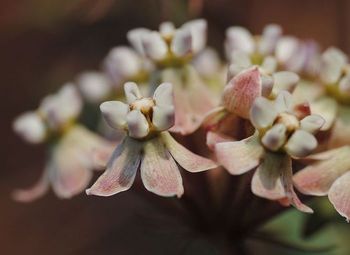
Asclepias adscendens (Schltr.) Schltr.
Conservation status: Least Concern (LC).
Perennial herb, 100–200 mm tall. Leaves linear-lanceolate to ovate; umbels solitary and terminal with 12–15 flowers. Peduncles 5–65 mm long. Corolla lobes reflexed or spreading reflexed with upcurved tips. Flowers white to pinkish or purplish. Plants flower in spring to early summer (August to December); in grassland. Widely distributed in Lesotho, Mozambique, South Africa (Free State, Gauteng, KwaZulu-Natal, Limpopo, Mpumalanga and North West Provinces); also Eswatini and Zimbabwe.
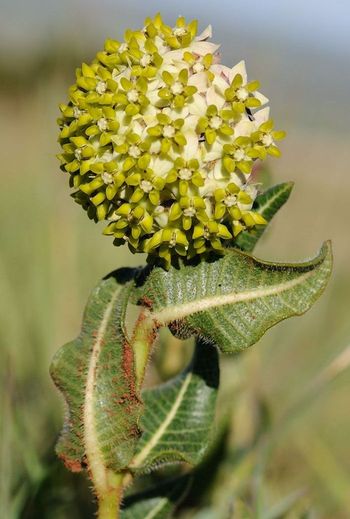
Asclepias albens (E.Mey.) Schltr.
Common names: cartwheels (Eng.); tshalale (TshiVenda).
Conservation status: Least Concern (LC).
Perennial erect or decumbent herb, 250–500 mm tall, unbranched or branched at the base. Leaves ovate to ovate-lanceolate, base subcordade to broadly rounded, bristly hairy on both sides. Umbels solitary, terminal, robust (up to 80 mm in diam.) with 15–30 flowers. Peduncles 40–100 mm long. Corolla lobes reflexed, glabrous inside. Flowers white or light purple or pinkish. Plants flower in midsummer (December to January) and grow in grassland. The young leaves are eaten as a spinach. Widely distributed in the eastern part of southern Africa in Lesotho, South Africa (Eastern Cape, Free State, Gauteng, KwaZulu-Natal, Limpopo, Mpumalanga and North West Provinces); also Eswatini.
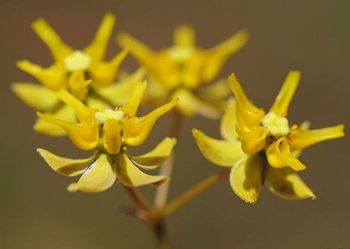
Asclepias aurea (Schltr.) Schltr.
Conservation status: Least Concern (LC).
Perennial herb, 140–500 mm tall. Leaves long and linear, glabrous; umbels axillary and terminal, usually with 4 (rarely 5–8) flowers. Relatively long scapose peduncles 40–140 mm long. Corolla lobes reflexed or spreading, canescent inside. Flowers yellow or white; corona white, yellow or purple with white sides; flowers in spring to autumn (August to May); grows on grassy slopes or rocky hillsides. Used medicinally as an emetic.

Asclepias brevipes (Schltr.) Schltr.
Common name: bokhorinkie (Afr.).
Conservation status: Least Concern (LC).
Perennial decumbent herb; leaves linear, scabrous. Umbels terminal and axillary, usually with 4 flowers; peduncle 10–50 mm long; corolla lobes spreading, canescent inside, pubescent outside. Flowers yellow-brown tinted white or green; corona reddish brown, purple or white; flowers in spring to early summer (September to December). Usually found in burnt veld on hillsides. Restricted to the northern parts of South Africa (Gauteng, KwaZulu-Natal, Limpopo, Mpumalanga and North West Provinces).
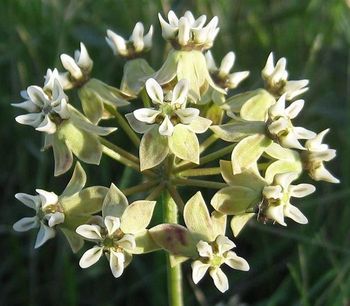
Asclepias crispa P.J.Bergius var. crispa.
Common name: bitterwortel (Afr.).
Conservation status: Least Concern (LC).
Perennial herb 150–400 mm tall; leaves crisped-wavy, linear to lanceolate, truncate, rounded or cuneate at base; scabrous or pubescent. Umbels solitary, terminal or 2–4 racemosely arranged, pedunculated, with 7–40 flowers; corolla lobes reflexed, glabrous on both sides or pubescent outside. Flowers dull green or purplish tinted inside, brown purplish outside; corona greenish or with purple outer margin. Usually flowers in September. Decoctions or infusions of the root is used as a diuretic and purgative medicine. Reported to be toxic to livestock.
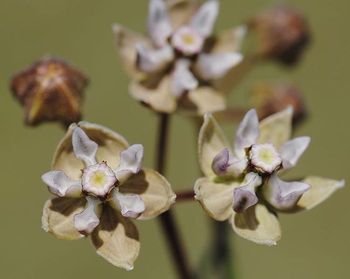
Asclepias cucullata (Schltr.) Schltr. subsp. cucullata.
Conservation status: Least Concern (LC).
Perennial herb, erect to decumbent. Leaves linear to narrowly lanceolate; corolla lobes spreading with tips curving up; scabrous to pubescent outside, canescent inside. Corona lobes erect, shorter than or only slightly exceeding the staminal column, cucullate part of corona lobes ± as long as broad. Flowers purple or mauve, white to grey. Plants usually flower in spring to early summer (September to December). Grows in open mountain grassland. Mainly along the southern Cape coast but also other parts of South Africa (, Gauteng, Mpumalanga and Eastern and Western Cape Provinces); also Eswatini.
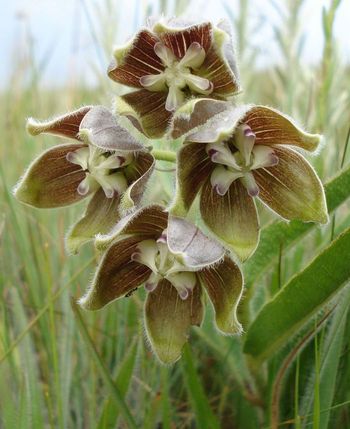
Asclepias cultriformis (Harv. ex Schltr.) Schltr.
Conservation status: Least Concern (LC).
Perennial herb 150–300 mm tall. Leaves oblong, lanceolate or ovate-lanceolate. Corolla lobes ascending-spreading, pubescent outside, pubescent to densely white-hairy at tips and along margins, glabrous inside. Corona lobes with compressed, erect processes or horn within cavity. Flowers green or dark purple-brown; corona white with violet spot on back near apex and violet at base. Plants flowers December to February. Grows in grassland. Distributed in Lesotho, South Africa (Eastern Cape, Gauteng, KwaZulu-Natal, Limpopo and Mpumalanga Provinces); also Eswatini.
Plant Attributes:
Plant Type:
SA Distribution:
Soil type:
Flowering season:
PH:
Flower colour:
Aspect:
Gardening skill:
Special Features:
Horticultural zones
Plant Attributes:
Plant Type:
SA Distribution:
Soil type:
Flowering season:
PH:
Flower colour:
Aspect:
Gardening skill:
Special Features:
Horticultural zones
Plant Attributes:
Plant Type:
SA Distribution:
Soil type:
Flowering season:
PH:
Flower colour:
Aspect:
Gardening skill:
Special Features:
Horticultural zones
Plant Attributes:
Plant Type:
SA Distribution:
Soil type:
Flowering season:
PH:
Flower colour:
Aspect:
Gardening skill:
Special Features:
Horticultural zones
Plant Attributes:
Plant Type:
SA Distribution:
Soil type:
Flowering season:
PH:
Flower colour:
Aspect:
Gardening skill:
Special Features:
Horticultural zones
Plant Attributes:
Plant Type:
SA Distribution:
Soil type:
Flowering season:
PH:
Flower colour:
Aspect:
Gardening skill:
Special Features:
Horticultural zones
Species
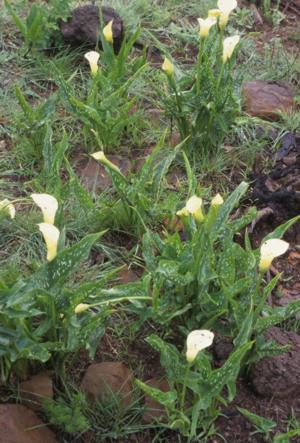
albomaculata (Hook.) Baill.
Common names: Arrow-leaved arum, spotted-leaved arum (Eng.); kleinvarkoor, witvlekvarkoor (Afr.); mohalalitoe (South Sotho); intebe (Xhosa, Zulu), ilabatheka-elimhlophe (Zulu), ilabatheka-omhlophe (Zulu). These are deciduous, medium to tall plants up to 0.7 m high, growing in small clumps. They have oblong or triangular arrow-shaped leaves, often speckled with white spots. Spathes are cylindrical, white, cream or pale yellow and frequently dark purple at the base within.
subsp. albomaculata
Leaves oblong, spathe tapering to apex, berries many, medium-sized, up to 18 mm in diameter. It flowers October to April. The subspecies occurs in the Eastern Cape, KwaZulu-Natal, Lesotho, Free State, Swaziland, Mpumalanga and Limpopo. It also extends into Zimbabwe, Malawi, Zambia, Angola and Tanzania. It is found along rocky hillsides, forest margins and stream banks.
subsp. macrocarpa (Engl.) Letty
Leaves triangular, spathe shortened at apex, berries few, large, mostly close to 20 mm in diameter. It flowers from November to April with a peak in December. The subspecies occurs in KwaZulu-Natal, Lesotho, Free State, Swaziland, Mpumalanga and Gauteng. It grows in grassy vleis and marshy ground beside streams.
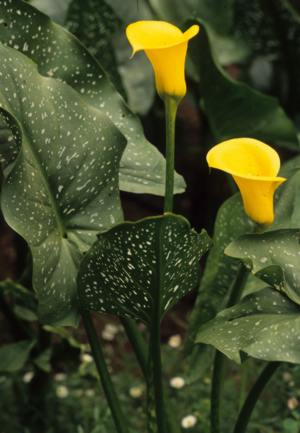
Zantedeschia elliotiana (Watson) Engl.
These are deciduous, medium to tall plants up to 0.6 m high, growing singly or forming small clumps. Their leaves are large, broadly ovate, deep green and speckled with white spots. The spathe is a cup-shaped funnel, bright golden-yellow and dark purple at the base within. It flowers November to January.
The species is known only from cultivated specimens and has not been found in the wild. It is probably a hybrid of garden origin. Suspected parents include Z. pentlandii or Z. jucunda and Z. albomaculata subsp. albomaculata.
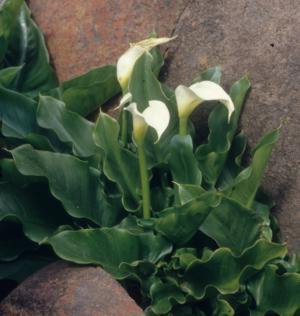
Zantedeschia odorata P.L.Perry
These are deciduous, medium to tall plants up to 0.75 m high. Their leaves are broadly ovate and not speckled. Spathes are cylindrical and white. They flower in late July and August.
Z. odorata is restricted to an area known as Klip Koppies at Nieuwoudtville in the Northern Cape. The outcrops are formed by large dolerite boulders which break down to form a red clay soil which retains water well in the rainy season. The plants grow in crevices between the boulders, where at least the lower part of the plant is in cool shade. The roots are in seasonally very wet soil or sometimes in standing water.
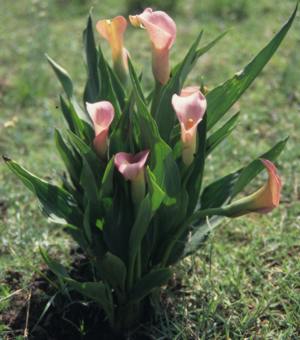
Zantedeschia rehmannii Engl.
These are small to medium plants 0.2–0.6 m high. Their leaves are lance-shaped, dark green and very rarely speckled with white spots. The spathes are cylindrical, colour ranging from white through shades of pink to dark maroon (almost black). They flower September to February, with a peak in November to January.
Z. rehmannii occurs from Harrismith in the Free State and northern KwaZulu-Natal, through Swaziland to Mpumalanga. This species grows among rocks on grassy hillsides at medium and quite high altitudes, in semi-shade at forest margins and in sandy furrows.
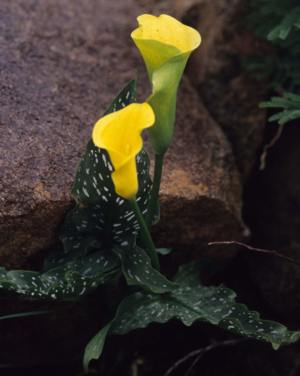
Zantedeschia jucunda Letty
Common name: magapule (Pedi)
These are deciduous, medium to tall plants, up to 0,8 m high, growing solitary or in small clumps. Their leaves are triangular-hastate, deep green and speckled with white spots. The spathe is a cup-shaped funnel, deep or cream-yellow and dark purple at the base within. They flower from November to January.
Z. jucunda is confined to the summit of the Leolo Mountains in the Sekhukuneland Centre of Floristic Endemism. This species grows on grassy slopes, among rocks in full sun.
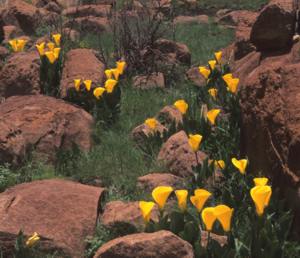
Zantedeschia pentlandii (Watson) Wittm.
Common name: Mapoch lily
These are deciduous, medium to tall plants, up to 0.6 m tall. Leaves broadly ovate, glaucous green and very rarely speckled with white spots. The spathe is a cup-shaped funnel, lemon-chrome yellow and dark purple at the base within. They flower from November to December.
The species is restricted to the Mapoch region of Mpumalanga, comprising the northern part of the Belfast District and adjoining parts of the Lydenburg District. Plants often grow in dense colonies wedged between rocks. Tubers are relatively superficial and plants can be dug out easily.
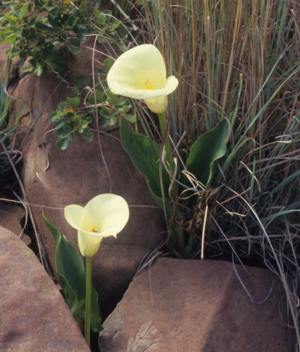
Zantedeschia valida (Letty) Y.Singh
These are deciduous, robust plants, up to 0.75 m tall. Leaves broadly ovate, plain, not speckled or very speckled with white spots. The spathe is a cup-shaped funnel dark purple at the base within. They flower from October to March with the peak in November.
The species is restricted to the region bordered by the Biggarsberg, Giants Castle and Collin's Pass in KwaZulu-Natal. Plants grow among rocks on the mountains in clefts and on foothills, as well as on the banks of streams and in vleis.
Plant Attributes:
Plant Type:
SA Distribution:
Soil type:
Flowering season:
PH:
Flower colour:
Aspect:
Gardening skill:
Special Features:
Horticultural zones
Pages
- « first
- ‹ previous
- 1
- 2
- 3
Rate this article
Article well written and informative
Rate this plant
Is this an interesting plant?
Login to add your Comment
Back to topNot registered yet? Click here to register.