


Rubiaceae
Species
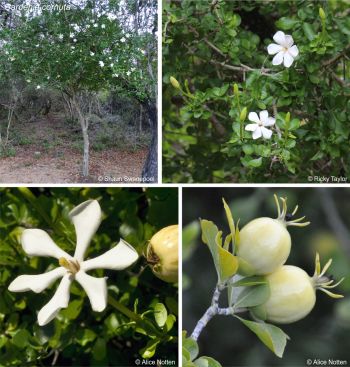
Gardenia cornuta Hemsl.
Tonga gardenia, Natal gardenia, horned gardenia (Eng.); wilde-appel, Tongakatjiepiering, Natalkatjiepiering (Afr.); unomphumela, umvalasangweni (isiZulu).
SA Tree No: 690.1
A small tree up to 5 m in height. Leaves arranged in whorls of three, clustered towards the ends of short, rigid branchlets, broadly obovate, measuring 20–50 x 15–27 mm, leathery, shiny light green on the upper side, dull green underneath, glabrous, with hairy pockets (domatia) present on the underside. The apex is very broadly tapering to a rounded tip, while the base narrows into a not-so-distinct petiole, up to 3 mm long. The margins are wavy and entire. Flowers are white, turning yellow as they mature, with a corolla tube up to 60 mm long and five spreading lobes. The calyx is tubular and foliaceous. The fruit is ovoid, measuring 45 x 38 mm, yellow, crowded with a persistent calyx (in profusion). Flowering occurs from late summer to early spring (Feb. to Aug.). It is recorded in low-altitude areas within the bushveld and thicket of northeastern KwaZulu-Natal, southern Mozambique, and the marginal regions of Mpumalanga. Young fruits are eaten by monkeys and Nyala (Tragelaphus sp.). Both fruit and roots are used as an emetic.
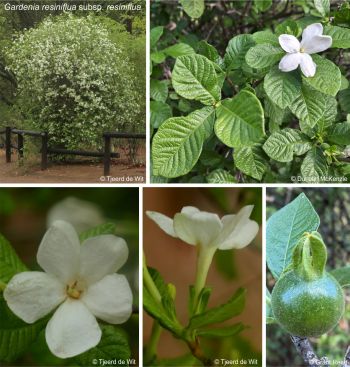
Gardenia resiniflua Hiern subsp. resiniflua
gummy gardenia (Eng.), harpuiskatjiepiering (Afr.)
SA Tree No:690.2
Shrub or small tree 3–7 m tall, with smooth, pale grey, slightly peeling bark. Leaves obovate, 20-80 mm long, apex pointed, veining conspicuous, velvety when young, becoming sparsely roughly hairy above, densely velvety below, in whorls of 3 on short, stiff side branchlets. Flowers white, about 30 mm long and 30 mm wide, solitary in the upper leaf axils, heavily sweet scented. Fruit small, yellowish-brown, ovoid to almost round, approximately 15 mm diameter, densely covered in short hairs, the calyx lobes remain attached to the fruit, like a crown. Flowering occurs in early summer (Nov. to Dec.), fruiting in late summer and autumn (Feb. to May). Occurs in bushveld, woodland and scrub, often along rivers, up to 1 300 m, in Limpopo and Mpumalanga in northern South Africa, and in Mozambique, Zimbabwe, Botswana, Malawi, Zambia and the DRC. The wood is suitable for carving and making utensils such as spoons. Fruits are used in tattoing. Leaves are browsed by buck. The name resiniflua means ‘with a flowing resin’ referring to the drops of yellow resin often found on the growing bud.
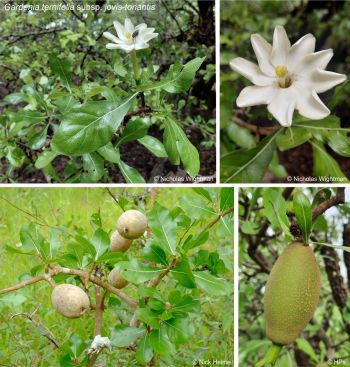
Gardenia ternifolia Schumach. & Thonn. subsp. jovis-tonantis (Welw.) Verdc. var. goetzei (Stapf & Hutch.) Verdc.
powder-bark gardenia (Eng.), poeierbaskatjiepiering (Afr.), tshiralala (Venda)
SA Tree No: 690.3
Shrub or small, spreading tree 3–5 m tall with smooth, powdery, grey or yellowish-brown bark. Leaves oblanceolate to obovate, apex rounded, roughly hairy on both surfaces and rough to the touch, in whorls of 3 on short, rigid side branchlets. Hair-tuft domatia are present on the leaves. Flowers are white, turning yellow with age, sweetly scented, up to 45 mm long and 40 mm wide, solitary at the ends of the branchlets. Fruits large, ovoid, 50 × 35 mm, velvety, yellowish-brown, crowned with the remains of the calyx, not ribbed. Flowering in spring and early summer (Sep. to Dec.), fruiting in late summer to winter (Feb. to Jun.). Occurs in wooded grassland, on rocky slopes and koppies, along streams and in vleis, and sometimes on termite mounds, in Limpopo in South Africa, and in Mozambique, Zimbabwe, Botswana, Namibia, Zambia, Malawi and in tropical Africa. The wood is hard and very fine-grained, yellow or pink. Seeds yield a black dye that is used for painting the skin. Branches are sometimes put on the roof to ward off lightning. The name ternifolia means ‘leaves in threes’, jovis-tonantis refers to ‘Jupiter the Thunderer’ and goetzii is named after German naturalist Walter Goetze (1872-1899).
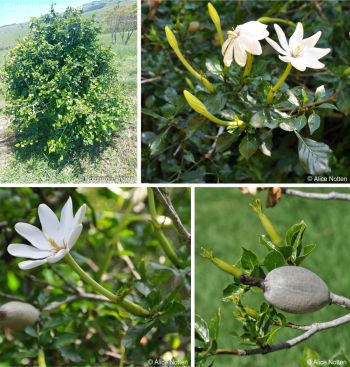
Gardenia thunbergia Thunb.
forest gardenia, white gardenia, wild gardenia (Eng.); witkatjiepiering, buffelsbal, boskatjiepiering, kannetjieboom (Afr.); umvalasangweni-wehlathi, umkhwakhwane (isiZulu); umkangazi, umkancaza, umkangana, isisende (isiXhosa).
SA Tree No:692
Shrub or small tree reaching up to 7 m in height. Leaves arranged in whorls of three to four, clustered towards the ends of branchlets; elliptic, measuring 75–150 mm by 38–100 mm; leathery with a glossy green appearance. Hairy pockets (domatia) are present on the underside of the leaves. The leaf apex is rounded and tapers finely, with a narrowed base attached to a slender petiole up to 26 mm long. The leaf margins are wavy and entire. Flowers are white, featuring a corolla tube up to 70 mm long with 8 (–9) spreading lobes. The calyx is tubular and foliaceous. The fruit is ovoid, approximately 90 x 55 mm, hard, with a persistent calyx. Flowering occurs from spring to late summer (Oct. to Feb.). Typically found in evergreen forests from the coast to the midlands, notably in the coastal region of Alexander Forest in the Eastern Cape to Kosi Bay in KwaZulu-Natal. Flowers attract hawk-moths (Agrius sp.). The root infusion is traditionally used as an emetic to treat biliousness and skin eruptions associated with leprosy.
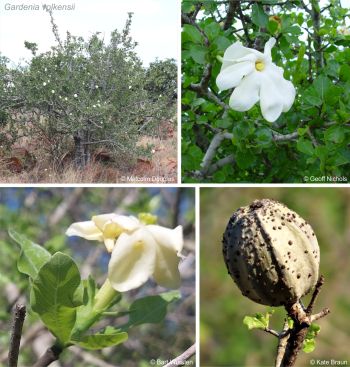
Gardenia volkensii K.Schum.
bushveld gardenia (Eng.); Transvaalkatjiepiering, bosveldkatjiepiering, kannetjieboom, stompdoring (Afr.); morala (Northern-Sotho, Tswana); umgongwane, umkhwakhwane-omkulu (isiZulu)
SA Tree No: 690.8 and 691 and 691.1
Small tree reaching up to 7 m in height. Leaves arranged in whorls of three, clustered near the ends of short, rigid branchlets. They are broadly ovate, measuring 30–75 x 25–40 mm, glossy dark green, often glabrous, rarely with the presence of hispid hairs on both sides. Hairy pockets (domatia) are present on the underside. The leaf apex is broadly tapering to a rounded tip, while the base narrows gradually into a slender petiole up to 26 mm long. Leaf margins are wavy and occasionally appear serrated. Flowers are white, turning yellow as they mature. The corolla tube can be up to 80 mm long, with 6(9) spreading lobes, opening at night. The calyx is tubular and foliaceous. The fruit is ellipsoid, measuring 110 x 100 mm, grey-green, and crowded with a persistent calyx. Flowering occurs from winter to summer (Jul. to Dec.). The species has been recorded in open woodlands and bushveld, from KwaZulu-Natal to tropical Africa.
Two subspecies of this species are recorded in southern Africa. They are separated based on their fruit morphology, although it is not always clear-cut, especially from preserved specimens. G. volkensii subsp. volkensii is distinguished from subsp. spatulifolia by its larger, white fruit with coarser ribs and conspicuous white dots (lenticels). G. volkensii subsp. volkensii var. saundersiae is diagnosed by its well-developed calyx lobes (15–25 mm long), whereas G. volkensii subsp. volkensii var. volkensii has calyx lobes up to 10–15 mm long.
Plant Attributes:
Plant Type:
SA Distribution:
Soil type:
Flowering season:
PH:
Flower colour:
Aspect:
Gardening skill:
Special Features:
Horticultural zones

Species

Rothmannia capensis Thunb.
Common names: Cape gardenia, common rothmannia, wild gardenia (Eng.); Kaapse katjiepiering, wildekatjiepiering (Afr.); modulatshwene (Northern Sotho); mukubudu (Tshivenda); umphazane-mkhulu (isiZulu); isithebe, umzukuza, ibolo (isiXhosa).
SA Tree No: 693
Medium to tall tree, 7–15(–25) m high. Leaves opposite, occasionally in whorls of three, clustered towards the end of the branches, elliptic, 75–100 × 25–40 mm, leathery, dark shiny green, paler beneath, hairy pockets (domatia) present on the undersurface, margins entire, wavy, tip tapering or rounded, base tapering; petiole almost absent. The upper expanded part of the calyx never splitting, always bearing filiform to linear lobes; the bases somewhat widened but always clearly separated by sinuses. Flowers are widely bell-shaped, up to 80 mm long, 60 – 70 diam., white to creamy yellow with maroon streaks in the throat. Flowering time: early to late summer (December–February).
Occurs on forest margins and rocky outcrops from the Western Cape to Botswana.

Rothmannia fischeri (K.Schum.) Bullock subsp. fischeri
Common name: woodland false-gardenia, scented bells (Eng.)
SA Tree No: 694
Shrub or small tree, 2–8 m high. Leaves opposite, occasionally in whorls of three, lanceolate to elliptical or broadly elliptical or narrowly obovate, 35–90 × 20–50 mm, leathery, dark shiny green, hairy pockets (domatia) present on the undersurface, apex and base tapering, margins entire, wavy; petiole up to 10 mm long. Flowers creamy with pink or purple markings in the throat, corolla tube funnel-shaped, 100 × 80 mm.
The upper expanded part of the calyx often splitting, with lobes 1–9(–18) mm long. The corolla tube is gradually funnel-shaped or has a narrow cylindrical lower half and is funnel-shaped above, 43–80 × 13–30 mm, wide at the opening; lobes 18–25 mm long.
Flowering time: spring to late summer (October–February).
Occurs in central Zimbabwe, Mozambique, KwaZulu-Natal and Limpopo provinces in semi-deciduous woodland, thickets and mixed evergreen forest patches, often on rocky hillsides or koppies, or near streams.

Rothmannia fischeri (K.Schum.) Bullock subsp. moramballae (Hiern) Bridson
Common name: sand false-gardenia (Eng.)
SA Tree No: 694.1
The upper expanded part of the calyx often splitting, with short lobes 1–3 mm long. The corolla tube is narrowly cylindrical in the lower part and approximately campanulate above, 50–70 × 20–30 mm, wide at the mouth, with the cylindrical part at least half the length of the campanulate part; lobes 25–35 mm long.
Flowering time: spring to late summer (October–February), after rain.
Occurs in moist places in mixed evergreen forests, sandy forests or riverbanks in KwaZulu-Natal, Mozambique and eastern Zimbabwe.

Rothmannia globosa (Hochst.) Keay
Common names: September bells, bell gardenia (Eng.); klokkiesvalskatjiepiering (Afr.); umgubhe (isiXhosa); umphazane (isiZulu); thudwane (Tsivenda); sikoba (SiSwati)
SA Tree No: 695
Evergreen or briefly deciduous tree, 4–7(–12) m high. Leaves opposite, elliptic to lanceolate, 40–140 × 20–50 mm, dark green above, paler beneath, midrib and side veins yellowish to paler green tinged reddish, raised beneath, hairy pockets (domatia) present on the undersurface, margin entire, broadly tapering tip, base tapering; petiole up 10 mm long. The upper expanded part of the calyx never splitting, always bearing filiform to linear lobes; the bases somewhat widened but always clearly separated by sinuses. Flowers bell-shaped, 25 × 35 mm, creamywhite, yellowish in throat with pink speckles within. They appear singly or in clusters along short side branches, appearing in profusion, usually before the leaves.
Flowering time: winter to spring (July–November), often flowers after rain in July, and again in September.
Plant Attributes:
Plant Type:
SA Distribution:
Soil type:
Flowering season:
PH:
Flower colour:
Aspect:
Gardening skill:
Special Features:
Horticultural zones
Plant Attributes:
Plant Type:
SA Distribution:
Soil type:
Flowering season:
PH:
Flower colour:
Aspect:
Gardening skill:
Special Features:
Horticultural zones
Plant Attributes:
Plant Type:
SA Distribution:
Soil type:
Flowering season:
PH:
Flower colour:
Aspect:
Gardening skill:
Special Features:
Horticultural zones
Plant Attributes:
Plant Type:
SA Distribution:
Soil type:
Flowering season:
PH:
Flower colour:
Aspect:
Gardening skill:
Special Features:
Horticultural zones
Plant Attributes:
Plant Type:
SA Distribution:
Soil type:
Flowering season:
PH:
Flower colour:
Aspect:
Gardening skill:
Special Features:
Horticultural zones
Plant Attributes:
Plant Type:
SA Distribution:
Soil type:
Flowering season:
PH:
Flower colour:
Aspect:
Gardening skill:
Special Features:
Horticultural zones
Plant Attributes:
Plant Type:
SA Distribution:
Soil type:
Flowering season:
PH:
Flower colour:
Aspect:
Gardening skill:
Special Features:
Horticultural zones
Plant Attributes:
Plant Type:
SA Distribution:
Soil type:
Flowering season:
PH:
Flower colour:
Aspect:
Gardening skill:
Special Features:
Horticultural zones
Plant Attributes:
Plant Type:
SA Distribution:
Soil type:
Flowering season:
PH:
Flower colour:
Aspect:
Gardening skill:
Special Features:
Horticultural zones
Rate this article
Article well written and informative
Rate this plant
Is this an interesting plant?
Login to add your Comment
Back to topNot registered yet? Click here to register.